Ford F-150 Coolant Flush: Procedure and Model-Specific Requirements
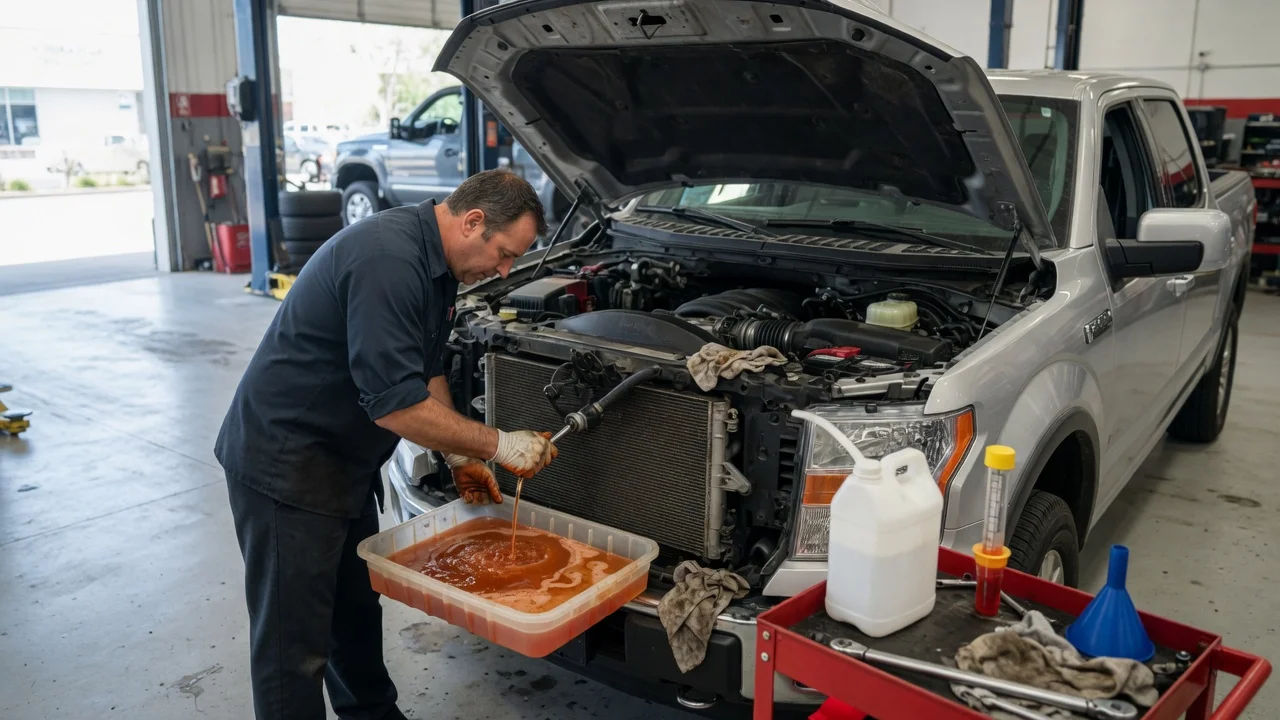
What a coolant flush on an F-150 actually is
A coolant flush on a Ford F-150 is a cooling-system service that removes old engine coolant and as much residual mixture as practical from the radiator, engine water jackets, heater core, and connecting hoses, then refills the system with the Motorcraft (or equivalent) coolant specified for that truck. It is a maintenance job, not a single specification that applies to every F-150. Coolant chemistry, fill volume, drain points, and air-bleed method change with model year, engine, and whether the truck is a conventional gasoline model, a PowerBoost hybrid, or an electric Lightning.
A drain-and-fill, which only empties the radiator, leaves a large share of old coolant in the block and heater core. A flush adds repeated distilled-water or chemical rinses, or a machine flush, so the new fill is not immediately diluted by leftover fluid. For trucks with a known, uncontaminated factory fill that is still within Ford’s published interval, a drain-and-fill plus a top-off to the correct premix may be enough. A full flush is the better choice when the coolant is unknown, rusty, oily, sludged, mixed across chemistries, or overdue, or after an overheating event, head-gasket concern, or water-pump or radiator replacement.
What changes by year, engine, and market
Ford has used more than one coolant family in the F-150. The correct product is the one named on the degas-bottle or radiator cap, on the under-hood coolant label, and in the owner’s manual for that VIN. Those markings override any year-range rule of thumb. Mixing incompatible coolants can gel, drop inhibitors out of solution, and damage the water pump, radiator, and heater core.
Typical factory fills, subject to confirmation on the truck, run as follows. Many mid-2000s through about 2010 F-150s used Motorcraft Premium Gold (a hybrid organic-acid, or HOAT, coolant). From about the 2011 model year, many F-150s used Motorcraft Orange (an OAT coolant). From roughly the 2018–2019 changeover onward, many F-150s, including 13th-generation late trucks and 14th-generation (2021–present) trucks, specify Motorcraft Yellow. Exact changeover dates vary by plant, engine, and market, so treat those eras as a starting point only.
Service interval is also variant-specific. Later Orange and Yellow factory fills are often described in Ford owner literature as long-life, commonly on the order of 10 years or 150,000 miles under normal service, with periodic level and condition checks. Older Gold fills used a shorter first-change interval. Severe service (heavy towing, extreme heat, short trips, off-road dust, or a history of overheating) justifies earlier service even when the calendar and odometer are inside the published window. The owner’s manual and the scheduled-maintenance guide for that model year are the documents that set the interval; published aftermarket “every two years” rules are not Ford’s specification.
Capacity is not interchangeable across powertrains. A 2.7-liter EcoBoost, 3.5-liter EcoBoost, 5.0-liter V8, 3.3-liter V6, 3.5-liter PowerBoost hybrid, and older 4.6- and 5.4-liter V8 trucks hold different volumes, and some packages add auxiliary coolers. Do not copy a quart figure from another engine or from an unlabeled chart. Read the capacity table in the owner’s manual or workshop manual for that engine and build, then buy extra because a true flush uses more fluid than a one-shot refill.
Two configurations sit outside a standard engine-coolant flush. The F-150 Lightning uses electric-drive thermal circuits rather than a conventional engine cooling system; that service is a different procedure. The 3.5-liter PowerBoost hybrid has an engine cooling loop and separate high-voltage inverter and battery thermal circuits. Opening or draining the high-voltage coolant side can require a high-voltage disable process and belongs with a shop equipped for that work.
Prerequisites, tools, and precautions
Work only on a completely cold engine. A hot cooling system is pressurized; loosening the degas-bottle cap or a hose can spray scalding coolant. Wear eye protection and chemical-resistant gloves. Ethylene glycol coolant is toxic to people and animals; contain every drain, keep pets away from the work area, and take used fluid to a household-hazardous-waste or parts-store recycling point. Do not dump it on the ground or into a drain.
Confirm the specified coolant type and whether Ford calls for prediluted 50/50 or concentrate mixed with distilled water. Use distilled water only if you mix concentrate; tap water introduces minerals that scale aluminum radiators and EcoBoost heads. Do not add stop-leak pellets or mix Orange, Yellow, Gold, and conventional green formulas unless a Ford-approved converter product is specified for a documented changeover.
Typical tools are a drain pan large enough for more than one system volume, a funnel that seals to the degas bottle, pliers or a screwdriver for hose clamps, a flashlight, a hydrometer or test strips compatible with the coolant family, and shop rags. A cooling-system vacuum-fill tool is the most reliable way to refill EcoBoost trucks and other systems that trap air. Optional items include a radiator-flush chemical only if it is labeled compatible with aluminum and with the OAT or HOAT coolant you will refill, and a new radiator cap or degas cap if the seal is cracked or the pressure valve is weak. Plastic draincocks on later aluminum radiators break easily; have a replacement cock on hand before you force it.
Professional-service boundaries sit at these points: a hybrid high-voltage coolant loop; a Lightning thermal system; a system that will not hold pressure or that shows oil in the coolant, milky oil, or combustion gas in the degas bottle; a heater core that will not flow; and any truck on which you cannot identify the coolant type or a safe drain path. Those conditions need diagnosis, not a backyard flush.
Procedure
Park on level ground, set the parking brake, and let the engine go fully cold. Record the current coolant appearance and the “full” and “low” marks on the degas bottle so you can judge the refill. Place the drain pan under the radiator. If the radiator has a petcock, open it slowly; if it does not, loosen the lower radiator hose at the radiator tank and drain into the pan. On engines that have a block drain, opening it after the radiator has started to empty removes more old coolant from the water jackets. Keep the degas-bottle cap off once the system is depressurized so the system can vent.
When the flow stops, close the petcock or refit the lower hose with the clamp in its original position, using a new clamp if the original is distorted. If you are performing a flush rather than a single drain, fill the system with distilled water (and a compatible flush chemical only if you choose to use one and will rinse it out completely). Start the engine with the climate control set to maximum heat and the blower on so the heater-core valve is open. Bring the engine to operating temperature, then shut it down and let it cool fully before draining again. Repeat distilled-water drains until the water runs clear and free of color, rust, and oil. Never run the engine without a filled system.
Close every drain. Fill with the specified Motorcraft coolant at the specified dilution. The preferred fill method, especially on 2.7- and 3.5-liter EcoBoost engines, is a vacuum-fill tool attached to the degas bottle: it pulls a vacuum on the cooling system, shows whether the system holds vacuum (a leak check), then draws premixed coolant in without trapping large air pockets. If you fill by gravity, pour slowly into the degas bottle to the maximum mark, leave the cap off or loosely fitted per the workshop-manual fill note for that year, set the heater to maximum, and idle the engine until the thermostat opens and the upper hose is hot. Watch the bottle level and add coolant as the level drops. Squeeze the upper and lower radiator hoses with a gloved hand only when the system is not scalding, to help move trapped air. Shut the engine down if temperature climbs toward the warning zone or if the bottle overflows violently.
After the first heat cycle, shut the engine down, let it cool completely, and bring the degas-bottle level back to the maximum cold mark. Fit the cap fully. Road-test at normal operating temperature, including a stretch that lets the electric or engine-driven fan cycle if equipped, then recheck the cold level the next morning. EcoBoost trucks and some 5.0-liter trucks may need a second or third heat-and-cool cycle before the level stabilizes and cabin heat is consistent. If the gauge climbs, the cabin stays cold with the heater on, or the bottle burps continually after several cycles, air remains in the system or there is another fault; stop and diagnose rather than driving on a low or aerated system.
Completion check
The job is complete when the cold level sits on the specified mark, the cap seals, there are no drips at the petcock, hose joints, water pump, or oil cooler, cabin heat is hot at idle and at cruise, and the temperature gauge or cluster display stays in the normal range through a drive that includes idle, highway, and, if you tow, a loaded pull. Coolant in the bottle should match the new fluid’s color and should be free of oil, rust flakes, and gel. Used fluid should already be in a sealed container for recycling.
Torque values for draincocks, hose clamps, and water-pump or thermostat housings, exact fill volumes, and any model-year bleed-screw or scan-tool fill routine are not restated here because they must be taken from the Ford workshop manual for that engine and year. If those figures are not in hand, treat the procedure as a guided outline and look them up before you tighten fittings or assume the system is full.
What remains truck-specific
The items that most often change the answer for a given F-150 are the coolant family on the cap, the engine’s listed capacity, whether a block drain is fitted and accessible, whether a vacuum-fill is called out, and whether a hybrid or electric thermal loop is present. Confirm those four points on the truck and in the model-year manual before buying fluid or opening a drain. That check is the difference between a correct flush and an incompatible refill that looks finished until the system gels or overheats.