Ford F-150 Catalytic Converter: Location and Replacement Planning
What you need to know first
The Ford F-150 catalytic converter is an exhaust emissions component that sits in the exhaust stream between the engine and the muffler. Its job is to convert unburned hydrocarbons, carbon monoxide, and oxides of nitrogen into less harmful gases before they leave the tailpipe. On this truck, the converter is often more than one canister: many configurations use close-coupled converters at or just after the exhaust manifolds plus one or more underbody converters farther back. Count, shape, and mounting all change with model year, engine, two- versus four-wheel drive, and whether the truck was certified to federal or California emissions rules. This guide covers how to locate and identify the part and how to plan a replacement; it does not substitute for a year-and-engine-specific service procedure.
Failure is usually flagged by a check-engine light tied to catalyst efficiency (commonly P0420 for Bank 1 or P0430 for Bank 2), a sulfur or rotten-egg smell, rattling from a broken substrate, failed emissions inspection, or, after theft, a cut exhaust pipe and loud open-pipe noise. Replacement is a legal emissions repair: the new unit must match the truck’s engine family and certification, and oxygen sensors, heat shields, and seized hardware often travel with the job. Exact fastener locations, pipe diameters, and labor times are not restated here because they were not checked against Ford workshop documentation for each F-150 configuration.
Where it sits and how to recognize it
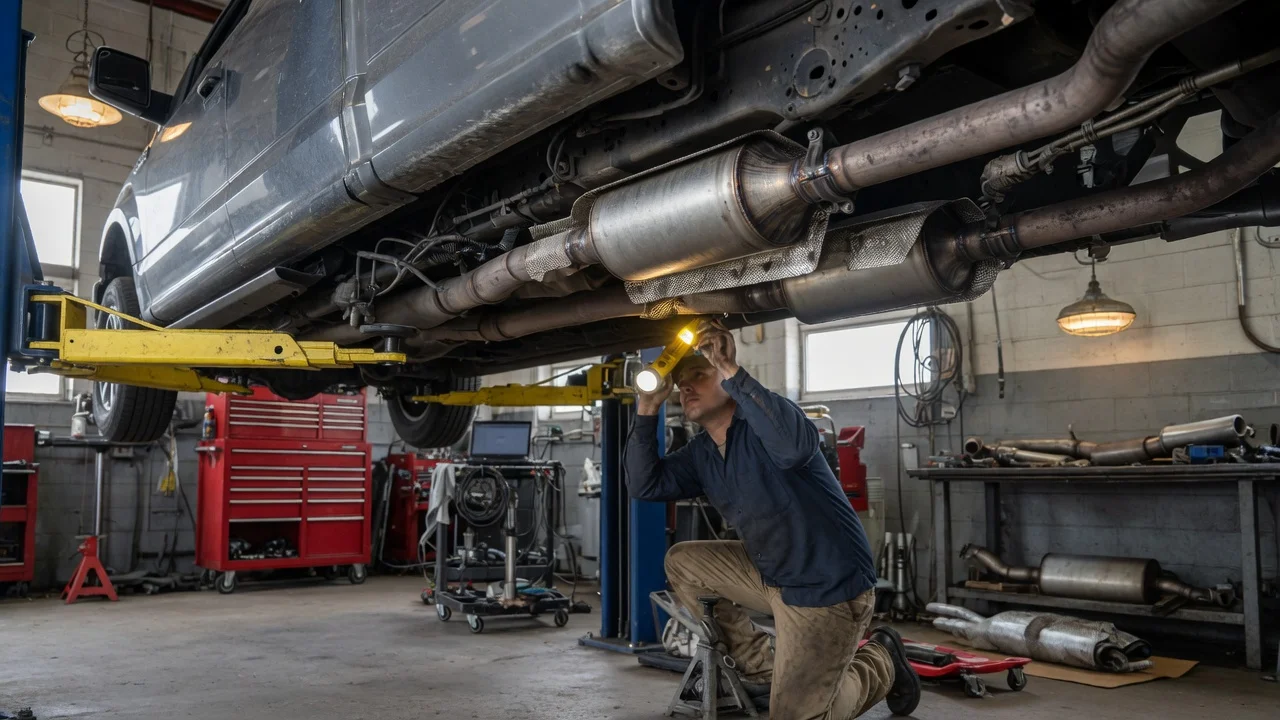
Look under the truck along the exhaust, starting at the engine and working rearward. Close-coupled converters, when fitted, sit high and forward: they bolt to or sit immediately after the exhaust manifolds or turbo downpipes, often tucked beside the engine and transmission. Underbody converters sit lower, typically under the cab, inboard of the frame rails, around the transmission or transfer-case area. Heat shields, hangers, and crossmembers can hide the canisters; a safe lift or ramps and a flashlight are needed to see them clearly. Do not rely on a single standard F-150 picture: a 5.0-liter V8, a twin-turbo 3.5-liter EcoBoost, a 2.7-liter EcoBoost, a 3.3-liter V6, a diesel, and a hybrid each route exhaust differently, and four-wheel-drive hardware changes what you can see from below.
The converter itself is a stainless steel canister, usually larger in diameter than the pipes that enter and leave it, with a welded or flanged inlet and outlet. Upstream and downstream oxygen sensors thread into bosses in the pipe or in the converter shell; those sensors, plus a honeycomb ceramic or metallic substrate inside, are the practical identifiers. A heat shield is often strapped or welded over the can. Generation matters: twelfth-generation trucks (about 2009–2014), thirteenth-generation trucks (about 2015–2020), and fourteenth-generation trucks (2021 and later) do not share one exhaust layout, and mid-cycle engine changes can add or move converters without a body-style change.
Parts that are easy to confuse with it
The muffler sits farther rearward, usually under the bed, and is built to quiet the exhaust rather than treat emissions; it is typically larger, rounder or oval, and has no oxygen-sensor bosses in the same pattern as a catalyst. A resonator is a smaller in-line chamber used for sound tuning; it can look like a short converter but is not a catalyst and is not a legal substitute. Exhaust manifolds and downpipes carry hot gas to the first converter; on some EcoBoost layouts the first catalyst is integrated with the manifold or sits on a very short downpipe, so the manifold and the catalyst occupy nearly the same space. Diesel F-150s use a diesel oxidation catalyst and a diesel particulate filter in a longer underbody assembly; those are not the same part as a gasoline three-way catalytic converter and are not interchangeable. Corrugated flex sections and rubber isolators sit near converters and are often damaged in theft or rust repairs; they are not the catalyst.
Bank labeling follows engine layout. On a V6 or V8, Bank 1 is the bank that includes cylinder 1; Bank 2 is the opposite bank. A P0420 or P0430 code points to catalyst efficiency on that bank, which may be a manifold converter, an underbody converter, or both in series. Confirm which canister the diagnostic points to before ordering parts. Visual confirmation still requires matching the part to the vehicle’s year, engine, and emissions calibration, not only to a photo of an F-150 converter.
What changes by year, engine, and market
Treat converter count and location as configuration-specific. Gasoline EcoBoost engines often place catalysts close to the turbos to light off quickly; a naturally aspirated 5.0-liter V8 more often uses manifold or near-manifold converters plus underfloor units. California-certified trucks can carry extra or different catalysts compared with federal trucks of the same year. After a powertrain or emissions mid-cycle change, the same cab-and-bed generation can use a different exhaust. The only reliable identifiers on the truck itself are the Safety Certification label and the underhood Vehicle Emission Control Information (VECI) label, plus the engine code and build date. Catalog listings that ask only for year and F-150 are not enough when federal and California parts, or 2.7- versus 3.5-liter EcoBoost parts, differ.
This article did not verify each layout against Ford workshop manuals, exploded exhaust diagrams, or parts catalogs for every model year and engine. If a statement about a specific year or powertrain is required for a purchase or repair, confirm it against the truck’s VIN-decoded build data and the applicable service information before ordering or cutting pipe.
Planning a replacement
Start by confirming that the catalyst is actually at fault. A lazy or failing oxygen sensor, an exhaust leak upstream of the downstream sensor, rich or misfire conditions that overheat the substrate, and contamination from coolant or oil can all set catalyst-efficiency codes. Repair those first; a new converter will fail again if the engine is still dumping unburned fuel or coolant into the exhaust. Once the converter is confirmed, identify every unit in the system (manifold versus underbody, Bank 1 versus Bank 2) so you do not replace the wrong can.
Match the replacement to the original equipment type: engine displacement, federal or California certification, and inlet and outlet diameter and flange pattern. Aftermarket universal converters still have to meet the legal standard for the vehicle; they often need custom pipe work and are a poor first choice when a direct-fit unit exists. Plan to replace related hardware in the same visit: oxygen sensors in or next to the failed can, gaskets, nuts and studs (which frequently seize and snap), heat shields, and any flex pipe cut during theft. On high-mileage or rust-belt trucks, budget for extra time to extract broken fasteners and to support the remaining exhaust so hangers and the muffler are not left hanging.
Access is from below. The truck needs a lift or stout ramps, a cold exhaust, and room to drop heat shields and, on some layouts, to work around the transfer case, driveshaft, and crossmembers. Close-coupled converters can require manifold or downpipe removal from above as well as below. There is no single labor-hour figure that covers all F-150 engines and years; shops quote after they see rust, aftermarket pipes, and whether both banks must come off. Torque values, sensor thread sizes, and pipe diameters should come from the service information for that VIN, not from a generic F-150 estimate.
Legal, theft, and next-step notes
In the United States, catalytic converters on in-use vehicles are regulated. A replacement generally must be the same type (for example, California versus federal) and must be a legal aftermarket or original-equipment unit for that application. Welding in an empty pipe, a resonator, or a converter that is not certified for the truck can fail inspection and can be unlawful. Keep the old unit and the purchase invoice; many jurisdictions and shops require documentation because of theft rules. F-150s have been frequent theft targets because the converters are relatively accessible and contain precious metals. After a theft, inspect the remaining exhaust for crushed pipes, damaged oxygen-sensor wiring, and missing shields, and consider a bolted or welded theft shield designed for that generation if one fits without covering required sensors or creating a heat hazard.
A practical next action is to record the model year, engine, drivetrain, and the emissions label text, scan for catalyst and oxygen-sensor codes with freeze-frame data, and look under the truck to count canisters and note which one is damaged or missing. Take those identifiers to a dealer or independent shop that can pull VIN-specific parts data. If you are comparing repair versus a used or salvage converter, weigh the unknown internal condition of a used catalyst against the cost of a new certified unit; a used converter can already be inefficient and may not clear an inspection. Specific prices, precious-metal loadings, and OEM part numbers are omitted here because they were not verified against current Ford parts data and they change by year and market.