Ford F-150 Catalytic Converter: Fitment and Replacement
The essential answer
A Ford F-150 catalytic converter is a model-specific exhaust emissions part, not a one-size truck accessory. The unit that fits is defined by model year, engine, and the emissions standard the truck was certified to meet. Gasoline F-150s use three-way catalytic converters. The 2018–2021 3.0-liter Power Stroke diesel uses a diesel aftertreatment system that is not interchangeable with gasoline converters. Raptor and other unique exhaust packages use different assemblies than a standard F-150 with the same displacement. Cab, bed length, and 4x2 versus 4x4 can change pipe length and hanger locations on some years, so an otherwise matching engine still may not bolt to the existing exhaust.
Replacement is legal in the United States only when the new converter is intended for that vehicle and meets the applicable EPA or California Air Resources Board (CARB) rules. Direct-fit assemblies that match the original flanges, oxygen-sensor bungs, and hangers are the practical choice for most owners. Universal converters require cutting and welding and may fail inspection where a listed, vehicle-specific part is required. Confirm the truck’s certification from the under-hood emissions label and the VIN before buying a part.
What the converter does on an F-150
A three-way catalytic converter uses a ceramic or metallic substrate coated with platinum, palladium, and rhodium. In a correctly running gasoline engine it converts carbon monoxide, unburned hydrocarbons, and oxides of nitrogen into carbon dioxide, water, and nitrogen. The F-150’s onboard diagnostic system watches converter efficiency with oxygen sensors: at least one sensor upstream of a catalyst measures air-fuel ratio, and a sensor downstream measures whether the catalyst is still storing and converting oxygen as designed.
On V6 and V8 F-150s the exhaust is split into two banks. Each bank typically has its own close-coupled converter near the exhaust manifold or turbocharger, and many trucks also have one or two underfloor converters farther back. Turbocharged EcoBoost engines place converters in or immediately after the downpipes, where exhaust is hottest. Exact count and layout change by generation and powertrain; the service parts catalog for that VIN is the authority, not a generic F-150 listing.
Fitment: what must match
Order a converter as a VIN-matched exhaust component. Year and engine are the first filters, then emissions certification, then the physical exhaust path. A 5.0-liter Coyote, 2.7-liter EcoBoost, 3.5-liter EcoBoost, 3.5-liter PowerBoost hybrid, 3.3-liter V6, and older 4.6-liter, 5.4-liter, and 3.7-liter engines do not share converter housings, bung locations, or pipe geometry. Hybrid PowerBoost trucks add packaging around the hybrid hardware; diesel F-150s use a diesel oxidation catalyst and related aftertreatment, which is a different system.
Model year and generation, because manifolds, Y-pipes, and underbody pipes were redesigned with each major exhaust change. Engine family and output package, including Raptor or other high-output exhausts that are not the standard F-150 part. Federal EPA versus California (CARB) certification, read from the under-hood Vehicle Emission Control Information label. Body and driveline: Regular, SuperCab, or SuperCrew; 5.5-, 6.5-, or 8-foot bed; 4x2 or 4x4, when those change pipe length or hanger points. Whether the original part is a manifold converter, a downpipe converter, a Y-pipe converter, or an underfloor converter. Replacing the wrong position leaves the failed unit in place.
On some gasoline years the converter is welded to the exhaust manifold or built as a manifold-converter assembly. Those trucks are not repaired by sliding a small underfloor can onto the existing pipe; the manifold or downpipe assembly is the service part. Stamped EPA or CARB numbers on the old shell, the door-jamb certification label, and a dealer or parts-catalog lookup by VIN are the reliable identification path. Aftermarket catalogs that list only “F-150, 5.0, 2015–2020” can still be wrong if they ignore California versus federal calibration or cab configuration.
OEM, direct-fit aftermarket, and universal units
Ford original-equipment converters match the truck’s flanges, sensor bosses, heat shields, and hangers and are the baseline for fit and emissions compliance. Direct-fit aftermarket converters are built to the same outline for a stated year, engine, and certification. They are the usual independent-shop replacement when the OEM assembly is costly or on back order. Universal-fit converters are a pipe-in, pipe-out can; a technician must cut the old shell out, weld or clamp the new can, and relocate oxygen-sensor bungs if needed. Universal parts are a poor match for F-150s that use tight close-coupled converters or dual-bank underfloor pipes, and they are often rejected in jurisdictions that require a listed, vehicle-specific converter.
Used converters appear in salvage channels. A used unit can be legal only if it is the correct application, is not obviously damaged or gutted, and is allowed under the rules of the state where the truck is registered. Substrate that has melted, broken, or been emptied will not restore catalyst-efficiency monitors. There is no supported public specification in this brief for precious-metal loading of any F-150 converter; do not choose a part by advertised scrap value.
Federal EPA and California CARB rules
In the United States it is illegal to remove a catalytic converter from a street-driven F-150 and leave the truck without a compliant replacement, or to install a converter that is not certified for that vehicle. Federal (often called 49-state) trucks need an EPA-compliant converter for that application. Trucks originally certified to California standards, and vehicles registered in California and other states that require CARB aftermarket parts, need a converter with a CARB Executive Order number for that F-150 configuration. Installing a federal-only aftermarket converter on a California-certified truck is a common parts error and can fail inspection.
Federal emissions warranty on light-duty vehicles generally covers the catalytic converter for eight years or 80,000 miles, whichever comes first, when the failure is an emissions-control defect and the truck has been maintained in a way that does not void that coverage. Warranty does not cover theft, impact damage, or converter failure caused by a neglected engine fault such as a misfire that dumped raw fuel into the exhaust. Confirm remaining coverage with the selling dealer or Ford using the VIN before paying for a replacement.
How failure usually shows up
The diagnostic trouble codes most often tied to catalyst efficiency on a gasoline F-150 are P0420 (Bank 1) and P0430 (Bank 2). Those codes mean the downstream oxygen sensor’s signal looks too much like the upstream sensor’s, so the module infers the catalyst is no longer storing oxygen. They do not, by themselves, prove the ceramic is destroyed. Exhaust leaks before the downstream sensor, a lazy or contaminated oxygen sensor, an engine misfire, a rich or lean fuel condition, or a recent repair that has not completed an official drive cycle can set the same codes.
Failed state emissions inspection or a persistent catalyst-efficiency monitor that will not set to ready. Rattle from a broken substrate inside the shell, often worse at idle or over bumps. Rotten-egg sulfur smell when the catalyst chemistry is degraded or the engine is running rich. Loss of power, overheating of the underbody, or a glowing converter when a misfire or fuel-system fault overloads the catalyst; that is an engine problem that will destroy a new converter if it is not fixed first. Visible damage, crushed pipe, or a missing converter after theft.
A scan tool that graphs upstream and downstream sensors, a check for exhaust leaks, and fuel-trim and misfire data are the usual diagnostic sequence. Replace sensors and repair leaks when those tests point there. Replace the converter when efficiency is actually low or the substrate is physically failed. Installing a new converter over an unresolved misfire or leaking injector is a repeat failure.
Replacement work on the truck
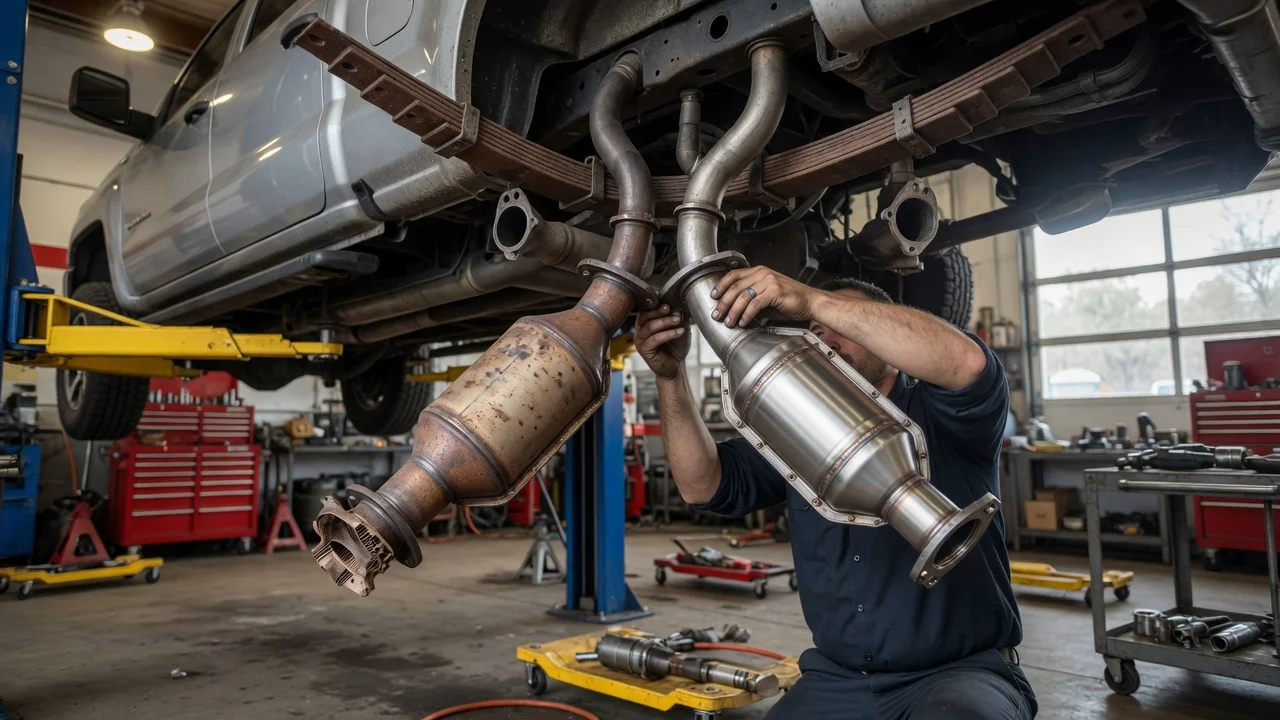
The truck needs a lift or equivalent safe support. Technicians disconnect the battery when required by the shop procedure, unplug the oxygen sensors at the affected converter, and either unbolt flanged joints or cut welded pipe. Seized fasteners on manifolds and downpipes are common on F-150s with high heat cycles; broken studs add labor. New gaskets, new oxygen-sensor anti-seize only on the threads if the sensor maker specifies it, and intact heat shields matter for both leaks and nearby wiring or underbody components.
Close-coupled and manifold converters often take more labor than an underfloor can because of steering, suspension, or turbocharger clearance. After installation the codes are cleared and the truck must complete the manufacturer drive cycle so catalyst monitors can run. A forced monitor test with a professional scan tool shortens that wait in the shop. If a monitor does not set, the new part may be the wrong certification, there may still be an exhaust leak, or an oxygen sensor may be out of range.
Cost factors
Published sticker prices for a given F-150 converter vary widely by which converter in the system is being replaced, OEM versus aftermarket, and EPA versus CARB. Manifold or turbo downpipe assemblies cost more than a single underfloor converter. Dual-bank trucks may need two parts if both banks are inefficient. Labor is higher when pipes are welded, fasteners are seized, or a cab or crossmember limits access. This brief does not include a surveyed price table; obtain quotes against the VIN and the specific position (Bank 1 close-coupled, Bank 2 underfloor, and so on). Ask whether oxygen sensors, gaskets, and a stolen-converter shield are in the estimate.
Theft and physical protection
Full-size pickups with high ground clearance, including many F-150s, are frequent catalytic-converter theft targets because the underfloor converters are reachable with a saw. A missing converter leaves an open exhaust, immediate noise, stored catalyst codes, and an illegal uncertified exhaust until a compliant part is installed. Insurance treatment depends on the policy; document the VIN, mileage, and police report. Aftermarket steel shields, alarm tilt or vibration sensors, and parking in a way that blocks underbody access reduce opportunity. Etching an identifier onto a remaining converter can help a recovered part be tied to the truck, but it does not restore a stolen unit.
Choosing a next action
Read the under-hood emissions label and capture the VIN, engine, cab, bed, and driveline. If the check-engine light is on, record the freeze-frame data and codes before clearing anything. Have a shop confirm that the engine is not misfiring and that oxygen sensors and the exhaust are leak-free. Then order a VIN-correct, correctly certified converter for the failed position—OEM or listed direct-fit—and budget for fasteners, gaskets, and monitor completion. If the converter was stolen, add a shield to the repair. If the truck is still inside the federal 8-year/80,000-mile emissions window and the failure is a warrantable defect, start with a Ford dealer warranty inquiry on that VIN before purchasing an aftermarket part.