Choosing a Ford Explorer Shift Interlock Solenoid by Model Year
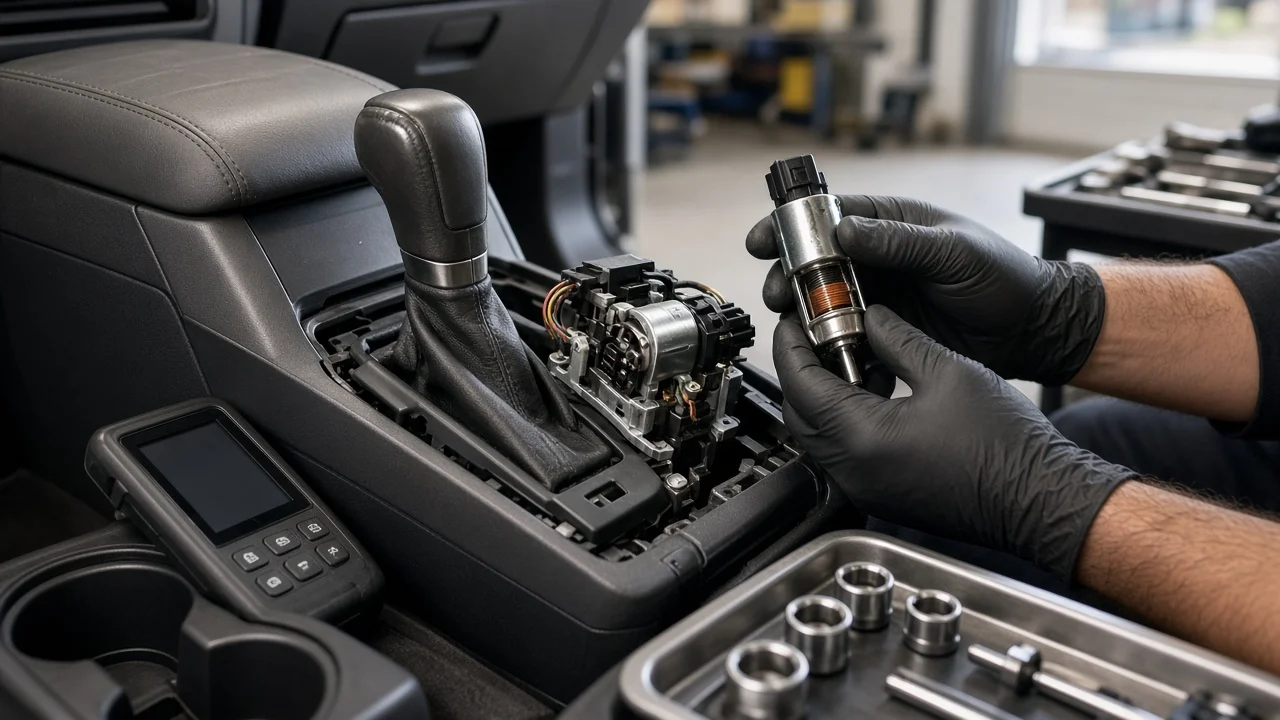
If your Explorer won't come out of Park even with your foot on the brake, the brake shift interlock solenoid is one suspect, but not the only one. The part sits in the shifter assembly, not inside the transmission, and its design changes between generations. This guide explains how to confirm the diagnosis, match a replacement to your model year and configuration, compare repair options, and avoid buying a solenoid that won't fit or won't fix the problem.
Define the job the product must do
The shift interlock solenoid is an electrically operated plunger. It holds the shift lever in Park until the ignition is on and the brake pedal is pressed. When it receives power through the brake switch circuit, it pulls back and frees the lever. If it sticks, burns out or loses power, the lever stays locked in Park. Some owners see the opposite fault: the lever leaves Park without the brake applied. In that case the interlock isn't doing its safety job and should be repaired promptly.
Before ordering anything, confirm the solenoid is the cause. Check that the brake lights work. A failed brake pedal switch or a blown fuse in that circuit removes the signal the solenoid needs. With the ignition on, listen near the shifter while someone presses the brake. A click suggests the solenoid is getting power. Silence points toward the switch, fuse, connector or the solenoid itself. A weak battery can also cause erratic behavior. Transmission diagnostic codes rarely identify this part directly, so testing for voltage at the solenoid connector is more useful than a code scan alone. If the lever moves normally after you use the manual shift lock release described in your owner's manual, the transmission and park mechanism are likely not the problem.
Check compatibility for your model year
Fitment depends on the shifter assembly, not the engine alone. The 2002 to 2005 Explorer, which includes the common 2004 model, and the 2006 to 2010 Explorer both use a floor console shifter. However, the interior and shifter were revised with the 2006 redesign. A solenoid listed only for one range should not be assumed to fit the other. The transmission type helps confirm the configuration. The 2002 to 2005 trucks use a five-speed automatic. The 2006 to 2010 trucks used a five-speed with the V6 and a six-speed with the V8, so a 2010 Explorer owner should confirm the engine and transmission before matching a shifter part.
Related models from the same era sometimes share parts with the Explorer. These include the Mercury Mountaineer, Explorer Sport Trac and the Explorer-based Lincoln Aviator. Listings vary, though, so treat a shared platform as a reason to check, not as proof of fit. The Ford Expedition is a different case. On its column-shift models, the interlock solenoid sits in the steering column rather than a floor console, so the part, mounting and access are all different. Don't buy an Expedition solenoid for an Explorer, or the reverse.
Newer Explorers use different shifter designs. Models with electronic shift controls handle park lock logic differently, so a traditional standalone solenoid may not be a serviceable item on them. The safest fitment check combines four things: your VIN, the part number printed on the original unit if you can reach it, the connector shape and pin count, and the mounting tabs. Comparing photos of the removed part against the listing photos catches most mismatches.
Features that affect the choice
The first decision is scope. A bare solenoid is the cheapest option and suits owners who are comfortable removing console trim. Some listings include a new connector pigtail. That helps if the original plug is brittle or corroded, but it requires splicing. A complete shifter assembly costs more, but it replaces worn bushings, the release mechanism and the solenoid together. That can make sense if the lever already feels loose or liquid has been spilled into the console. Genuine Ford parts usually carry clear model-year fitment from the parts catalog. Aftermarket units vary in fitment notes and build quality.
Treat labels such as heavy duty, upgraded or OE quality as marketing unless the seller explains what actually changed. Useful evidence includes a stated interchange or original part number, clear photos of the connector and plunger, and a listed model-year range with engine notes. Look for a warranty and return policy that covers incorrect fitment. Reviews help only when the reviewer names the same model year and configuration as your vehicle.
Limitations and ownership costs
Replacing the solenoid usually means disconnecting the battery and removing the console trim around the shifter. The clips that hold that trim often become brittle with age. The job requires basic hand tools, trim tools and a meter for testing. No fluid is drained, so the transmission fluid specification has no bearing on this repair. Budget for replacement clips if the trim is old, and allow extra time the first time you take the console apart.
A new solenoid can't fix a faulty brake pedal switch, a blown fuse, damaged wiring, a stretched shift cable or a transmission problem. If shift behavior is wrong while driving, such as harsh engagement, slipping or a gear indicator that doesn't match the lever, the cause is elsewhere and needs separate diagnosis. Using the manual release as a permanent workaround defeats a safety feature. Use it only to move the vehicle until the repair is done. If a replacement fails quickly, look for a wiring short, a spill inside the console or an incorrect part before buying another.
Build a practical shortlist
Before comparing listings, write down the model year, engine, transmission type, drive layout and VIN. Note any service history for the brake light switch, the shifter and earlier console repairs. Then confirm the fault with the brake light check, fuse check, click test and connector voltage test. A part comparison only makes sense after that.
For each candidate, confirm that the listing names your exact model-year range and configuration. The connector and mounting should match your original, and the listing should state an interchange or original part number. The return policy should cover fitment problems. Then match the repair to the fault. A bare solenoid suits a confirmed solenoid failure with healthy wiring. A solenoid with a pigtail suits a damaged plug. A complete shifter assembly suits a worn or contaminated shifter. A shop visit makes sense if testing is beyond your tools. Choosing on these points avoids paying for a part that fits poorly or solves the wrong problem.