Ford Escape 2008–2011 steering angle sensor replacement

A steering angle sensor issue on a 2008–2011 Ford Escape usually appears as a warning light, a change in steering effort, or a stability control message rather than a complete loss of steering. The sensor reports steering wheel position to modules that manage electronic stability control and other chassis functions, and a noisy or missing signal can make those systems react incorrectly. Owners searching for a 2008 Ford Escape steering angle sensor or a 2010 Ford Escape steering angle sensor replacement are often trying to separate an electrical calibration problem from a mechanical fault. This overview explains what the part does, why replacement can become necessary, and how diagnosis generally narrows the cause before any parts are changed.
Essential answer
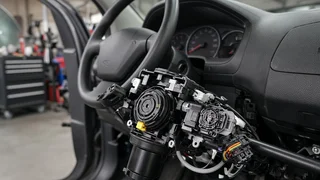
For a 2008–2011 Ford Escape, steering angle sensor replacement is not automatically the correct repair simply because a fault code or warning appears. The sensor measures how far and in which direction the steering wheel has turned, and the vehicle uses that information for stability control, traction control, and sometimes electric power steering assistance. On models in this range, the sensor may be integrated into the steering column assembly or packaged near the clockspring, so replacement can involve removing trim and column components. A proper diagnostic sequence checks the sensor signal, wiring, connector condition, steering wheel centering, and any related chassis faults before condemning the part.
An owner looking up a 2009 Ford Escape steering angle sensor or an 08 Ford Escape steering angle sensor is usually seeing symptoms such as a traction control lamp, an ABS warning, or a stability control message. Because several modules share the sensor data, a single bad input can disable more than one function. Replacement may restore normal operation when the sensor itself is faulty, but the same symptom can also follow a wheel alignment change, suspension work, or a battery disconnect that erased the learned center position. Confirming the exact fault and performing any required relearn or calibration is therefore as important as installing a new part.