Ford EcoBoost Turbo Lag: Normal Response or a Problem?
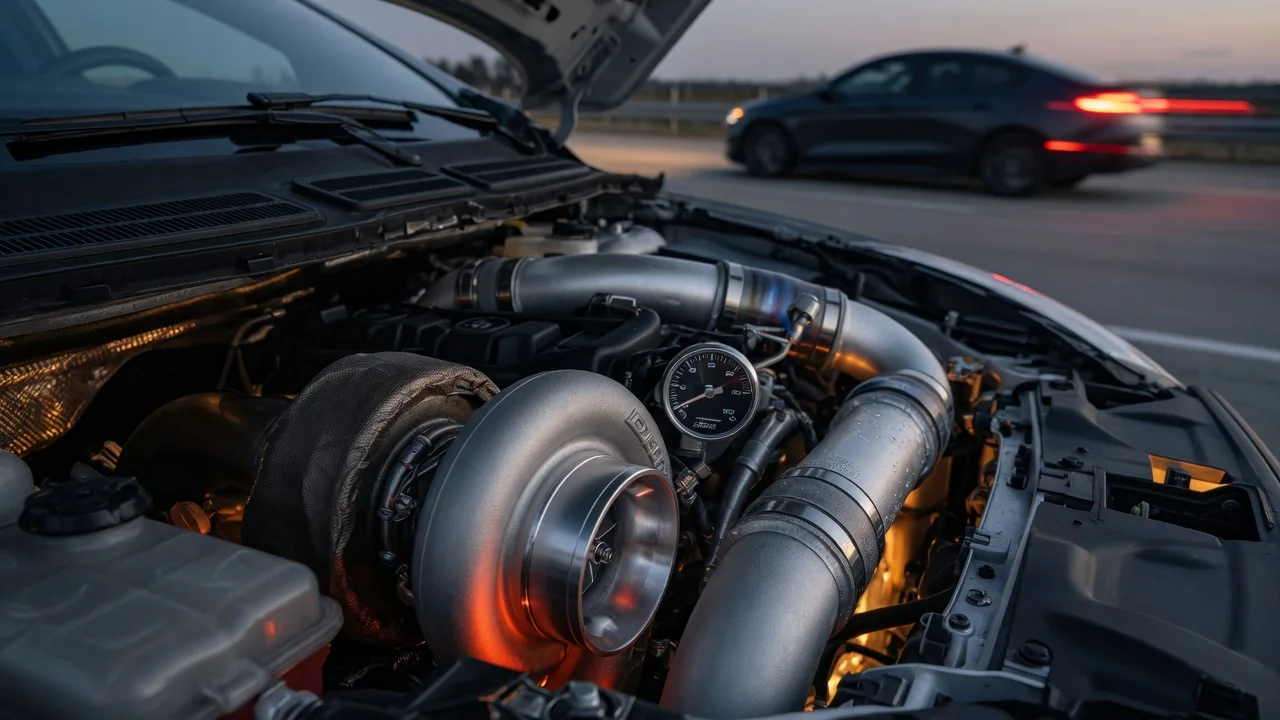
Every turbocharged engine needs a moment to build boost, and Ford's EcoBoost family is no exception. A short delay when you press the throttle at low rpm is part of how these engines work. A delay that is new, getting worse, or comes with warning lights, noises or smoke is different. This guide explains how a mechanic separates normal turbo response from a fault, accounting for model year and engine variant, so you can describe the issue accurately and avoid replacing parts on a guess.
Establish the symptoms
Start by defining what you actually feel. Normal lag on an EcoBoost is usually brief and most noticeable when you accelerate from very low rpm in a high gear, or pull away gently and then ask for full power. The character differs across the lineup: a small three-cylinder, a four-cylinder and a twin-turbo V6 do not respond the same way, and the same engine can feel different in different vehicles. Transmission behavior also matters. A delayed downshift, an economy-oriented throttle map or a selected drive mode can feel like turbo lag even when boost builds normally.
Write down the symptom conditions each time it happens: engine cold or warm, road speed, gear, approximate rpm, outside temperature and humidity, towing or heavy load, and whether it follows a long highway cruise. Note associated signs such as a check engine light, a flashing light, a reduced-power message, hissing or whistling under acceleration, smoke, a stumble or shudder, or rising oil consumption. Then list recent changes: a tune, aftermarket intake, new spark plugs, battery disconnection, a different fuel grade or any repair. Keep in mind that a report that the truck feels slow is a symptom. A stored code, a measured boost shortfall or a leak you can see is a verified finding.
Distinguish plausible causes
The first possibility is that nothing is wrong. Normal spool time, drive mode settings, shift logic, adaptive learning after a battery disconnect, and reduced output in very hot weather or at high altitude all change how quickly the engine responds. This explanation is supported when the delay is consistent, no codes are stored and the behavior has not changed over time. It is weakened by sudden onset, warning lights or new noises.
Boost-system faults are the next group. A split intercooler hose, loose clamp, leaking coupler or damaged intercooler lets pressurized air escape, typically causing a hiss or whoosh under load, slower boost build and underboost codes. Oily residue at a joint can point to the leak location. Wastegate or actuator problems can cause underboost or overboost codes, and on some engines a rattle at idle or light load. A failing turbocharger may produce a siren-like whine, blue smoke, heavy oil in the charge pipes or noticeable shaft play; a light film of oil from crankcase ventilation is common and not proof of turbo failure on its own.
Several non-turbo faults feel like lag. Misfires under boost from worn spark plugs or weak coils usually feel like a stumble or hesitation rather than slow pull, and they often set misfire codes. Some earlier 3.5-liter EcoBoost F-150 trucks were the subject of service bulletins for hesitation under hard acceleration after highway driving in humid weather, linked to condensation in the intercooler; whether that applies depends on the specific vehicle. Direct-injection engines can also accumulate intake valve deposits that reduce response gradually. Fuel pressure problems, a faulty manifold pressure or airflow sensor, a dirty throttle body, a clogged air filter or a restricted exhaust can all limit power too.
Checks in a useful order
Begin with checks an owner can do safely. Note any warning lights and read stored diagnostic codes with a basic OBD-II scanner, recording them before anything is cleared. Check the engine oil level. With the engine off and cool, inspect the air filter, intake ducting and visible intercooler hoses for cracks, loose clamps or oily residue. Try the same driving situation in a different drive mode to see whether the feel changes. Review the service history for spark plug replacement and oil change intervals, and ask a dealer to check the VIN for open recalls and applicable service bulletins.
The next stage needs tools and manufacturer specifications. A capable scan tool can compare desired and actual boost, wastegate control, manifold pressure, fuel rail pressure, fuel trims and misfire counters during a road test. A smoke test of the intake and charge-air system finds leaks that are hard to see. Checking turbo shaft play, testing the wastegate actuator, measuring compression or leak-down, and inspecting intake valves are jobs for a qualified technician. Do not open fuel lines yourself: direct-injection systems operate at very high pressure.
Interpret the findings
If no codes are stored and live data shows boost tracking its target, the delay is most likely a normal characteristic or calibration behavior. Comparing the vehicle with another of the same engine configuration and model year is a fair way to confirm that. If an underboost code is stored and a leak is found, repair the leak, clear the code and retest under the same conditions; the fix is confirmed only if the code stays away and boost now matches the target. An underboost code without a visible leak still leaves the wastegate, its control, a sensor or the turbo itself as candidates. A code describes a condition, not a part.
Rising misfire counts under load point toward ignition or fuel delivery before the turbo. Oil in the intake tract matters only in proportion: pooling, blue smoke and increased oil consumption together support a turbo or ventilation fault, while a light film alone does not. Turbo shaft movement must be judged against specification, because some play is normal. Replacing a turbocharger is expensive, and lag is often traced to a hose, clamp or plug instead, so the replacement should be supported by measurements rather than by the symptom alone.
Urgency and next action
Stop driving and arrange an inspection or tow if you see a flashing check engine light, which indicates an active misfire that can damage the catalytic converter. The same applies to heavy smoke, loud grinding or screeching from the turbo area, a sudden loss of power with warning messages, an oil pressure warning, a fuel smell or overheating. A steady check engine light with mild lag is less urgent, but book an inspection soon and avoid towing or heavy loads until it is diagnosed. No one can promise how far a vehicle with an undiagnosed fault can safely be driven.
Give the repair shop the model year, model, engine displacement, mileage and VIN, along with service history covering oil changes and spark plugs, any modifications or tunes, your notes on when the symptom occurs, and the codes you recorded. That information lets a technician reproduce the problem, check for applicable bulletins and test the most likely cause first.