Ford EcoBoost Engine Problems and Failure Symptoms
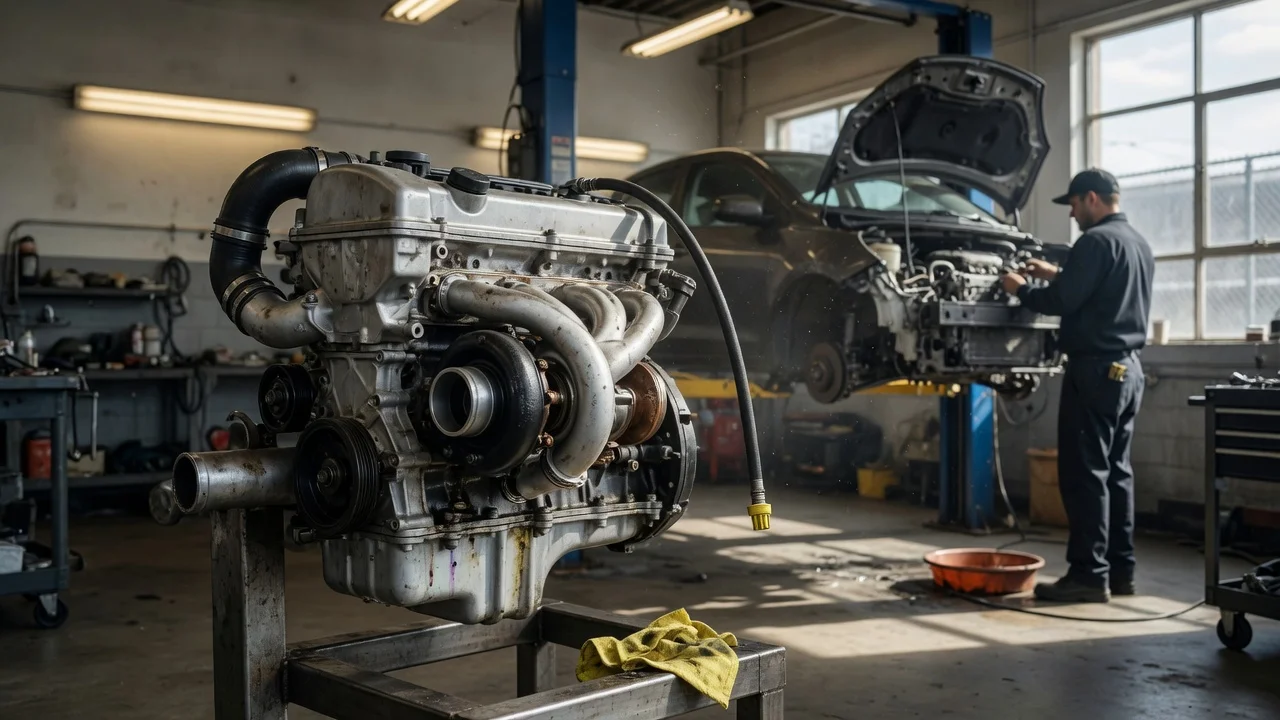
What a Ford EcoBoost engine failure usually means
There is no single Ford EcoBoost failure. EcoBoost is not one engine: it is a family of turbocharged gasoline engines used in many different vehicles, sizes and model years. A failure may mean anything from a misfire that can be repaired with routine service to mechanical damage that requires major engine work. The first step is therefore to identify the exact engine, vehicle and symptom rather than treat every EcoBoost problem as the same condition.
The same warning sign can have very different causes. A rough idle, loss of power, coolant loss, smoke or a check-engine light each points in a direction, but none of those observations alone identifies the failed part. The useful approach is to match the observed symptom with the conditions under which it occurs, then use live data and targeted checks to separate possibilities.
Common symptoms and how to narrow the cause
If the reader reports a symptom, the diagnostic value comes from the conditions attached to it. A cold-start misfire with a flashing check-engine light, for example, supports a different set of causes than a misfire that appears only under heavy boost. Before replacing a component, record when the symptom starts, whether it clears after warm-up, and whether it appears at idle, light throttle or wide-open throttle.
Rough idle or running: consider induction leaks, fuel delivery, ignition components and engine-mechanical condition; a vacuum or boost leak can mimic several other faults. Misfire with flashing check-engine light: the flashing light is a misfire warning and a request to reduce load immediately; the relevant fuel, ignition and mechanical checks depend on which cylinder is recorded. Coolant loss without a visible external leak: this can point to coolant entering the combustion chamber, a head-gasket or sealing concern, or another internal path; it should not be assumed from the reservoir level alone. White smoke or sweet-smelling exhaust: these can support coolant in the combustion process, but the observation needs to be confirmed under consistent operating conditions. Loss of power or boost: check for air-path faults, charge-cooler or induction leakage, and control-system limits before assuming turbocharger failure. Unusual noise: record when the noise occurs and whether it changes with engine speed or load rather than naming a part from the sound alone.
Why a fault code is evidence, not a verdict
A stored diagnostic trouble code identifies the circuit or system that reported a problem, not necessarily the component that must be replaced. For example, a code for a sensor circuit can be caused by the sensor, its connector, its wiring, its supply voltage, the reference signal or a condition elsewhere in the system. Treat the code as an entry point: retrieve the full code definition and any freeze-frame data, inspect the related circuit, and test the operating conditions before reaching a conclusion.
Many readings are only meaningful under the correct operating conditions. Fuel trim values, for instance, must be interpreted with the engine at the intended temperature, load and speed. A voltage that looks abnormal in one condition may be valid in another. Where the required test condition is not available, state that the result is unresolved rather than treating it as proof of a failed component.
A practical checking order
Begin with the least invasive checks that can separate observations from causes. Confirm the exact vehicle and engine configuration first, because parts and calibrations vary by model year, displacement and market. Then confirm the symptom under repeatable conditions, retrieve any fault codes with their freeze-frame data, and inspect the air, fuel, ignition, cooling and crankcase systems for obvious leakage, contamination or damage.
From there, move to measured checks chosen for the symptom. A cylinder-balance or relative-compression result can distinguish ignition and fuel faults from mechanical loss. A cooling-system pressure test and combustion-gas check can help separate external leakage from internal paths when coolant loss is reported. Boost-system testing can distinguish an induction leak from a control or turbocharger concern. Explain what each result supports and what it leaves open.
When evidence is missing
Some questions cannot be answered from a symptom alone. The specific engine, model year, market configuration and service history materially change the likely causes and the next action. Where those details are not supplied, the responsible answer is to name the information needed and the reason it matters instead of guessing at a single failed part.