Identifying a Ford 4R70W Transmission Shift Solenoid
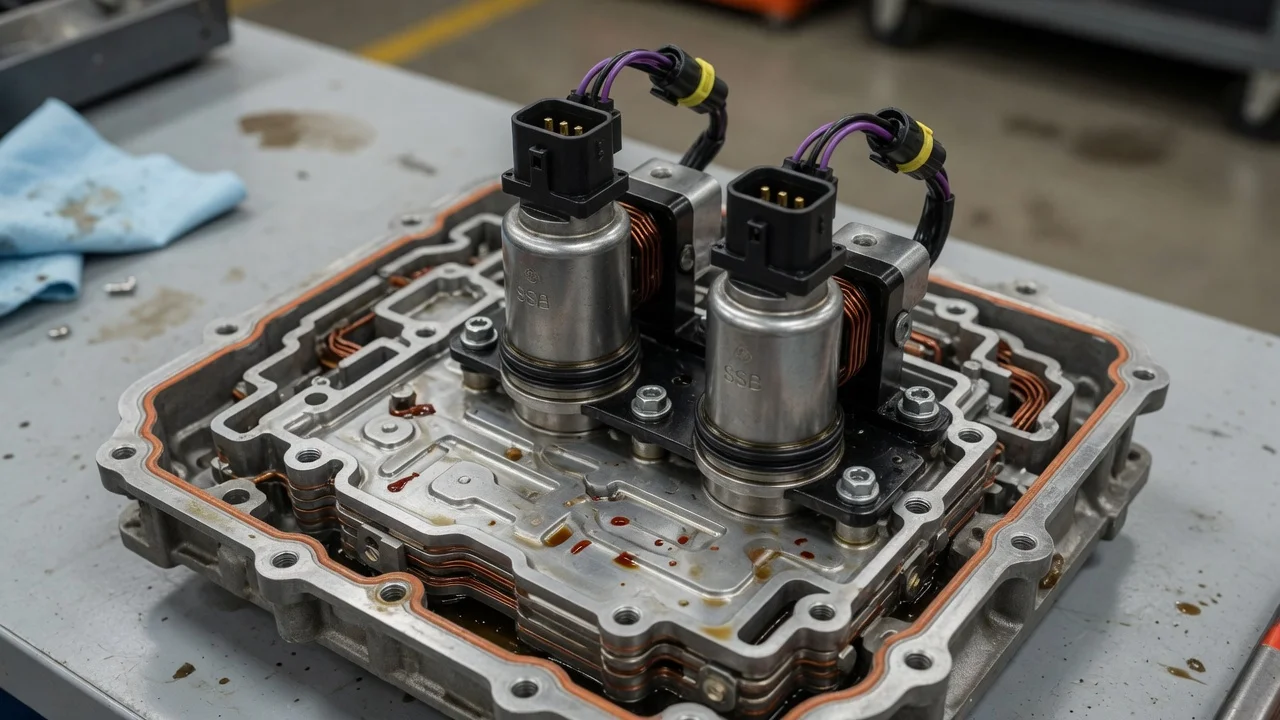
The Ford 4R70W is an electronically controlled four-speed automatic used in many rear-wheel-drive Ford, Lincoln and Mercury trucks and cars. Its shift solenoids decide which gear the transmission selects, so they are a common suspect when shifting goes wrong. This guide explains how to identify the shift solenoid on a 4R70W, how it fits into the larger solenoid assembly, and what to confirm before you replace anything.
Where the 4R70W Shift Solenoids Are and What They Look Like
On a 4R70W, the shift solenoids are not separate parts scattered around the case. They are part of a solenoid body assembly, often called a solenoid pack, that bolts to the valve body inside the transmission pan. The pack usually contains Shift Solenoid A and Shift Solenoid B, a coast clutch solenoid (identified as Shift Solenoid C in some service literature), the torque converter clutch solenoid, the electronic pressure control solenoid and, on most versions, the transmission fluid temperature sensor. A single wiring harness connector passes through the side of the case to link the pack to the vehicle's powertrain control module.
So when someone asks for a 4R70W transmission shift solenoid, they usually need either the complete solenoid pack or an individual solenoid that fits that pack. The pack is the more common replacement unit, because the solenoids share one body and one connector. Before you order, confirm that the vehicle actually has a 4R70W and not a closely related unit such as the earlier AODE or the later 4R75W, since they look similar from underneath.
How the Shift Solenoids Control Gear Changes
The 4R70W shifts hydraulically, but the computer decides when. Shift solenoids A and B are on/off valves. The powertrain control module switches them in different combinations, and each combination routes fluid through the valve body to apply the clutches and bands for a particular gear. The coast clutch solenoid manages engine braking in certain ranges, while the torque converter clutch solenoid controls lockup at cruising speed.
The electronic pressure control solenoid works differently. Instead of switching on and off, it varies line pressure, which affects how firm or soft each shift feels. That distinction matters for diagnosis: a shift solenoid fault tends to show up as the wrong gear, a missing gear or a gear selected at the wrong time, while a pressure control problem more often shows up as harsh, soft or slipping shifts. Both can overlap with mechanical wear, low fluid or wiring faults, so shift behavior alone does not prove which component has failed.
What Changes the Answer for Your Vehicle
Fitment is the biggest variable. The 4R70W was produced across many model years and installed in vehicles ranging from pickups and full-size SUVs to police sedans and luxury cars. Solenoid pack part numbers changed during production, and connectors, internal layout and calibration can differ between years and applications. Some vehicles marketed with the same engine used different transmissions in different years. Matching by vehicle model alone is not enough; use the transmission identification tag on the case, the transmission code on the vehicle certification label, or the VIN-based parts lookup at a dealer or parts counter.
The diagnostic path also changes with vehicle age and equipment. Diagnostic codes, test procedures and connector pin assignments are specific to the powertrain control module and wiring used on that model. Fluid specification can differ too: check the dipstick marking, the owner's manual or the factory service information rather than assuming one fluid covers every 4R70W. If the transmission has been rebuilt or swapped, the installed unit may not match the original build records, so service history is worth reviewing.
What the Owner Can Check Before Replacing Parts
Start with the transmission fluid. Check the level and condition according to the procedure for your vehicle, which normally requires a warm transmission and the engine running. Low, burnt or contaminated fluid can produce symptoms that look like a solenoid failure, and debris in the fluid can point to internal wear that a new solenoid will not fix. Then scan for stored and pending diagnostic codes with a tool that can read transmission data. Generic circuit codes such as P0750 for Shift Solenoid A or P0755 for Shift Solenoid B indicate an electrical problem in that circuit, not automatically a failed solenoid.
Inspect the wiring before condemning the pack. Look at the harness and connector where it enters the transmission case for damage, corrosion or fluid seeping through the connector, which can disturb the signal. Note the exact symptom: whether the vehicle is stuck in one gear, skips a gear, shifts late, shifts harshly or fails to engage converter lockup. Record when it happens, cold or hot, under light or heavy throttle. That information narrows the diagnostic path and helps a shop separate solenoid, wiring, pressure control and mechanical causes.
If testing points to the solenoid pack, repair options typically include replacing the complete pack or, where available, an individual solenoid. Access requires draining fluid and removing the pan, and often the filter, so plan to refill with the correct fluid and replace the pan gasket. Use a pack matched to your transmission's identification rather than a visual match.
Limitations and When to Get Professional Help
This overview cannot replace the factory service information for a specific vehicle. Electrical test values, solenoid application charts, connector pinouts and torque specifications vary, and they should come from the documentation for your exact transmission and model year. A code or symptom is a starting point, not proof that the shift solenoid is the failed part; a damaged harness, a module fault, worn clutches or valve body problems can produce similar results.
Consider a transmission specialist if codes return after a repair, if the fluid shows heavy debris or a burnt smell, if the vehicle will not move or will not shift at all, or if you are unsure which transmission is installed. A shop with a capable scan tool can monitor solenoid commands and live data while driving, which is often the quickest way to confirm whether the solenoid pack, the wiring or the transmission itself needs attention.