Ford 1.5 EcoBoost Engine Problems: Symptoms and Diagnosis
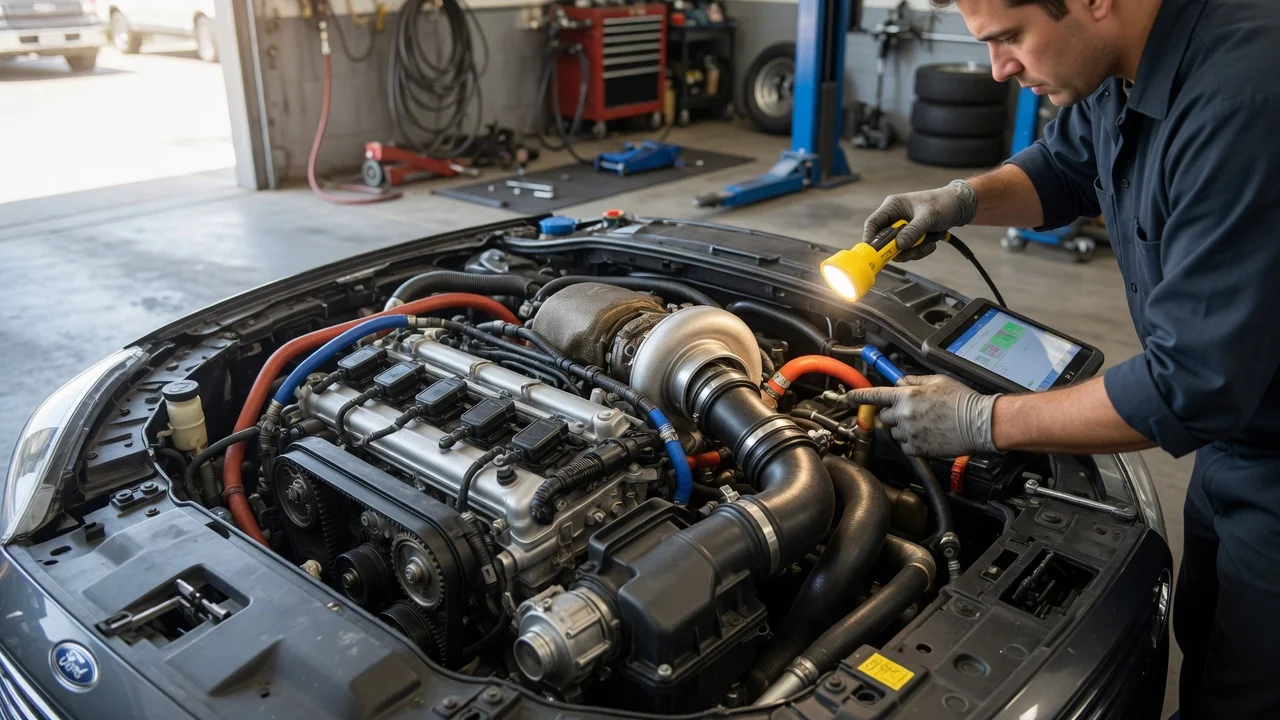
Direct answer and scope
The Ford 1.5 EcoBoost is a turbocharged gasoline engine, and reported problems tend to concentrate in a few areas: coolant loss or cooling system faults, turbocharger behavior, fuel or ignition concerns, and fault codes that are often misread as proof that a specific part has failed. The exact symptoms and likely causes depend on the model year, vehicle platform, market configuration and emission calibration, so a single universal failure list would be misleading. The most useful approach is to treat any warning light, abnormal reading or driveability symptom as a diagnostic starting point rather than a component verdict.
What could explain my symptom, warning or fault code?
Observations should be separated from possible causes. A fault code identifies a monitored condition or circuit that has moved outside the expected range; it does not by itself prove that the named sensor, actuator or module requires replacement. For example, a code related to boost pressure may be caused by an intake air leak, a charge pipe issue, a wastegate or bypass control problem, a sensor reading error, or a wiring and connector fault, not necessarily a failed turbocharger.
Order checks by discrimination
Confirm the operating conditions: note whether the symptom appears cold, warm, under load, at idle, during acceleration or after a drive cycle. Many engine management tests only run under specific conditions such as closed-loop operation, a set temperature range, steady load or a defined speed window.
Check live data, not just stored codes
Compare the reported value with the expected range under the correct conditions. A reading that is plausible at idle may reveal a deviation only during boost or high load. Short-term and long-term fuel trim, manifold pressure, coolant temperature, intake air temperature and misfire counters can distinguish a genuine mechanical issue from a sensor or adaptation concern.
Resolve the code definition before replacing parts
Diagnostic trouble codes follow standardized categories, but their meaning and enabling criteria vary by calibration. Check the applicable code definition for the vehicle and engine variant, including the conditions required to set the code. A pending or history code may record an event that is not currently active, and clearing codes without identifying the triggering condition can leave the underlying problem unresolved.
What each check supports and leaves open
Check | Supports | Leaves open; Coolant level and cooling system pressure test | Confirms external loss or pressure decay within the tested system | Internal consumption, small seepage or loss that occurs only at specific temperatures; Live boost and intake pressure comparison | Shows whether actual pressure follows requested pressure under load | Whether deviation is from a leak, control fault, sensor error or wiring fault; Fuel trim review | Indicates a lean or rich correction trend | Whether the cause is unmetered air, fuel delivery, sensor input or combustion behavior; Misfire count by cylinder | Localizes the cylinder or pattern | Whether it is ignition, fuel, mechanical or a secondary effect of another fault
Practical next step for owners
Record the exact warning messages and fault codes, freeze-frame data where available, and a simple description of when the symptom occurs. That information allows a diagnostician to select the correct test criteria for the applicable model year and calibration. Unless a code definition and a completed check clearly show an out-of-range component or circuit, avoid replacing parts on the basis of an unconfirmed code reading alone.
A material gap remains where specific test values, torque specifications, repair procedures or model-year applicability are required. Those must be obtained from the vehicle-specific service information for the exact engine code and market configuration rather than assumed from general descriptions.