Ford Focus RS Wastegate Actuator: Identification
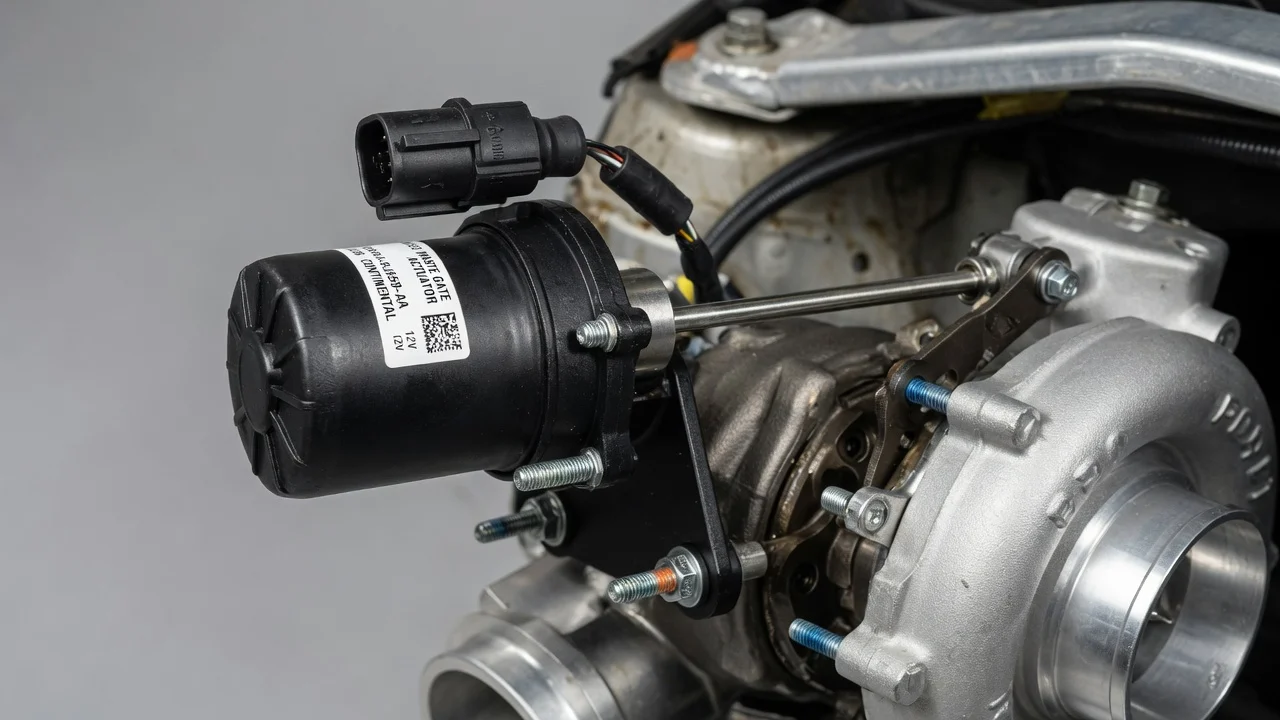
The wastegate actuator on a Ford Focus RS opens the turbocharger's wastegate to limit boost pressure. To identify the correct actuator, you need to know which RS generation you have, whether the turbocharger is still the factory unit, and what type of actuator is fitted. This guide covers how to recognize the actuator, what changes the correct answer, and when part numbers and dealer data matter more than appearance.
The short answer on identifying the actuator
On a Focus RS, the wastegate actuator is mounted on or next to the turbocharger. A rod or linkage connects it to the wastegate lever on the turbine housing. The most reliable way to identify the exact part is the vehicle's VIN together with the part number on the actuator or the turbocharger. Appearance alone is not enough. There have been three Focus RS generations. The first, from the early 2000s, used a turbocharged 2.0-liter four-cylinder. The second, from the end of that decade, used a turbocharged 2.5-liter five-cylinder. The third, sold in the United States for the 2016 to 2018 model years, uses a 2.3-liter EcoBoost four-cylinder.
An actuator is matched to the turbocharger it was built for. Knowing the generation narrows the search but does not confirm the part. If the turbo has been replaced or upgraded, the original factory part number may no longer apply. In that case, the actuator has to suit the turbocharger that is actually installed.
How the wastegate actuator works
The wastegate is a valve that lets some exhaust gas bypass the turbine wheel. This slows the turbo and caps boost. The actuator is the part that moves that valve. A pneumatic actuator is a sealed canister with a diaphragm and a spring inside. Pressure or vacuum reaches the canister through a hose, usually regulated by a boost control solenoid that the engine control module operates. When the pressure overcomes the spring, the diaphragm pushes or pulls the rod and opens the wastegate.
An electronic actuator uses a small motor and a position sensor, and the engine control module commands it directly. The most practical visual difference is the connection. A pneumatic unit has one or more hose nipples. An electronic unit has an electrical connector and wiring. Check your car's service information to confirm which design it uses rather than assuming from another turbocharged Ford.
What changes the answer
Vehicle configuration is the biggest variable. Each RS generation has a different engine and turbocharger, so their actuators are not interchangeable as a rule. Market differences and production changes within a generation can also produce more than one part number. That is why a VIN-based lookup is safer than a generation-based guess.
The Focus ST is a common source of confusion. ST and RS models share a platform, and some generations use related engine families. Even so, the turbocharger, boost calibration and actuator can differ. A part that looks the same and bolts on may still have a different spring rate or setting. Treat a Focus ST wastegate actuator as a separate part unless the part numbers confirm a match.
Modifications change the picture further. An aftermarket or hybrid turbocharger may come with its own actuator. A tuned car may have an adjusted rod length, a different actuator canister or an aftermarket boost controller that changes the hose routing. A separate valve mounted on the exhaust manifold or downpipe means an external wastegate is present. That is an aftermarket setup, and its identification depends on that hardware, not on factory data.
What the owner can do
Start with paperwork. Note the VIN and review the service history for any turbocharger replacement, upgrade or tuning work, since this tells you whether factory part numbers still apply. With the engine fully cold, locate the turbocharger and find the actuator canister or motor. Check whether it has hoses or an electrical connector. Look for a printed or stamped label on the actuator body and for an identification plate on the turbocharger itself. Clean grime off gently and photograph any numbers you find. Labels can be hard to read once fitted, so a clear photo helps a parts counter or technician.
While you are there, a basic inspection is worthwhile. Look for cracked, split or disconnected hoses on a pneumatic system. Check that the rod is attached to the wastegate lever with its retaining clip in place. Look for damaged wiring or a loose connector on an electronic unit. If you have an OBD-II scanner, generic codes such as P0299 for underboost or P0234 for overboost can point toward the boost control system. Neither code proves the actuator itself has failed.
Avoid adjusting the rod length or preload without the manufacturer specifications for your car, because this directly changes boost behavior. Do not fit a part from another model on the strength of looks alone. The actuator is not usually a fixed-interval replacement item, so follow your car's maintenance schedule and inspect it when boost symptoms appear.
Limitations and next step
Visual identification has clear limits. Labels fade or corrode, and previous repairs may have introduced non-original parts. Aftermarket turbochargers are not covered by factory catalogs. Boost faults also share symptoms with vacuum or boost leaks, solenoid faults, sensor problems and turbocharger wear. A suspected actuator problem should be confirmed with proper boost and actuator testing under real operating conditions before parts are bought. An electronic actuator may also need a diagnostic tool for setup or adaptation after replacement, depending on the vehicle.
The most dependable next step is to give your VIN, plus any part numbers and photos you collected, to a Ford dealer parts department or a reputable parts supplier. If the car is modified or the fault is not clear-cut, have a technician experienced with turbocharged Fords diagnose the boost system before replacing the actuator.