Fleet Auto Emissions Testing: What Applies to Your Vehicles and How to Choose a Testing Option
The short answer
There is no single national emissions test for fleet vehicles in the US. Whether a fleet vehicle must pass an emissions test, and what kind of test it gets, is set by the state, and sometimes by a specific county or metro area, where the vehicle is registered. The federal Clean Air Act requires inspection and maintenance programs in areas that do not meet air quality standards, but states design and run those programs themselves. As a result, one fleet can have some vehicles that need regular testing and others that need none.
Several conditions change the answer for an individual vehicle: the registration location, the vehicle's weight class, its fuel type (gasoline, diesel, hybrid or fully electric), its model year or age, and any state exemptions. Fully electric vehicles have no tailpipe and are generally outside tailpipe emissions testing. Hybrids are often still tested. Heavy-duty diesel trucks may fall under separate programs from passenger cars and light trucks.
Gaps in this guide
No confirmed state-specific information was available for this guide. That includes testing intervals, fees, exemption cut-offs by model year or weight, deadlines and provider details. Confirm these with the vehicle agency or environmental agency in each state where your fleet vehicles are registered before you build a compliance schedule or compare quotes.
How emissions testing relates to roadworthiness certification
In states that require it, passing an emissions inspection is usually a condition of registering or renewing a vehicle's registration. Some states combine emissions checks with a safety inspection. Others require only one of the two, and some require neither. For a fleet manager, this means emissions compliance is tied to the registration renewal calendar. A vehicle that misses or fails its test can block renewal and take the vehicle out of legal service.
Fleets that operate across state lines should note that the requirement typically follows the registration jurisdiction, not the states the vehicle drives through. Vehicles with apportioned registration for interstate commercial use can complicate this. Confirm with the base jurisdiction which emissions rules apply to them.
Common test methods by vehicle type
The test method depends on the vehicle and the state program. The table below summarizes common approaches. It is a general orientation, not a statement of any one state's rules.
Vehicle category | Common test approach | What to confirm; Newer light-duty gasoline cars and trucks | On-board diagnostics (OBD) plug-in check that reads the vehicle's computer for fault codes and system readiness | Which model years your state tests this way, and whether any older vehicles get a tailpipe test instead; Older light-duty gasoline vehicles | Tailpipe or idle test in some programs; exempt in others | Age-based exemptions and the test type used; Light-duty diesel vehicles | OBD check or a separate procedure, depending on the state | Whether your state tests diesel vehicles in this class at all; Heavy-duty diesel trucks | Smoke opacity testing (measuring how much light the exhaust blocks) and, in some states, OBD-based checks under dedicated heavy-duty programs | Whether a separate heavy-duty or fleet program applies, such as the heavy-duty programs California runs; Hybrids | Usually tested like comparable gasoline vehicles | Whether your state offers any hybrid exemption; Fully electric vehicles | Generally no tailpipe test | Whether registration still requires any inspection paperwork
Testing options for fleets
Depending on the state, fleets may be able to use one or more of these options:
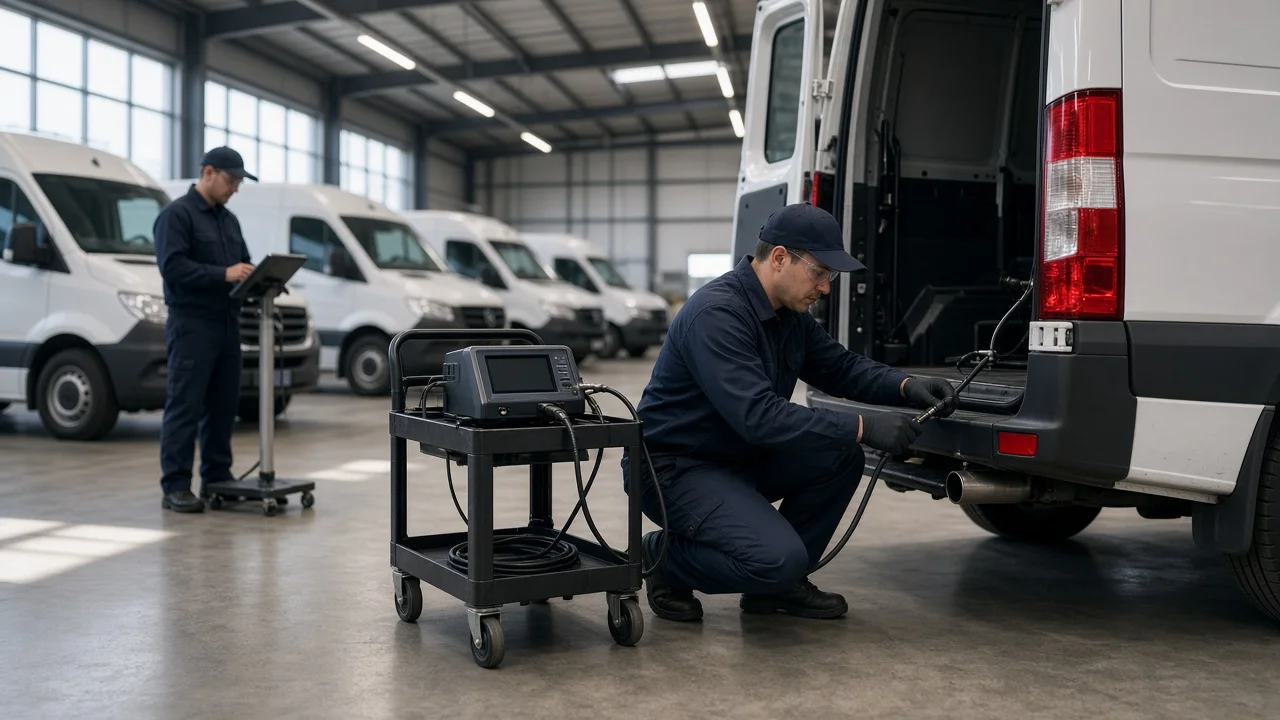
Public or state-contracted test stations, where drivers bring vehicles in individually. Licensed private inspection stations, often at repair shops or dealerships. Mobile or on-site testing, where a licensed tester comes to the fleet's yard, which reduces downtime. Fleet self-testing programs, where some states let qualifying fleets test their own vehicles under a license or certification, with record-keeping and audit requirements.
Not every option exists in every state, and eligibility for fleet self-testing usually depends on fleet size, vehicle type and approval from the state. Check which options your registration states allow before you request quotes.
What to check when choosing a testing provider
State licensing or certification for the exact test types your vehicles need. A provider certified for light-duty OBD checks may not be authorized for heavy-duty diesel opacity testing. Coverage of every vehicle class in your fleet, so you do not have to split work across several vendors. On-site or mobile service if downtime and driver travel time matter to your operation. How results are reported to the state. Ask whether submission is electronic and automatic, or whether you handle the paperwork for registration. Record-keeping and access to past results. These are useful for audits, resale and tracking recurring faults. Scheduling tied to your registration renewal dates across multiple states, if you operate in more than one. The process after a failed test, including retest policy and whether the provider repairs vehicles or refers them elsewhere. How pricing is set. Some states fix the test fee and others let providers set it. Ask what is included, such as travel charges for mobile service, retests and reporting.
Preparing vehicles to avoid avoidable failures
For OBD-based tests, a lit check-engine light usually means an automatic failure. A vehicle can also be rejected if its readiness monitors are not set. Readiness monitors are the vehicle's internal self-checks, and they can reset after a battery disconnect or after fault codes are cleared. A vehicle with freshly cleared codes or a new battery may need a period of normal driving before it can be tested. For diesel opacity tests, unresolved maintenance problems that cause visible smoke are a common failure point. Building a pre-test check into routine fleet maintenance reduces retests and missed registration deadlines.
Suggested next step
Start with an inventory of each fleet vehicle that lists its registration state and county, weight class, fuel type and model year. Use it to confirm which vehicles fall under an emissions program and which test each one needs. Then shortlist providers licensed for those tests in each jurisdiction, and compare them on the criteria above.