Choosing a Turbo Blanket for the Honda Civic Type R FK8
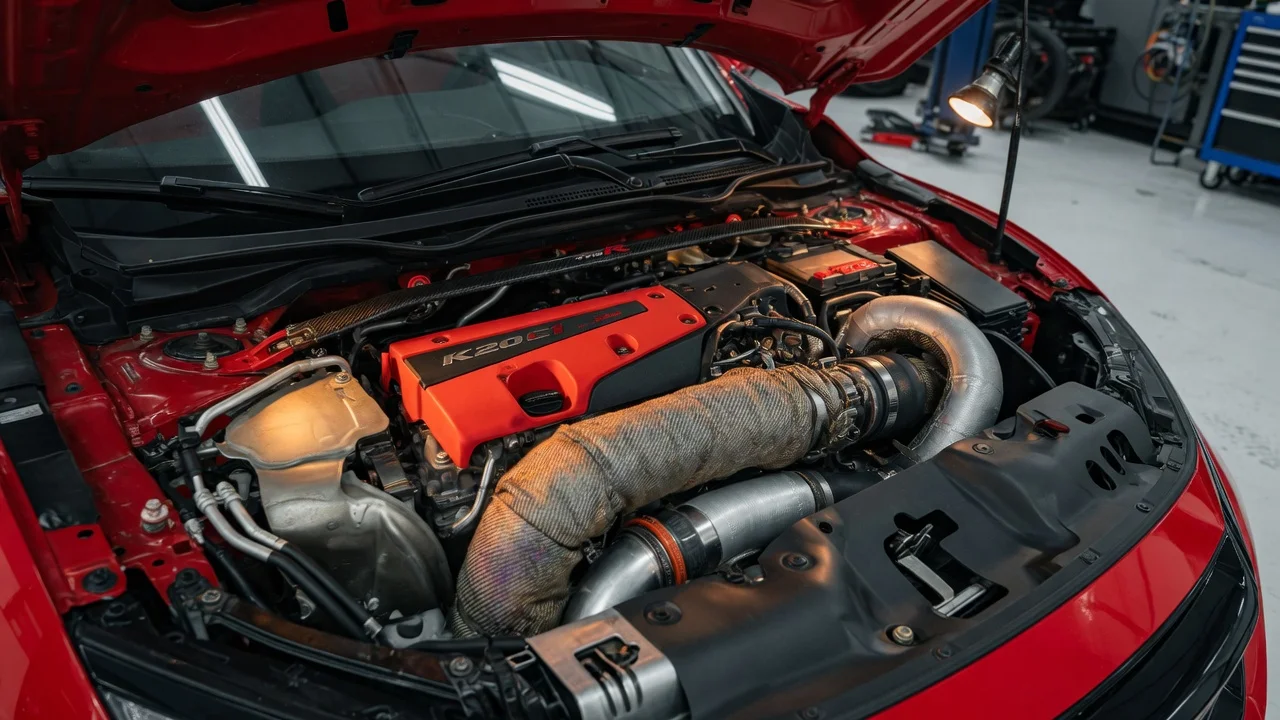
A turbo blanket for the FK8 Civic Type R wraps the turbine housing to keep more exhaust heat inside the turbo and less of it radiating into the engine bay. It is a small part, but it sits on one of the hottest surfaces on the car, so fitment, material and upkeep all matter. This guide covers 2017 to 2021 FK8 owners with the K20C1 engine and explains how to judge a blanket against your actual setup rather than marketing claims.
Define the job the product must do
Start by naming the problem you want to solve. A blanket reduces radiant heat from the turbine housing, which can help protect nearby wiring, hoses and plastic parts and may slow heat soak in the intake tract after hard driving or long idling. It is not a power upgrade, and any change in spool or response depends heavily on the rest of the setup. A stock daily driver, a car that sees track sessions, and a car running an upgraded turbo each have different priorities for durability, coverage and ease of removal.
Separate what you have observed from what you have verified. Owners often report feeling slower after sitting in traffic or between track sessions, but that symptom alone does not confirm a heat problem. Before buying, log intake air temperature under repeatable symptom conditions, such as the same ambient temperature, route and idle time, so you have a baseline to compare against after installation. If logs show normal behavior, the blanket may offer little benefit for your use.
Also consider practical constraints: whether the car is under warranty, whether your area has emissions or visual inspection rules that look at modified underhood parts, and whether you are comfortable working in the tight space around the turbo.
Check compatibility
Confirm the chassis and engine configuration first. The FK8 Civic Type R was sold in the US for the 2017 through 2021 model years, and all US cars use the 2.0-liter turbocharged K20C1. Do not assume a blanket listed for the later FL5 Type R, or for the 1.5-liter turbo Civic models, will fit an FK8. A listing that simply says Civic or Honda turbo is not enough; look for an explicit FK8 or K20C1 fitment statement from the seller.
The bigger variable is the turbocharger itself. A blanket shaped for the factory turbine housing may not suit an aftermarket bolt-on upgrade turbo, and larger turbo kits often use completely different housings. If your service history includes a turbo replacement or upgrade, identify the exact unit installed and match the blanket to that housing, not to the car.
Then check the interfaces around the housing. Cut-outs and openings must clear the wastegate linkage or actuator, the downpipe connection, the oxygen sensor, and the oil and coolant lines. Find out whether the factory heat shielding must be removed or modified, and whether the fastening springs or wire can reach their anchor points without crossing sensor wiring.
Features that affect the choice
Material and construction determine how long a blanket lasts. Common designs use layered insulation such as silica, basalt or fiberglass fabric, sometimes with a woven or wire-mesh outer layer for abrasion resistance. Stitching quality, reinforced edges around cut-outs and a well-formed shape help the blanket stay snug instead of loosening as it heat-cycles. Fastening methods vary between springs, safety wire and straps; springs are generally easier to remove for inspection, while wire can hold a tighter fit but takes longer to service.
Treat temperature ratings carefully. A stated maximum temperature usually describes the insulating material, not a test on an FK8 under real driving loads. Claims such as large reductions in engine bay temperature are only useful if the seller states how they were measured, where the sensor was placed and under what conditions. Manufacturer specifications for material, thickness and fastening hardware are more useful evidence than labels like race-proven or maximum protection.
Oil resistance deserves attention. Some outer layers are coated or treated to resist fluid absorption, which matters because an oil-soaked blanket on a hot turbine housing becomes a fire risk.
Limitations and ownership costs
Installation can take longer than the part suggests. Access around the FK8 turbo is tight, and depending on the blanket design you may need to remove heat shields or surrounding components. Any fasteners you disturb should be reinstalled to the manufacturer specifications in the factory service information. Budget for new gaskets or hardware if removal requires it, and for shop labor if you are not doing the work yourself.
A blanket is a wear item. Repeated heat cycling causes fraying, shrinkage and loosened springs over time, so inspect it at routine service intervals and replace it if it is damaged or contaminated with oil or coolant. Fix any existing turbo oil feed, return or coolant line seep before installing one, since the blanket can hide a slow leak during visual inspection and then absorb the fluid.
Know what the product cannot do. It will not resolve boost leaks, a failing turbo, wastegate faults or stored diagnostic codes; those need proper diagnosis first. Some owners and turbo builders debate whether trapping heat in the housing affects housing or fastener longevity. These are reported concerns rather than established failures on the FK8, so follow any guidance from your turbo manufacturer and keep an eye on the area during inspection.
Build a practical shortlist
Narrow your options with a short checklist. Does the listing name the FK8 or K20C1 and specify the stock turbo or your exact upgrade turbo? Are the material, layer construction and temperature rating stated in the manufacturer specifications rather than only in marketing copy? Do the cut-outs clear the wastegate, oxygen sensor, downpipe and fluid lines? What fastening hardware is included, and can the blanket be removed for inspection without disturbing other parts? Does the outer layer resist oil absorption? Are installation instructions provided, and does the seller accept returns if fitment fails?
Once you choose a blanket, repeat the same intake air temperature logging you did before installation, under matching conditions, to see whether it produced a measurable change on your car. That before-and-after comparison is more reliable than any general claim, and it tells you whether the part is earning its place under the hood.