Fees, Taxes, and Hidden Costs When Buying a Used Car
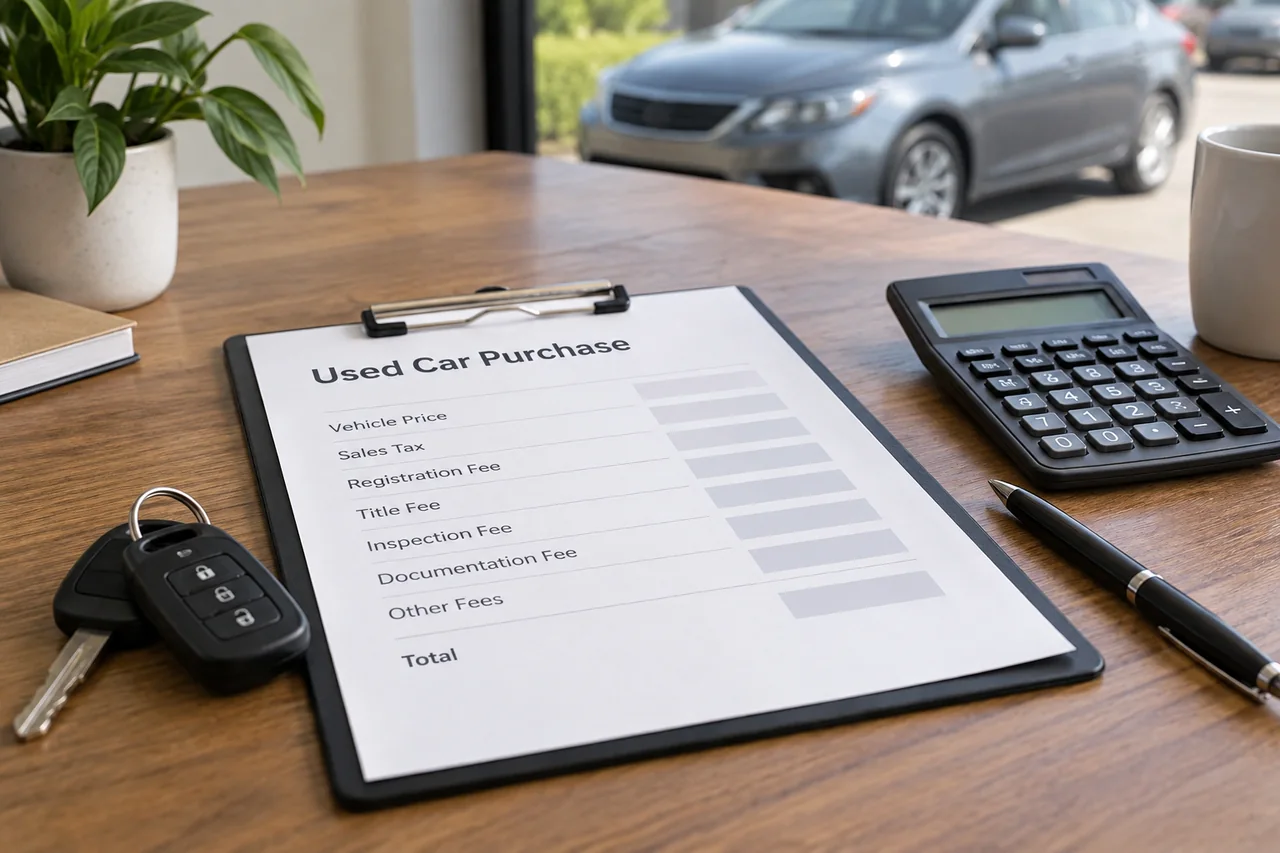
Buying a used car costs more than the advertised price. Fees and taxes when buying a used car typically include government charges, dealer fees, and any optional add-ons you accept. Hidden costs of buying a used car can sit outside the contract as well. Knowing which fees are required, which are negotiable, and which to refuse keeps the out-the-door total from expanding after you agree on the vehicle price.
Build the Total Purchase Cost Beyond the Advertised Price
The advertised price is only one part of the cost of buying a used car. Sales and use tax, government charges such as title transfer and vehicle registration, dealer charges including a documentation fee, and accepted optional add-ons combine into the out-the-door total. Extra fees when buying a used car can change that figure substantially, so the vehicle price alone cannot describe the costs involved in buying a used car.
There is no universal fee total because location, vehicle details, transaction terms, and selected products all affect how much you pay in fees when buying a used car. An itemized purchase agreement makes each charge visible before you commit. A down payment reduces the remaining balance but does not change the purchase cost. The finance charge, amount financed, and later ownership expenses belong in a separate budget from the out-the-door total.
Understand How Used-Car Sales and Use Taxes Apply
Applicable sales or use tax depends on jurisdiction and on how the sale is structured, not on a single national rate. A private-party purchase does not automatically avoid tax when buying a used car; sales or use tax can still apply to a private transfer and may be collected when the title is processed. Who pays taxes is set by local rules. An advertised price cannot establish the tax due because the taxable base and collecting agency both vary.
The taxable amount may include certain dealer fees or optional add-ons, and locally allowed credits or exemptions can change it. A dealer may collect tax at sale, or you may pay during title and registration, depending on local requirements. Taxes on buying a used car across state lines are easy to misread from the sticker, because rate, taxable base, and collecting office may follow the buyer's residence, the sale location, or both. Confirm the tax for buying a used car against the written total.
Account for Title, Registration, and Other Government Charges
Government fees when buying a used car cover title transfer, vehicle registration, and plate-related charges. Title transfer records the change of ownership. Registration authorizes the vehicle for road use for a stated period. Plate fees may apply for new plates or a permitted transfer. DMV fees when buying a used car are paid to a motor vehicle agency or authorized provider, even when a dealer collects them for convenience.
The amount of DMV fees when buying a used car depends on location, vehicle characteristics, registration duration, and plate-transfer eligibility. Inspection or emissions requirements may add expenses where they apply; identify whether payment goes to the motor vehicle agency, an inspection station, or another designated provider. Confirm that each government charge matches this vehicle and registration term. Estimated charges should be reconciled, and overpayments returned or credited by the collecting agency.
Identify Documentation Fees and Other Dealer Charges
A documentation fee, often called a doc fee, is a dealer charge for processing sale paperwork. A document fee when buying a used car is not a government fee, and the amount of document fees depends on the dealer and local rules rather than a uniform national schedule. Dealership fees may also appear as administrative, electronic filing, preparation, or reconditioning line items. Labels vary, so the wording on the form is not proof of who receives the money.
A dealer fee when buying a used car is a charge the dealership adds, distinct from a government assessment. Dealer fees may be negotiable or removable, subject to applicable law and dealer policy. Appearing on the buyer's order does not convert a dealer charge into a required government fee. Non-tax fees can include both government charges and dealer charges, so each line needs an identified purpose and recipient. Additional fees should be explained in writing or treated as candidates to refuse.
Recognize Optional Add-Ons and Unapproved Extra Charges
Optional add-ons often appear as service contracts, GAP products, theft marking, and appearance protection. Extra charges when buying a used car can also include etching or appearance packages presented as if they were part of the sale. Each product needs a clear description of coverage and whether it is optional. Hidden fees when buying a used car often appear in this group: a line that looks like a required filing may be a product you never requested.
Check whether you explicitly authorized each product. Unwanted optional products and unauthorized or duplicate charges are fees to avoid when buying a used car and should be refused before you sign, with corrected paperwork that removes them. Financing an add-on raises the amount financed and can add a finance charge over the loan term. Cancellation and refund terms depend on the contract and applicable law, so do not assume a later call will unwind a product signed at closing.
Determine Which Fees Belong in the Final Agreement
Taxes and legally required government charges generally belong in the final agreement, yet applicability and amounts still need verification for this vehicle and this sale. A commonly charged fee is not automatically legally required, and a lawful dealer charge is not automatically nonnegotiable. Fees you should pay when buying a used car are those with a legal or contractual basis you accept. Charges that lack that basis are fees not to pay when buying a used car, no matter how often they appear elsewhere.
Before signing, review each line for purpose, recipient, legal or contractual basis, and your authorization. Fees that are required, and other fees to expect when buying a used car, should survive that review; unexplained extra fees should not. Reconcile the final agreement with the itemized written total shown earlier. If new charges appear, resolve them on corrected paperwork before you sign. Other fees that come with buying a used car belong in the contract only when they pass this review.
Budget for Expenses That May Never Appear on the Sales Contract
Some costs associated with buying a used car never appear on the sales contract. Budget for an independent pre-purchase inspection, vehicle-history information if you purchase it, and any pickup or delivery expenses. Obtain an insurance quote before you take possession and confirm when coverage must begin. These extra costs when buying a used car sit beside the out-the-door total, so a complete acquisition budget is larger than the buyer's order.
Condition-dependent work can add hidden costs of buying a used car after you leave. Inspection findings may point to maintenance, tires, a missing key, or repairs, but not every vehicle needs those items. Loan interest still accrues on the amount financed even though it is absent from the cash out-the-door total. Fuel, parking, and routine maintenance are ongoing ownership expenses that affect affordability long after the fees associated with buying a used car have been paid.