Exhaust Manifold Repair: Repair Options and When Replacement Is Needed
What is the essential answer to my question?
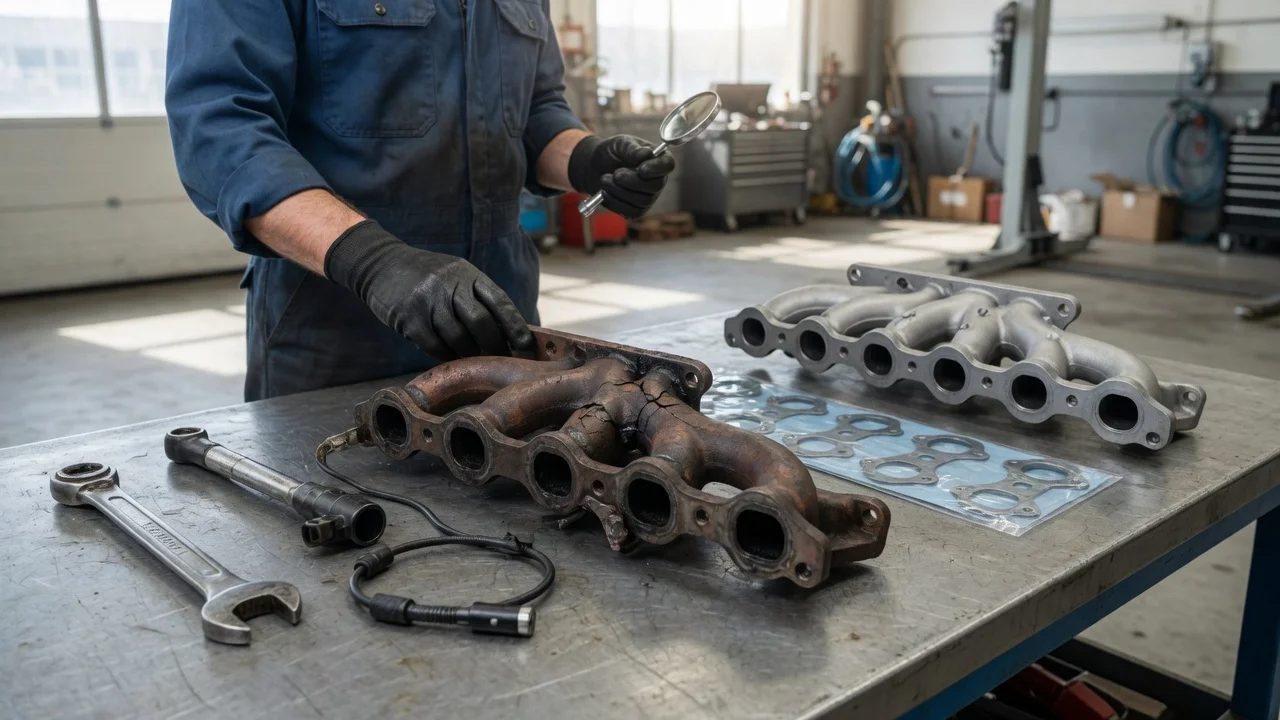
An exhaust manifold can often be repaired rather than replaced, but the right choice depends mainly on the failure type, the manifold material and the condition of the sealing surfaces. Small accessible cracks in a cast-iron manifold, a broken fastener hole, or minor gasket-surface damage may be repairable by welding, machining or using a repair insert. A manifold that is heavily cracked, rusted thin, warped beyond safe resurfacing, or damaged in a load-bearing area is usually a replacement candidate. A repair that restores a flat sealing surface and a complete gas path can be durable, but a repair that leaves a distorted flange or a weakened casting may fail again quickly.
Exhaust Manifold Repair Options
Repair choices are normally considered in this order: replace the gasket and fasteners, machine the flange, repair damaged threads or a broken stud, weld a crack, and finally replace the manifold. The gasket and hardware are generally the least expensive parts to renew, so they are checked before condemning the manifold itself.
Gasket and fastener replacement: appropriate when the leak is at the cylinder-head flange and the manifold is still flat and intact. Flange resurfacing: used when the manifold face has light pitting, erosion or minor distortion and there is enough material to machine flat again. Stud or thread repair: used when a broken exhaust stud or stripped threaded hole is causing the leak; the manifold itself may not need replacement. Crack welding or brazing: possible for a solid cast-iron manifold with a clean, accessible crack, especially when the casting is no longer available or is expensive. Manifold replacement: preferred when the manifold is cracked through multiple runners, rusted thin, severely warped, or the cost of repair approaches the price of a new or serviceable replacement manifold.
Which option better fits my priorities?
If the priority is low cost on a common vehicle with an inexpensive replacement manifold, replacement is often the more predictable choice, especially after the labor of removing the manifold has already been paid. If the priority is keeping an original or difficult-to-source manifold, or the replacement part is costly, then a quality weld repair or flange resurfacing can be the better fit.
Decision factor|Repair tends to be better|Replacement tends to be better; Failure location|Single accessible crack or damaged flange face|Crack through a runner or collector, or multiple cracks; Manifold material|Thick cast iron with enough remaining wall|Thin-wall steel or rust-damaged casting; Flange condition|Light pitting or distortion within safe machining limits|Deep erosion or warp beyond resurfacing allowance; Availability|Original manifold unavailable or expensive|Common manifold with affordable new or used supply; Risk tolerance|Acceptance of possible repeat failure|Preference for a single predictable repair
The same failure can produce very different recommendations because shops cannot always know how much material remains inside a rusted casting until it is removed and cleaned. A crack that looks small on the outside may extend through an internal web, and a flange that appears flat may show measurable distortion when checked against a straightedge. For that reason, the choice is best finalized after removal and inspection, not from the outward symptom alone.
What could explain this symptom, and what should I check next?
An exhaust leak near the manifold can produce a ticking or puffing noise that is louder when the engine is cold, a smell of exhaust in the engine bay, reduced turbo response on turbocharged engines, or an exhaust-related fault code. These symptoms point to the manifold area but do not by themselves prove whether the cause is the gasket, a broken stud, a cracked manifold, or a warped flange.
Cold-start noise that quiets as the engine warms: often a flange leak that closes slightly as the manifold expands, but it does not rule out a crack. Visible black soot marks around the flange or along the runners: a useful sign of the leak path; clean the area before inspection so new traces are easier to see. A broken or missing exhaust stud or nut: the manifold may be fine, and the repair may be limited to extracting the broken fastener and renewing the gasket. Exhaust odor inside the cabin or engine bay: indicates a leak that should be located before continued use, because exhaust gas can enter the passenger compartment. An exhaust or oxygen-sensor fault code: evidence to investigate rather than proof of a failed manifold; unmetered air entering ahead of an oxygen sensor can also cause mixture-related codes.
Inspection Checks That Help Separate Repair from Replacement
A straightedge and feeler gauge across each flange can reveal distortion that would prevent a new gasket from sealing. Light pitting can often be cleaned up, but a flange with a large low area may require machining or replacement. Cracks should be traced to their ends after cleaning; a crack that runs into the collector or around a runner is more serious than a short surface crack. If the manifold has rust scaling or visibly thinned walls, welding may not leave enough sound parent metal.
Stopped Use and Professional Diagnosis
Stop driving and arrange professional inspection if exhaust odor is noticeable in the cabin, if the leak is accompanied by a loss of power or an overheating warning that suggests other damage, or if the manifold is visibly cracked in a load-bearing area. A leaking manifold can also allow hot exhaust gas to damage nearby wiring, hoses or plastic components. A professional diagnosis after the manifold is removed gives the most reliable basis for choosing between a repair and a replacement, especially when the visible damage does not match the severity of the leak.
When Replacement Is Clearly Needed
Replacement is the safer default when the manifold has multiple cracks, a crack through a runner or mounting boss, deep flange erosion, warp beyond the specified resurfacing limit, or metal too thin to weld reliably. It is also preferred when the replacement part is inexpensive relative to the labor and risk of a repeat repair. A repaired manifold should still be checked for flatness before installation; a good weld will not compensate for a distorted flange.
Evidence and Uncertainty
The comparisons above are general engineering guidance, not measured specifications for one vehicle. Repair limits for flange flatness, machining allowance and welding procedure vary by model, generation, powertrain and market. Always confirm the applicable flatness specification, torque procedure and replacement-parts availability for the specific vehicle before deciding. Material condition inside the manifold cannot be fully known until it is removed and cleaned.