Exhaust Leak Repair: Options for Sealing a Leaking Exhaust
Direct Answer
The appropriate exhaust leak repair depends on the location, size, and cause of the leak. For small cracks or pinholes, an exhaust sealant or patch may provide a temporary fix. For damaged flanges, failed gaskets, or corroded flex pipes, the reliable repair is to replace the affected component or gasket. Sealants cannot restore structural integrity to a rusted or broken exhaust joint and are not a substitute for mechanical repair where the component is loose, cracked beyond a pinhole, or separated.
Identify the Leak First
A cold exhaust is easier to inspect than a hot one because components are not at operating temperature. Common leak points include the exhaust manifold gasket, the flex pipe or flexible coupling, flange gaskets between pipe sections, the catalytic converter shell, and the muffler or resonator seams. Exhaust leaks are frequently heard as a ticking, puffing, or rasping sound that gets louder under acceleration and load. A visual inspection may show black soot deposits around a joint or crack, a common sign of escaping gas. Because an exhaust leak can appear as a noise or as an exhaust odor inside the cabin, separating a small pin-hole leak from a failed gasket matters for choosing a repair.
Comparing Repair Options
Exhaust Sealants and Pastes
Exhaust sealants are designed for minor surface leaks such as pinholes, short hairline cracks, or small leaks at a slip joint. Most require the surface to be cleaned with a wire brush so the compound can adhere to bare metal. Many sealants cure with heat and are intended to be applied to a cold exhaust. Their main limitation is that they cannot bridge a gap, repair a failed gasket, or restore structural strength. Sealant should not be used in place of a gasket at a bolted flange because the joint needs a compressible sealing surface.
Exhaust Patch Kits and Bandages
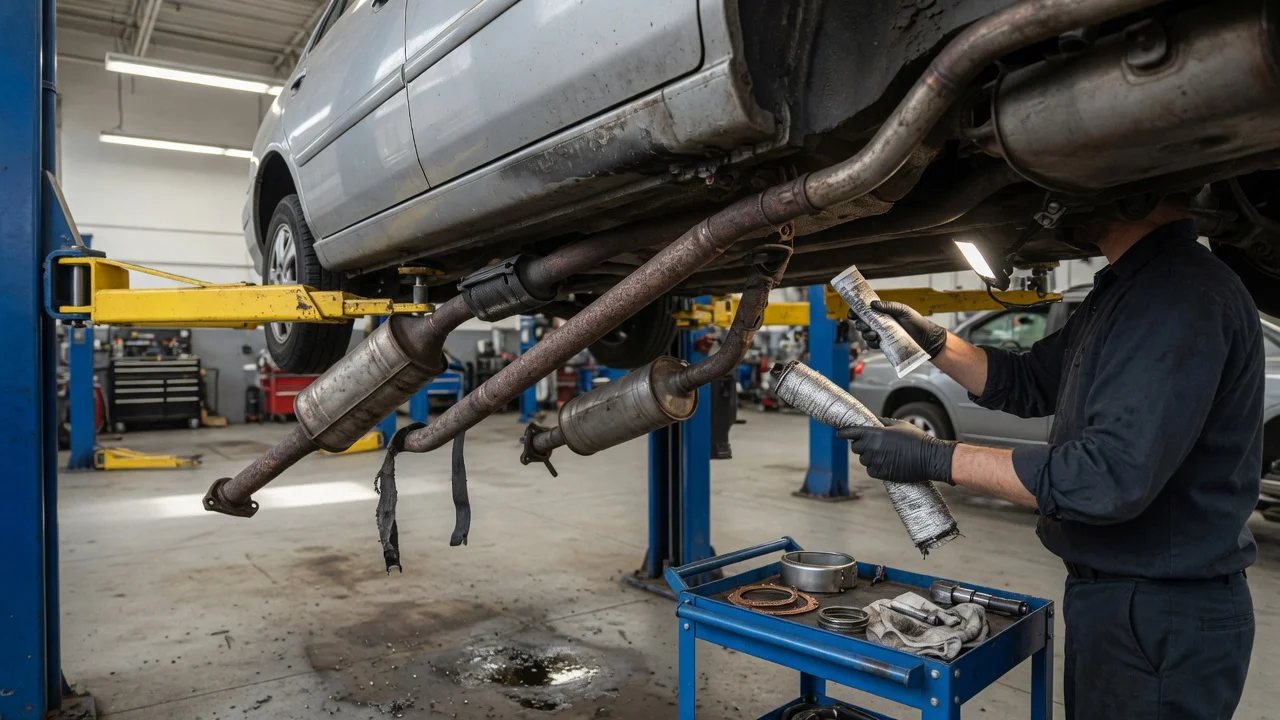
Exhaust repair tape or bandage wraps are intended for temporary repairs on moderately sized cracks or small holes in pipes and mufflers. They generally include a heat-activated resin or an adhesive wrap that hardens after the engine reaches operating temperature. A wrap is more effective on smooth, round sections of pipe than on angular areas such as flanges or convoluted flex sections. It is a short-term solution because the underlying corrosion or structural damage is not corrected.
Gasket and Flange Replacement
When a bolted flange leaks, the normal cause is a worn gasket, loose fasteners, or a warped or corroded flange surface. Replacing the gasket and checking the flange for flatness is the appropriate repair. New fasteners may be needed if the old hardware is heavily rusted. Tightening the flange may stop a leak temporarily if the fasteners were loose, but it does not restore a burned or compressed gasket.
Flex Pipe Replacement
A leaking flex pipe usually requires replacement because the woven mesh and internal bellows flex continuously and are difficult to seal reliably with paste or wrap. The flex pipe is also often integrated into a front exhaust section, so replacement may involve cutting the old section and clamping or welding in a new assembly. Sealants are generally unsuited to this area because the component's movement and high temperature defeat most surface repairs.
Diagnostic Checks and What They Support
A visible crack or soot mark indicates the general area of leakage but does not always reveal whether the leak is at the gasket, the pipe, or the flange. Holding a strip of paper near a suspected joint on a running engine may show it being blown or fluttering; this can help confirm escaping gas at that point. A hiss or puff felt by hand near a suspect area is also a useful indication; do not touch hot components. An exhaust leak upstream of an oxygen sensor can also create a diagnostic fault code for a lean condition or an oxygen sensor reading. A stored fault code alone does not identify a specific leaking component. If a code is present along with exhaust noise, confirm the mechanical leak first; sensor readings often return to normal when the leak is repaired.
Choosing a Repair Approach
Use a sealant or patch only when the leak is small, the surrounding metal is structurally sound, and the repair area is accessible and clean. Consider mechanical replacement when the leak involves a gasket, flex pipe, cracked flange, or extensive rust. A temporary repair may be suitable to quiet a noisy exhaust and keep the vehicle drivable for a short period, but the repair should be followed by inspection for carbon monoxide entry into the cabin if the leak is near the floor or the firewall. A confirmed exhaust leak inside the cabin area should not be left as a permanent condition.
Limitations and Safety Notes
Vehicle applicability varies by model year, engine, and exhaust configuration. Clamp-on and paste repairs approved for mild steel may behave differently on thin stainless steel or aftermarket systems. Hot exhaust parts should not be sealed while the engine or exhaust is at operating temperature; most preparation requires a cold exhaust or a waiting period. Repairs near the exhaust manifold must tolerate high temperature and repeated heat cycling. Where rust has reduced wall thickness, any sealant repair may be unsuitable because the pipe or muffler may continue to degrade and open again.