Exhaust Leak Repair: Choosing the Right Repair Method
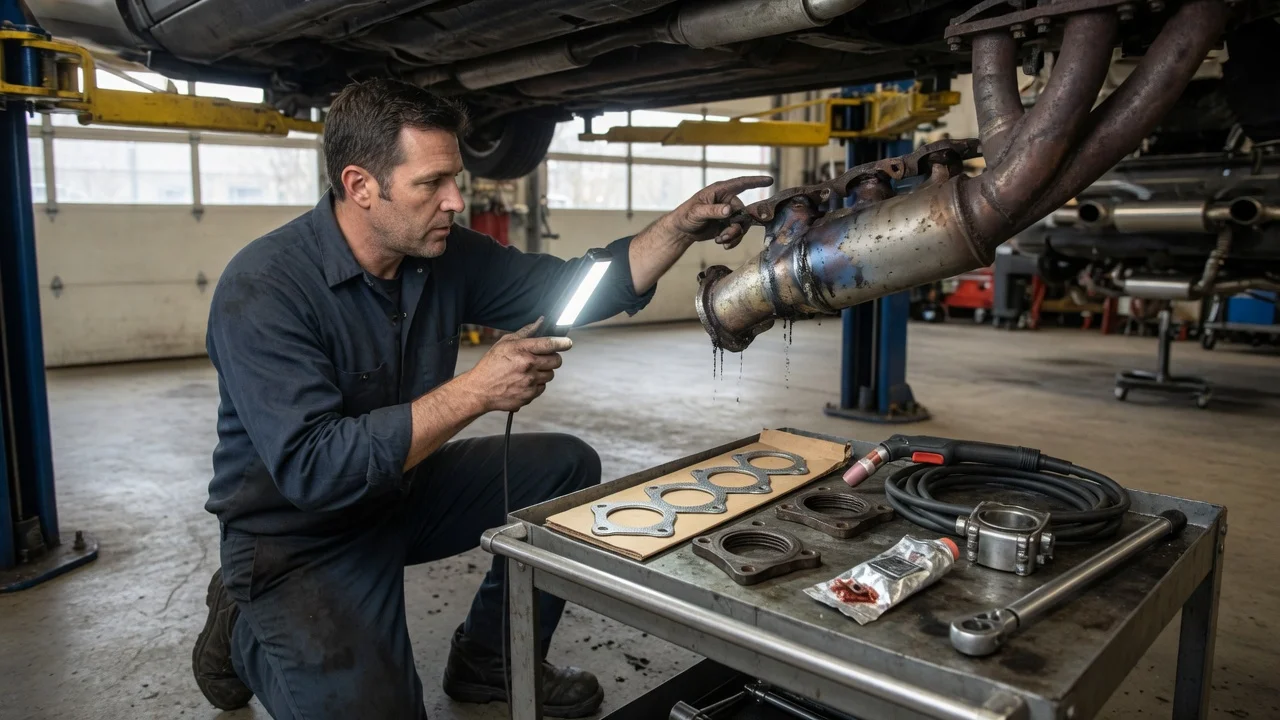
The right exhaust leak repair depends on where the leak is and whether the surrounding metal is sound. A leaking joint may need a gasket, clamp or fastener repair. A localized crack may be suitable for welding. A pipe, muffler or other component weakened by widespread corrosion usually needs replacement. Repair paste, tape and wraps have limited uses and should not be treated as equivalent to replacing damaged metal.
Establish what needs repairing
Before choosing a method, have the leak location and the condition of nearby pipes, joints, mounting points and hangers checked. A failed seal between otherwise serviceable parts calls for a different repair from a hole in a rusted pipe. Repeated cracking can also require attention to movement, alignment or support; closing the opening alone may leave the reason for failure unresolved.
No vehicle details, inspection findings or product specifications were supplied, so a particular part, repair material or welding procedure cannot be recommended. The exact repair depends on the vehicle’s model year, engine, market and exhaust configuration.
When a gasket or clamp repair makes sense
A gasket seals certain connections between exhaust components. If that seal has failed and the mating surfaces remain serviceable, replacing the gasket and addressing damaged fasteners may restore the joint. A new gasket cannot compensate reliably for a cracked flange, badly corroded sealing surface or misaligned connection.
A replacement clamp or repair sleeve may suit a compatible pipe connection with enough sound metal to support it. Match the joint design and pipe dimensions, and follow the part’s installation requirements. Tightening a clamp harder is not a dependable remedy for a rusted pipe or distorted joint.
When welding is appropriate
Welding can provide a lasting repair to a localized crack or a replacement pipe section when the surrounding metal is sufficiently sound and the material is suitable for the process. Access, wall condition and the location of nearby components affect whether this is practical. Thin, extensively rusted metal may not support a reliable weld.
A cracked exhaust manifold needs separate assessment because its material, heat exposure and accessibility can make repair more demanding than work on an underbody pipe. Whether welding or replacement is appropriate requires inspection and vehicle-specific guidance.
Where paste, tape and wraps fit
Exhaust repair compounds and wraps may offer a temporary seal for limited damage if the product explicitly supports that location, material and operating temperature. Their suitability depends on surface preparation, curing requirements and the condition of the metal. They do not restore the strength of a weakened pipe or replace missing support.
Do not assume a product intended for an exhaust pipe is suitable for a manifold, flexible section or catalytic converter. No product evidence was supplied to establish compatibility or service life, so there is no basis for promising how long a patch will last.
When replacement is the better choice
Replacement is generally the stronger option when corrosion is widespread, several holes are present, a component has lost structural integrity or earlier repairs keep failing. A damaged flexible section needs a repair that preserves its movement. Where the exhaust design permits, replacing a damaged section may avoid replacing an otherwise serviceable assembly.
Confirm replacement compatibility using the exact vehicle configuration. Physical fit alone does not establish that a part preserves the required emissions equipment, sensor provisions and system operation. Applicable emissions requirements also matter when replacing a catalytic converter or modifying nearby pipework.
Make the repair safely and verify the result
Exhaust leaks can expose occupants to harmful gases, including carbon monoxide, which has no smell. If exhaust fumes enter the cabin, stop using the vehicle and arrange inspection. Run an engine only in a properly ventilated area, let exhaust components cool before handling them, and never work beneath a vehicle supported only by a jack.
After repair, check that the system is sealed, supported and correctly aligned, with adequate clearance from nearby parts. Ask the repairer to explain why the surrounding material can support the proposed repair and whether the work is intended as a temporary measure or a lasting correction.