Exhaust Leak Repair: Choosing the Right Fix
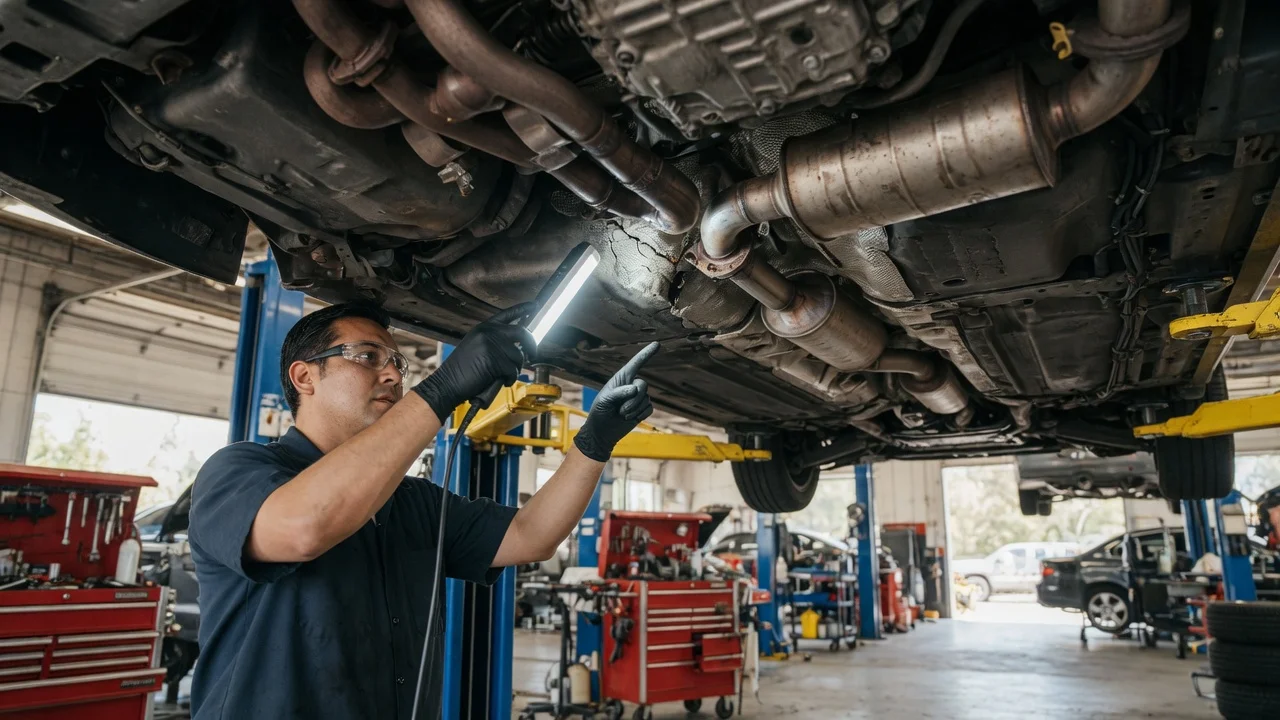
The repair has to match the failed spot
The right exhaust leak fix is the method that reseals the actual failed joint or section and can still hold on the metal that is left. A leak at a connection is usually a gasket, flange, or clamp job. A hole or crack in a pipe, muffler, flex section, or manifold needs a sleeve, a welded section, or a replacement part. Paste, putty, and tape can quiet a small leak for a short time. They do not restore strength and they do not replace a gasket. If the damage is in a flex pipe, a catalytic converter, or a cracked manifold, plan on replacing that component.
“Exhaust leak repair” is not one product and not one job. A tick at the cylinder head is a manifold or manifold-gasket problem. A hiss under the floor can be a pin-hole, a failed slip joint, a torn flex pipe, or a blown muffler. Choosing a can of sealant before you know which of those you have is how the wrong fix gets picked. Find the leaking component first, then pick a method that component can actually support.
Differences that decide the fix
Selection turns on location, damage type, and whether the surrounding part is still structurally sound. Physical fit of a clamp or pipe is not the same as emissions or sensor compatibility. A sleeve that matches pipe diameter still will not seal a crushed or egg-shaped end. A replacement pipe that bolts up still fails the job if it lacks the correct oxygen-sensor (O2 sensor) boss, hanger points, or catalytic-converter specification for that engine and model year.
Location: cylinder-head flange and manifold, downpipe, flex pipe, catalytic converter, mid-pipe, muffler, or tailpipe. Heat and movement are highest at the manifold, flex pipe, and converter; a tailpipe patch that holds there may not hold upstream. Damage type: loose or missing hardware, a failed gasket, a crack, a pin-hole, rust-through, a crushed pipe, or torn flex bellows. Each of those needs a different repair. Remaining metal: thick, round, and intact metal can take a clamp or a weld. Thin, flaking, or collapsing metal needs a new section. Physical fit: pipe diameter, flare or flange style, hanger positions, and the location of any sensor bosses on that vehicle’s exhaust. Electrical and sensor support: many systems thread an O2 sensor, and some add exhaust temperature or pressure sensors, into the pipe. The repair must leave those bosses intact and in the right place. Emissions role: a leaking or missing catalytic converter is not equivalent to a patched pipe. Whether a given aftermarket converter will satisfy a local inspection depends on the vehicle and the jurisdiction; that is not a universal claim.
How the common repairs compare
Use the comparison below to separate a joint repair from a pipe repair, and a temporary seal from a structural one. None of these methods is “best” in every case. The useful question is which limitation you can live with at that leak.
Method Use when Limitation; Hardware and clamp service Loose slip joints or flanges, and the pipe ends are still round and intact Will not seal a burned gasket, a crack in the casting or pipe, or rust-through; Gasket replacement Weeping or blowing at a manifold-to-head joint or a pipe flange Needs reasonably flat flanges, the gasket style that joint uses, and even bolt or clamp load; Paste, putty, or tape A small pin-hole on relatively cool, still-solid pipe, as a short-term seal Adds no strength; heat, flex, and exhaust pulse typically open it again; Sleeve or band clamp A localized hole or short split in round pipe with enough wall left to clamp Poor seal on oval, crushed, or paper-thin pipe; may not clear flares, hangers, or sensor bosses; Welded patch or welded-in section A crack or hole where remaining metal can accept a weld Unsuitable on thin rust, on many coated pipes without proper prep, and on flex bellows; Section or component replacement Torn flex pipe, failed muffler, damaged converter, cracked manifold, or pipe too far gone to clamp or weld The new part must match diameter, flange style, hangers, and sensor bosses for that model year, engine, and market
A conditional way to choose
Work from the joint outward, and replace the part when the metal can no longer hold a mechanical repair. Exact clamp sizes, torque figures, and weld procedures are vehicle-specific and are not listed here.
If the leak is at a flange or slip joint and the pipes are round and intact, replace the gasket when the joint uses one, then fit the correct clamp or bolts and tighten evenly. Retightening a clamp over a destroyed gasket will not last. If there is a small hole in a round pipe with solid wall around it, a sleeve or band clamp is a reasonable mechanical repair. Welding a patch is an option only if the remaining steel can take a weld. If rust is widespread, the pipe is crushed or ovalized, or the hole sits next to a hanger, replace the section. Clamps and paste will not hold on collapsing metal. If the flex pipe is torn or the bellows are cracked, replace the flex assembly. Sealant and wraps fail here because that part is meant to move. If the exhaust manifold is cracked, replace the manifold, or have it welded only after a specialist confirms that casting can be repaired. Exterior paste at the head is not a lasting manifold repair. If the catalytic converter shell, substrate, or joints are damaged, replace it with a part specified for that vehicle. A patch or a straight pipe is not an equivalent repair and may be restricted where you are. If you only need to move the vehicle a short distance before a proper repair, paste or tape on a cool, small leak is a temporary measure. Treat it as time to reach a lasting fix, not as the intended repair.
A leak ahead of an O2 sensor can disturb the mixture reading and may set a stored fault. Sealing that leak is the repair. Replacing the sensor without fixing the leak leaves the cause in place. A fault code by itself is not proof that a converter, sensor, or muffler must be replaced.
What a general guide cannot settle
Which original-equipment or aftermarket pipe, gasket, or converter fits a given car depends on model year, engine, driveline, and market. Those applications are not universal, and listing them without the vehicle would be guesswork. Whether remaining metal is thick enough to weld, whether a “universal” converter will pass a local inspection, and which torque or clamp size that joint uses are likewise vehicle- and shop-dependent. After the chosen repair, a cold visual check of the joint or section, then a careful running check that keeps hands and face clear of hot parts, is the practical confirmation that the leak is gone.