Choosing a Turbo Blanket for a Mitsubishi Evo X
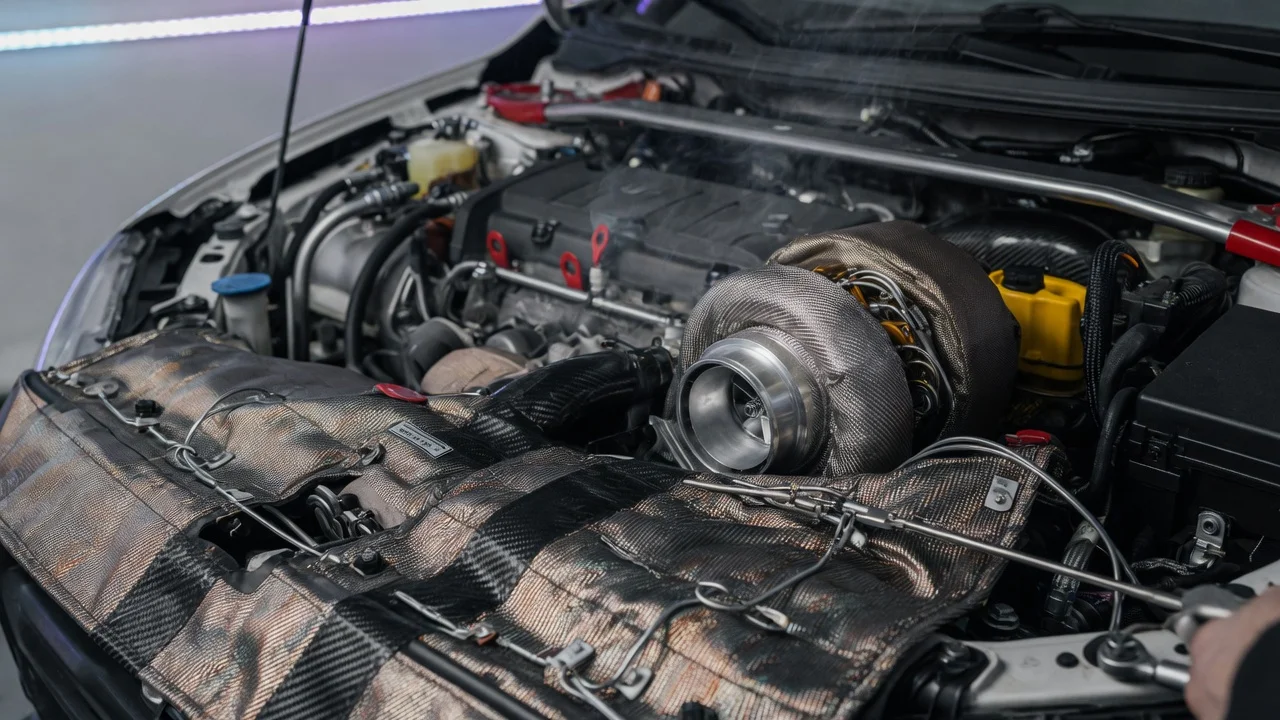
A turbo blanket for the Evo X is a heat-management part, not a performance upgrade with a guaranteed result. Its job is to keep turbine housing heat away from nearby components in a tightly packed engine bay. Whether one makes sense depends on which turbo is bolted to your 4B11T, how the car is driven and which heat-related problems you have actually confirmed. This guide covers fitment, materials, limits and a practical way to narrow the options.
Define the job the product must do
Start by writing down what you expect the blanket to fix. On the Evo X, the turbo sits at the front of the engine, close to the radiator support, intake plumbing and wiring routed around the block. Owners usually buy a blanket for one of three reasons: to reduce radiant heat reaching intake piping and the charge path, to protect hoses, boots and harnesses near the turbine housing, or to lower under-hood temperatures after hard driving or track sessions. Each goal is reasonable, but they are not the same, and the right product differs slightly for each.
Separate symptom reports from verified failures. Hearing that intake temperatures climb in traffic, or that power fades after a few pulls, is a symptom report; it may come from heat soak, an intercooler issue, the tune or ambient conditions. A verified problem is something you can show: a datalog of intake air temperature under repeatable symptom conditions, a melted vacuum line, a cracked boot or a heat-damaged connector found during inspection. If nothing is being damaged and logs show no heat trend, a blanket is a refinement rather than a repair. Practical constraints matter too: a daily-driven car on the factory turbo has different needs from a track car running a larger aftermarket unit with more sustained exhaust heat.
Check compatibility
Fitment is driven by the turbine housing, not the car's name. The Evo X was sold in the US for the 2008 through 2015 model years with the 4B11T 2.0-liter turbocharged engine, and the factory twin-scroll turbo is the same basic design across those years. Blankets sold as Evo X specific are usually shaped around that stock turbine housing and the factory heat shield mounting points. The Lancer Ralliart also uses a 4B11T, but with a different, smaller turbo, so a part listed for the Evo X should not be assumed to fit a Ralliart; confirm by turbo part number.
If the car has an aftermarket turbo, ignore the car-model listing and match the blanket to the turbo itself. The relevant details are the turbine inlet flange (for example T25, T3, T4 or a twin-scroll variant), the outlet type such as V-band or bolted flange, the housing size and A/R, and whether the wastegate is internal or external. Check clearance for the wastegate actuator and its rod, the oil and coolant lines feeding the center section, nearby sensors and the downpipe connection. A blanket that crowds an actuator or rubs a line creates a new problem. Service history matters here: a car that has had a turbo swap, manifold change or different downpipe may no longer match any catalog fitment, so a hands-on inspection beats trusting a listing.
Features that affect the choice
Construction is where real differences live. Most blankets use an inner layer of high-temperature fabric such as fiberglass, basalt or silica, insulation inside and an outer woven or foil-faced shell. Retention is typically springs, stainless wire or straps that hook around the housing. Useful evidence when comparing includes a published continuous and peak temperature rating, the material of each layer, the stitching thread, how the blanket attaches and which openings are cut for flanges and the wastegate. Labels such as race-grade, lava or titanium describe a material or an appearance, not a measured result on your car.
A turbo-specific shape generally fits tighter and leaves fewer gaps than a universal blanket sized only by flange. Fit matters because loose fabric can flap, wear against brackets or leave the hottest areas exposed. Consider whether the blanket can be removed and reinstalled without damage, since you may need access for inspection or turbo service. Treat claims of a specific temperature drop or horsepower gain with caution; those numbers depend on engine configuration, tune, ambient temperature and test method, and they rarely transfer to another car. To judge a blanket on your own Evo, log intake air temperature before and after on the same route under similar conditions.
Limitations and ownership costs
A blanket keeps heat in the turbine housing, which raises the housing's own temperature. Some turbo manufacturers publish guidance on insulating their housings, and some advise against it for certain designs, so check the manufacturer specifications and warranty terms for your exact turbo before installing one. A blanket does not cool the center section, replace a sensible cool-down habit, compensate for an undersized intercooler or cure a tuning problem. It will not resolve diagnostic codes either; boost, sensor or misfire codes need their own diagnosis.
Oil is the main ownership risk. A seeping valve cover gasket, turbo oil feed or return line can soak the fabric, and an oil-saturated blanket over a hot housing is a fire hazard. Fix the leak first and replace a contaminated blanket rather than trying to clean it. Expect the outer layer to discolor and the fabric to become brittle over time; inspect it at oil changes for fraying, loose springs and contact marks. Budget for replacement springs or wire, and possibly a new blanket after repeated removal. Installation is usually straightforward once the factory heat shield is off, but access on the Evo X is tight, and removing some intake piping often makes the job cleaner.
Build a practical shortlist
Narrow the field with a checklist instead of a ranking. First, confirm the exact turbo: the stock Evo X unit, a Ralliart unit or a named aftermarket turbo with known flange, outlet and wastegate type. Second, require a published temperature rating and a clear description of layers and retention hardware. Third, check that the cutouts suit the actuator, lines and outlet on your setup, ideally using photos or a fitment drawing from the seller. Fourth, read the turbo manufacturer's position on blankets and any warranty implications.
Then compare the practical side: how easily the blanket comes off for service, whether replacement springs are available and what the return terms are if it does not fit. Keep a simple baseline record, including intake air temperature logs, any heat-damaged parts found during inspection and recent service history, so you can tell whether the blanket made a measurable difference. If logs and inspection show no heat problem, keeping the factory heat shield in good condition may be the better use of your money.