EVAP Check Engine Light: Understanding Codes and Finding the Cause
What an EVAP check engine light means
A check engine light tied to the evaporative emission control system (EVAP) means the powertrain control module detected a leak, a stuck valve, or incorrect vapor flow in the system that stores fuel tank vapors and sends them to the engine to be burned. The light is a stored diagnostic trouble code, not a measure of how badly the car is running. Many EVAP faults do not cause a stall, a loss of power, or a change in fuel economy that a driver can feel.
The answer holds for gasoline vehicles that use an onboard EVAP monitor. Diesel vehicles, some motorcycles, and some older pre-OBD-II cars either lack this monitor or use a different evaporative design. Hybrid and plug-in hybrid gasoline models still use EVAP hardware, but the monitor may run only after specific drive conditions because the engine is not always on. A flashing check engine light is a misfire warning and is outside this subject; an EVAP fault is almost always a steady lamp.
How the system is supposed to work
Fuel in the tank gives off vapor. Instead of venting that vapor to the air, EVAP routes it through hoses to a charcoal canister, then uses a purge valve to meter the vapor into the intake when the engine can burn it. A vent valve (often called the canister vent solenoid or vent shut valve) opens to let fresh air in during purge and closes when the module runs a leak test. A fuel-tank pressure sensor, or a similar vacuum/pressure sensor, tells the module whether the sealed system holds pressure or vacuum as expected.
The module typically runs the leak monitor after a cold start or during a later drive cycle, with conditions such as fuel level in a mid range, stable ambient temperature, and no other major faults present. If the test sees a leak, a blocked path, or a valve that does not change state, it stores a code and turns on the lamp. Exact enable criteria vary by model year, powertrain, and market calibration.
Common EVAP trouble codes
Scan the vehicle with an OBD-II reader and record the code, freeze-frame data, and whether the code is pending or confirmed. Generic powertrain codes in the P0440–P0459 and P0496 families are the usual EVAP set. Manufacturer-specific (P1xxx) codes can point to the same parts with different wording. The list below describes the typical meaning of the common generic codes; a service information lookup for the exact year, engine, and market is still required before replacing parts.
P0440 — evaporative emission system, general fault. The monitor failed, but the code does not by itself name a leak size or a single part. P0441 — incorrect purge flow. The module did not see the expected change in fuel-tank pressure or airflow when it commanded the purge valve. P0442 — small leak detected. The sealed system lost vacuum or pressure faster than the calibration allows for a small opening. P0443, P0444, P0445 — purge valve circuit open, short, or performance. Electrical or mechanical failure of the purge solenoid or its wiring. P0446, P0447, P0448, P0449 — vent control circuit or vent performance. The vent valve did not open, close, or report as commanded. P0455 — large leak detected. The system could not build or hold the test vacuum or pressure, often from an open path to atmosphere. P0456 — very small leak detected. A tighter threshold than P0442; some calibrations use this for a pinhole-class leak. P0457 — leak detected with the fuel cap off or loose, on vehicles that set a dedicated cap code. P0496 — evaporative flow during non-purge. Vapor or air is moving when the purge valve should be closed.
Freeze-frame data matters. Fuel level, engine temperature, and whether the test was a cold-start or a running monitor help decide if the fault is repeatable. A pending code that never confirms may be an incomplete monitor rather than a hard failure.
Where leaks and faults usually start
The most frequent cause of a large-leak code is a loose, missing, or damaged fuel filler cap, or a filler-neck seal that does not close. After that, cracked or disconnected vapor hoses, a failed purge valve stuck open or closed, a vent valve stuck open or clogged with debris, a saturated or cracked charcoal canister, and a leaking fuel-tank pressure sensor or sending-unit lock ring are the usual mechanical suspects. Rodent damage to rubber lines and a canister that has taken in liquid fuel or water also show up in service work.
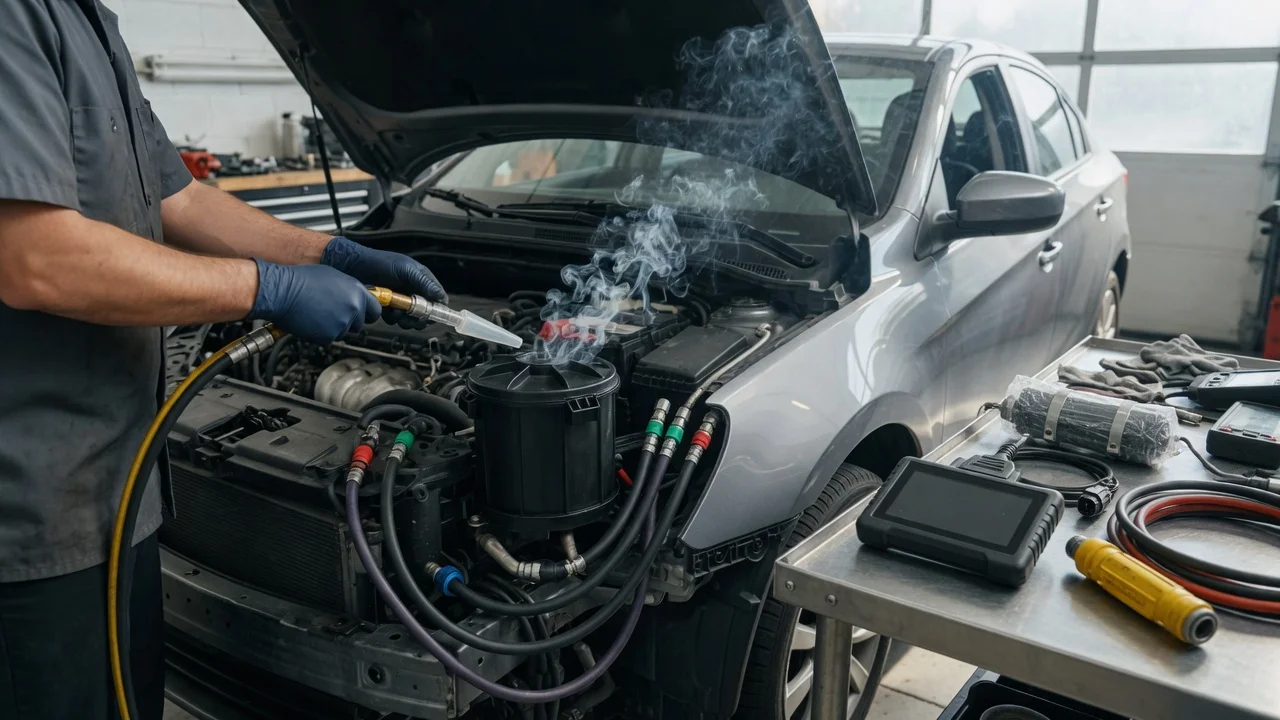
A small-leak or very-small-leak code is harder to see. The opening can be a hairline crack in a hose, a worn cap O-ring, a weeping canister seam, or a filler-neck corrosion pit. Smoke testing the sealed EVAP circuit with the vent commanded closed is the shop method used to find those paths. Electrical codes point first to the solenoid, connector, and harness rather than to a hose leak.
Variant notes change the parts list. Some late-model tanks use a capless filler; the equivalent of a “gas cap” fault is then the filler-neck shutter or its seal. Some trucks and SUVs place the canister near the tank or spare-tire well, where road debris and splash are more likely. Some turbocharged engines add a purge check valve or an ejector in the purge path; a stuck check valve can set a purge-flow code without a tank leak. Those layout differences are model-year and powertrain specific.
A practical order of checks
Read and save the codes and freeze-frame data before clearing anything. Clearing the lamp also clears the evidence of when the monitor failed. Inspect the filler cap or capless filler: seated fully, seal intact, and the correct cap for that tank. After a cap reseat, a confirmed code may still need several drive cycles to turn the lamp off even if the leak is gone. Look at visible EVAP hoses, the canister, the purge valve on or near the engine, and the vent valve near the canister for cracks, loose quick-connects, and contamination. If a circuit code is stored, check the solenoid resistance and connector against the service specification for that vehicle rather than swapping parts by guess. If a leak code remains, a smoke test or a shop EVAP tester is the reliable way to find the opening. Visual inspection alone often misses small leaks. Do not ignore a fuel smell, a dripping tank, or a damaged filler neck. Those are safety and emissions issues, not only a lamp.
After repair, the EVAP monitor must run to completion for the lamp to stay off and for an emissions inspection that reads readiness. That usually takes a mix of cold starts, city driving, and a period of steady speed, with fuel level not full and not near empty. The exact drive cycle is published in the service information for that calibration; a generic “drive it a few days” instruction is only a rough substitute.
What this light does not tell you
An EVAP code does not, by itself, prove the catalytic converter, oxygen sensors, or spark plugs have failed. It also does not measure how much vapor escaped, and it does not rank repair cost. Parts prices and labor hours depend on whether the fault is a cap, a hose in the engine bay, a valve, or a canister and tank assembly that needs the vehicle raised. Those figures are not universal and are not stated here.
If the scan tool shows only a generic P0440 with no companion leak-size or circuit code, further testing is required; that code is a category, not a completed diagnosis. If the lamp returns immediately after a cap or hose repair, the original leak was not the only fault, or the monitor is seeing a valve that does not seal. At that point, service information for the specific year, engine, and market, plus a smoke test, is the supported next step.