EV Charging Types, Connectors, Cables, and Adapters Explained
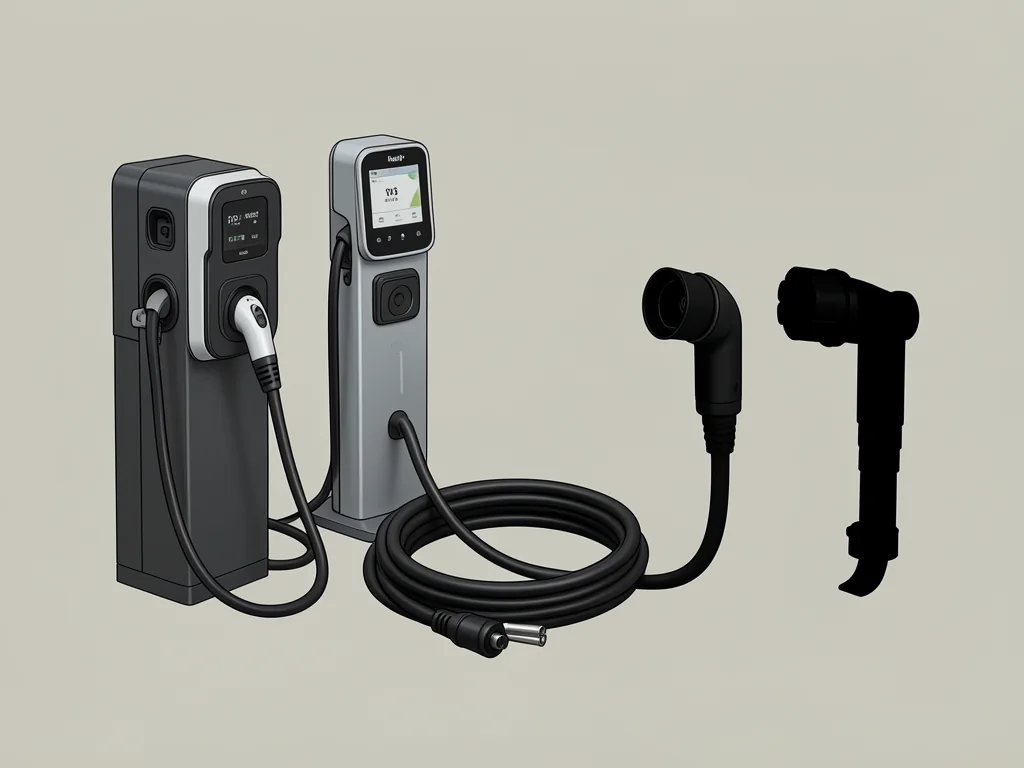
Electric car charging types describe how power reaches the battery, while connectors, cables, and adapters describe how the vehicle joins the station. Level, plug shape, and delivered power are related but separate. Electric car charging standards, the charging port, and whether a station supplies a cable help you choose compatible electric car charging equipment without treating every socket as interchangeable.
What Level 1, Level 2, and DC Fast Charging Mean
Level 1 and Level 2 are AC charging categories used in the United States. Level 1 typically uses a household outlet; Level 2 uses higher-capacity AC supply equipment. Both rely on the onboard charger converting AC to DC for the battery. DC fast charging is a separate category: the station converts power to DC and feeds it toward the battery, bypassing that onboard AC path. Types of electric car charging stations differ by energy delivery, not only by plug shape.
Electric car charging levels, connector shape, and delivered power describe separate aspects of a session. A matching charging plug for an electric car does not guarantee a particular rate. Battery condition, pack temperature, vehicle limits, and station capability all influence accepted power. The vehicle's electric car charging system and the station's electric car charging systems must handshake within those limits. Treat rate as a combination result rather than a fixed time promise, even with an EV fast charging cable.
Identify the Vehicle Port and Connector Standard
The charging port for an electric car is the vehicle inlet. The electric car charging plug is the cable connector; some stations present a socket instead. Type 1 (J1772) is the common North American AC connector. Type 2 is the usual European AC standard and appears on imported vehicles. CCS1 adds DC contacts below a Type 1 face; CCS2 does the same under Type 2. CHAdeMO is a separate DC charging connector found on some older inlets and public posts.
NACS, documented as SAE J3400, uses one connector design that can carry AC or DC depending on the vehicle and equipment. Support is not automatic from inlet shape. Confirm electric car charging connector types and electric car charging socket types from the owner's manual and the station listing. Electric car charging ports are not one universal family; an inlet that accepts AC may still refuse DC. Check the exact standard before assuming a CCS EV charging cable, CHAdeMO handle, or NACS coupler will work.
Check Station Compatibility and Adapter Requirements
Are electric car charging stations universal? Connector fit alone does not prove electrical, communication, or network compatibility. Electric car charging plugs are not universal; a handle may seat while the session fails. An electric car charging adapter or adaptor is needed only when the vehicle maker and charging provider support that connection. Adapters have a direction, application, and electrical rating. Check AC and DC separately, including Type 1 to Type 2 and Type 2 to Type 1 adapters for an EV charging cable.
A connector adapter does not convert AC charging into DC fast charging and does not raise the vehicle's charging limits. An EV charging cable adapter is an interface, not a power converter. Before arrival, confirm network access, payment, account setup, and any vehicle eligibility the provider requires. Electric car charging station standards and site listings should match the inlet and the intended charging category. Skip improvised adapter chains; unsupported combinations can interrupt the session even when the plug appears to fit.
Know When to Bring a Charging Cable
Tethered equipment has an attached cable. Untethered equipment provides a socket for a suitable detachable cable. US public AC stations commonly attach cables, so drivers rarely carry an EV charging cable for public charging stations. DC fast chargers generally supply their own EV DC charging cable, including a liquid-cooled EV charging cable when high current demands cooling. An EV charging station with cable is typical here; a Type 2 tethered EV charging cable is discussed more where socketed posts mix with handles.
Socketed AC stations remain common where drivers carry a detachable Type 2 cable and expect an electric car charging socket rather than a hanging handle. Home wall units vary: some include a tethered electric car charging lead, others require you to supply a charging cable for the electric car. Station details and home equipment specifications reveal whether a cable is supplied. Confirm the arrangement before travel or purchase; an empty socket without a matching EV charging station cable cannot charge the vehicle.
Recognize Detachable Cables and Portable Charging Equipment
A Type 1 EV charging cable uses a J1772 coupler, while a Type 2 electric car charging cable uses the Type 2 face. Both ends of a detachable cable must suit the vehicle and station. A Type 2-to-Type 2 cable is usual at compatible socketed AC posts. A Type 1 to Type 2 EV charging cable or Type 2 to Type 1 EV charging cable is a mixed-end lead; each end must match the inlet and socket present.
Do not treat a detachable charging cable as portable EV supply equipment. Portable units include control and protection functions that manage a session from a wall outlet. The cable itself is only the conductor and connectors. A Type 1 or Type 2 designation identifies the connector standard, not charging power. Older Type 3 EV charging cables and a Type C EV charging cable label are easy to confuse with USB-C; confirm the automotive standard on the EV charging cable connector and charging port before packing a lead.
Choose Cable Ratings and Length for the Intended Use
What cable is used for EV charging depends on connector compatibility, current and voltage ratings, and supported AC phases. The EV charging cable specification shows whether a charging cable for an electric car suits the setup. Vehicle, supply equipment, installation, and cable ratings constrain charging power; a higher-rated cable does not raise that ceiling. Types of EV charging cable start with the inlet and station, then the electrical rating, not a claim that one Type 2 or Type 1 lead is always enough.
Selecting the best EV charging cable means matching the job, not chasing a ranking. Reach, handling, storage, environmental suitability, and safety certification matter as much as plug type when deciding which EV charging cable you need. An electric car charging cord or electric car charging wire usually means a complete assembly. Loose wire is not a substitute for rated equipment. Choose an EV charging cable that matches the inlet, the station, and the AC or DC application without uncertified extensions.
Inspect Charging Equipment and Recognize When to Stop
Before use, inspect the charging plug for the electric car, the electric car charging cables, and the inlet. Look for damaged insulation, bent contacts, discoloration, moisture, and cracked connector housings. A cable that feels hot, stiff, or swollen deserves extra caution. Types of electric car charging plugs and sockets can hide damage in the latch area, so check that the coupler seats fully. These checks apply to a home charging cable, a public handle, and electric car charging adapters in the trunk.
A connector that will not latch, repeated interruptions, or equipment errors cannot establish a specific fault without further testing. Stop using damaged or overheating equipment and contact the station operator or provider. Home circuit suitability belongs with a qualified electrician. Do not modify connectors, improvise extensions, or chain adapters. Electric car charging plug types and electric car charging cable types only work as a system when the hardware remains intact.