EV Charging Power Explained: Voltage, Amperage, Wattage and Level 1 vs Level 2
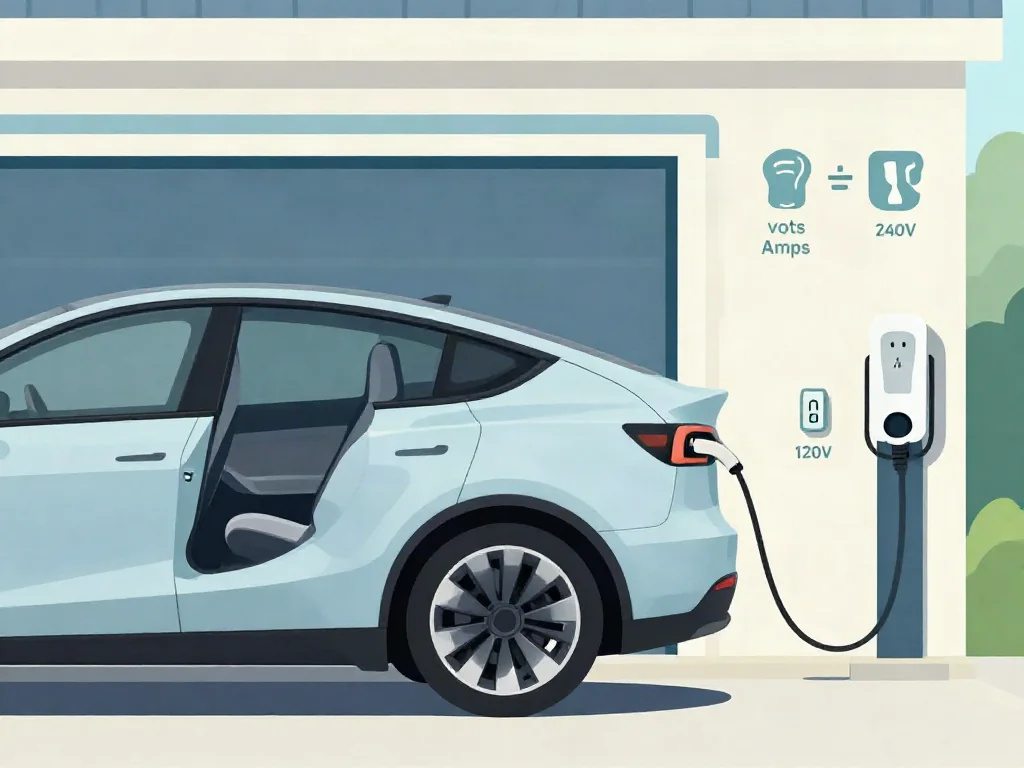
Charging an electric car at home or at a public post comes down to a few electrical quantities: voltage, current and the power they produce together. Understanding how they interact explains why a level 2 electric car charging station can refill a battery several times faster than a household outlet. It also explains why the car itself often decides the final speed.
Volts, Amps and Watts: The Formula Behind Every Charging Speed
Voltage is the electrical pressure pushing charge through a circuit. Current, measured in amps, is how much charge actually flows. Think of water in a hose: pressure does little without flow, and flow is limited without pressure. Wattage is the product of the two, so watts equal volts multiplied by amps, and dividing by 1,000 gives kilowatts. A 240-volt supply carrying 32 amps delivers about 7.7 kilowatts. Doubling either the voltage or the current roughly doubles the energy delivered each hour.
Kilowatts describe a rate. Kilowatt-hours describe stored energy, which is the same unit used for battery capacity. Seven kilowatts sustained for one hour adds roughly seven kilowatt-hours. The power figure printed on a charger label is a maximum, not a promise, because the vehicle's onboard charger and battery management system decide how much is drawn. Real-world power usually lands slightly below the nameplate figure. Converting AC to DC generates heat, and some energy also goes to cooling or warming the battery pack.
Level 1 Charging on a Standard 120V Household Outlet
Level 1 charging uses an ordinary 120-volt household outlet and the portable cord set that typically ships with the vehicle. The voltage is half that of a Level 2 supply, and the cord usually draws somewhere around 12 amps. As a result, delivered power tends to sit in the low single-digit kilowatts, often near 1.4 kilowatts. That generally adds only a few miles of range per hour, which makes it the slowest charging option by a wide margin.
That pace still works for many drivers. Level 1 top-ups can cover a short daily commute, a plug-in hybrid with a small battery, or a car parked overnight for ten hours or more, especially where no dedicated circuit exists. Watch for warning signs, though. If a plug or outlet feels warm, a breaker trips, or the outlet is shared with other heavy appliances, stop using it and have an electrician evaluate the circuit.
Level 2 Charging Stations at 240V: Where Amperage Really Matters
A level 2 electric car charging station runs on 240 volts, the same type of supply that feeds an electric dryer or range. Doubling the voltage and allowing higher current is why these units charge several times faster than Level 1. Stations differ most in their amperage. At 240 volts, 16 amps yields roughly 3.8 kilowatts, 32 amps about 7.7, 40 amps about 9.6 and 48 amps about 11.5. Two stations with identical voltage can therefore charge at noticeably different speeds.
Stations are either hardwired or plugged into a dedicated 240-volt receptacle. In both cases, the rated output must match a circuit sized to carry it continuously. Many units offer adjustable current limits, so an installer can set a lower maximum for a smaller circuit. Public Level 2 stations are rated the same way as home units, but the vehicle's onboard charger often becomes the ceiling. A car limited to around 7 kilowatts gains nothing from a higher-rated post.
Three-Phase Supply: What It Is and When EV Charging Uses It
Single-phase power delivers electricity through one alternating waveform, so the power it delivers briefly dips in each cycle. Three-phase power uses three overlapping waveforms offset from one another. The flow is smoother, and more total power can travel over similar-sized conductors. Most US homes have single-phase service, which is why residential Level 2 charging is single-phase 240 volts. Three-phase supply is common in commercial buildings, workplaces and fleet depots, where large electrical loads are routine.
Three-phase AC charging is more widespread in some other markets, but a vehicle benefits only if its onboard charger is designed to accept it. Owners should check their own vehicle documentation rather than assume support. DC fast charging is a separate concept. Those high-power units typically draw three-phase AC from the grid and convert it to DC inside the charger cabinet. The car receives direct current regardless of how the site is fed.
Reading Charger Specifications: What the Ratings Actually Tell You
A charger's specification sheet usually lists input voltage, maximum current, maximum output power, connector type and cable length. Input voltage tells you whether the unit needs a 120-volt or 240-volt supply, while maximum current and output power show its ceiling. On the vehicle side, the onboard charger rating, usually expressed in kilowatts, caps AC charging no matter how powerful the station is. If the car's onboard charger accepts less power than a station offers, the car sets the rate.
Connector names describe what each connector is for. J1772 is the common North American connector for AC charging. CCS is associated with DC fast charging, and NACS is a single connector design that carries both AC and DC. Extra features such as smart scheduling, load management and weather-resistance ratings affect convenience, durability and outdoor suitability rather than raw speed. Specifications change by model year and trim, so confirm every figure in your own vehicle and charger manuals.
Electrical Requirements for Home and Station Charging
At an overview level, a Level 2 station needs a dedicated 240-volt circuit sized for its rated current with a safety margin, because charging is a continuous load. For example, a station set to deliver 32 amps is commonly paired with a circuit rated higher than 32 amps. Whether that works depends on the home's service size, other large loads such as heat pumps, ranges or dryers, and the space left in the panel. A licensed electrician should evaluate those factors.
Public and workplace stations need larger supply capacity. They often share available power across multiple ports and rely on network connectivity for access and billing. Permits, code compliance and installation work belong to a qualified electrician, and this article does not cover wiring steps. Utility programs and time-of-use rates also shape the choice. When cheap overnight hours are long, a modest charger may cover daily needs, while shorter windows can favor higher output.
What Really Limits Charging Speed Beyond the Station
Charging speed depends on a chain of limits: circuit capacity, station rating, cable, onboard charger and battery condition. The weakest link sets the actual rate. Battery temperature and state of charge also matter. A cold pack, or one that is nearly full, is normally charged at reduced current to protect the cells, and this tapering is expected behavior rather than a fault. For a rough time estimate, divide the kilowatt-hours needed by the delivered kilowatts. Adding 40 kilowatt-hours at 7 kilowatts takes nearly six hours.
Treat that estimate as approximate, because energy losses and tapering add time. Some situations call for professional help. Charging that stays far below the rated figure in mild weather, repeated fault messages on the station or vehicle, or a breaker that trips during sessions all call for testing by a qualified electrician or dealer technician. A fault message helps narrow down the cause but does not prove which part failed, so avoid attempting electrical diagnosis at home.