EV Battery Swapping Explained: How Swap Stations Work
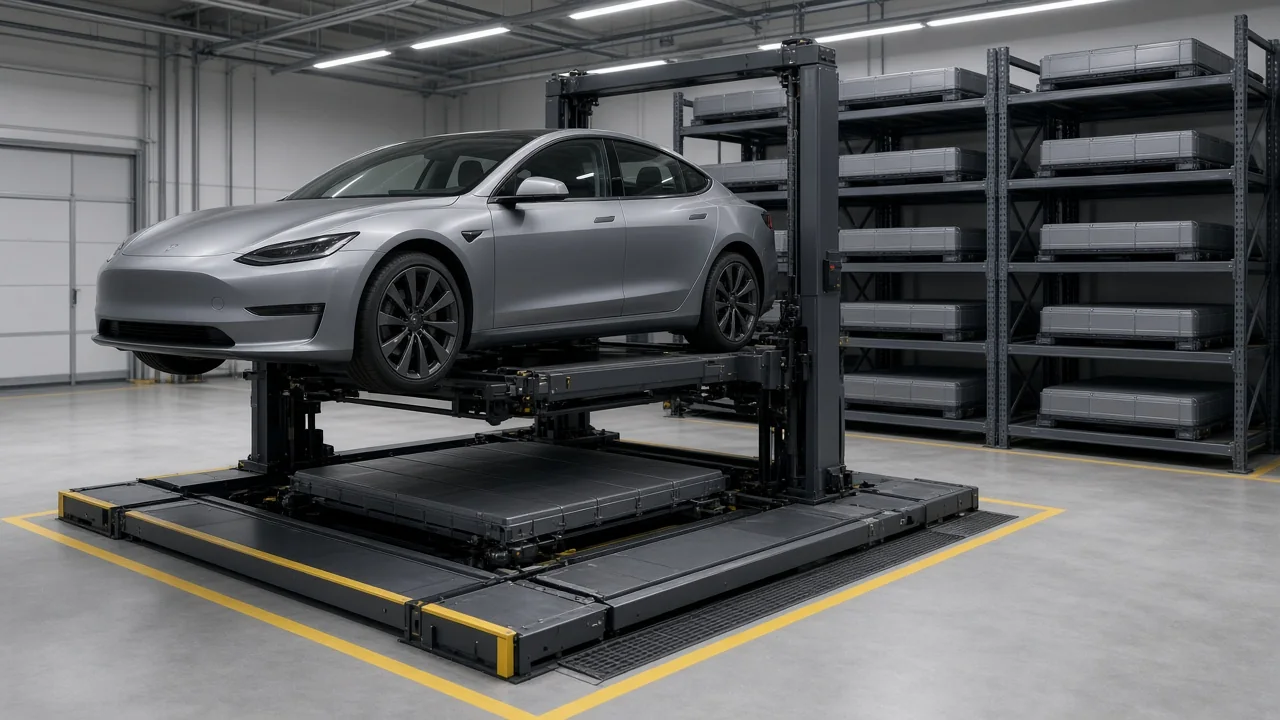
An EV battery swap replaces a depleted high-voltage traction battery with a charged pack in minutes, rather than waiting for plug-in charging. The vehicle pulls into an automated swap station where the underbody pack is exchanged. Most US-market EVs cannot be swapped because their packs are not designed for rapid removal. Battery swapping is most established for Chinese fleets, where dense cities and ride-hailing demand favor minimal downtime. Understanding the technology, station operation, and ownership model helps drivers evaluate if a swappable battery EV fits their use.
What EV Battery Swapping Means and How It Differs From Plug-In Charging
Battery swapping means physically removing the car's depleted traction battery and installing a fully charged pack, instead of recharging the installed battery via a cable. For this to work, the vehicle must be engineered for swapping from the outset: the pack has a standardized shape, quick-release mounts, accessible connectors, and an underbody bay that automated equipment can reach. A conventional EV has its battery rigidly bolted into the chassis, with high-voltage connections that are not meant to be disconnected routinely. Retrofitting such a car for swapping is generally impractical.
During a swap, the driver typically remains inside the vehicle or in a safe waiting area while the station handles the exchange. The car is positioned precisely, the depleted pack is lowered out, and a charged pack is lifted and locked into place. The process is much shorter than even fast DC charging, though exact times vary by station design and pack size. Drivers must verify with the manufacturer whether their specific model supports swapping, because swapping capability is tightly integrated with the maker's own station network and battery management software.
Inside a Battery Swap Station: The Step-by-Step Process
A typical battery swap station begins by identifying the vehicle and reading its battery status through a short-range communication handshake. The car is driven onto a platform where automated alignment pins or guides center it over the exchange bay. A lift mechanism then reaches up from below, unbolts or unlocks the depleted pack, and lowers it onto a conveyor. The charged pack is raised from a storage rack, aligned, and secured to the vehicle's mounting points. Torque-limited tools and self-checking latches ensure the pack is firmly attached before the car is released.
Behind the scenes, the station manages a buffer of packs in various states of charge. Removed packs are placed in climate-controlled racks where they cool down and are slowly recharged, often using lower power levels that are gentler on battery chemistry. This inventory allows swaps to happen quickly, but it also means the station must have enough packs and grid capacity to serve a line of vehicles. Automated systems or trained staff monitor pack temperature, voltage, and state of health, and any pack that falls outside acceptable parameters is flagged and removed from rotation.
How Swap Station Networks Are Planned and Operated
Operating a swap network requires careful planning because every station must hold multiple fully charged packs, not just chargers. The number of packs and the speed at which they can be recharged determine how many vehicles can be served in a row before the station runs out of ready packs. A fleet of taxis arriving within a short window could exhaust the buffer, so operators size their inventory based on expected traffic patterns and peak demand. Floor space is another constraint, because the exchange bay, pack storage racks, and charging electronics all need room.
Siting a swap station involves balancing grid connection capacity, real estate, and route coverage. A station near a highway interchange or a dense commercial district can serve fleet vehicles without lengthy detours. By scheduling pack recharging during off-peak hours, operators can reduce strain on the local grid and potentially lower electricity costs, though specific utility rates vary. Network software tracks every pack's health history, charge cycles, and current efficiency. When a pack's capacity or internal resistance drifts beyond defined limits, it is retired from the rotation and either refurbished or recycled.
Why Battery Swapping Took Hold in China
China's lead in battery swapping stems from a mix of urban density, supportive policy, and large manufacturer-controlled networks. In crowded megacities, many drivers do not have dedicated home charging, and public fast chargers can be occupied or slow. Swapping sidesteps that wait and returns a vehicle to service almost immediately. The technology is especially attractive for commercial fleets: taxis, ride-hailing cars, and delivery vans lose money when they are parked. A swap that takes only minutes preserves revenue and keeps the vehicle on the road for more of the day.
The subscription model also matters. In many cases, a customer buys the EV without the battery and pays a monthly fee for battery-as-a-service, which includes swaps, battery maintenance, and warranty. This lowers the upfront purchase price and shifts the risk of battery degradation to the operator. The operator, in turn, benefits from centralized battery management and the ability to rotate packs across many vehicles. While the concept is spreading, it requires a dense network of stations and a large pool of identical or interoperable packs, which is easier to achieve with a few dominant manufacturers.
EVs Designed With Removable or Swappable Batteries
A truly swappable car battery requires more than just loosening a few bolts. The pack's outer case must be strong enough to be lifted and handled repeatedly, its mounting points must tolerate frequent mechanical cycling, and its high-voltage connectors must be engineered for make-and-break operation without arcing or wear. The pack shape and size must fit the station's handling equipment, which is why swapping is usually limited to a single manufacturer's ecosystem. In contrast, small removable batteries for electric scooters or e-bikes are light enough for a person to carry and use simple slide-in connectors.
For a specific EV model, the only reliable way to know if it supports swapping is to check the manufacturer's official documentation for that market. Some models are swap-capable in China but not offered with that feature elsewhere, or the service may be limited to certain cities and fleet contracts. Even when a vehicle is designed for swapping, it depends on the maker's own branded stations; a battery cannot be exchanged at a competitor's facility. Drivers considering a swap-capable EV should confirm station locations, service hours, and subscription terms before purchase.
Why Swapping Adoption Varies Around the World
A major barrier to swapping worldwide is the lack of standardization. Automakers use different pack shapes, voltages, cooling systems, and mounting bolt patterns. A station built for one brand's trapezoidal 400-volt pack cannot handle another brand's flat 800-volt pack without extensive re-engineering. Industry bodies have proposed common interfaces, but mass adoption would require competitors to share designs or adopt a single modular standard. Until then, each swapping network is effectively a walled garden with high duplication of infrastructure and pack inventory.
The economics also work against swapping in markets with cheap home charging and improving fast-charge speeds. A standard AC charger costs far less to install than a station with robotic lifts and dozens of stored packs. When an EV can add 200 miles of range in 20 minutes at a highway charger, the time saved by swapping shrinks. Ownership questions create further friction: drivers worry about receiving a pack with more degradation than the one they gave up, and warranty terms for swapped batteries must be clearly defined. Battery-as-a-service solves some of this, but many consumers prefer to own their battery outright.
Battery Health, Safety and Ownership Questions for Drivers
Before handing over a charged battery, swap operators typically run a quick diagnostic check on the pack's voltage, temperature, and state of health. Battery management data logs past charging and discharging behavior, and packs that show abnormal capacity fade or internal faults are pulled from service. Drivers should ask what guarantee the operator provides for the swapped pack's capacity and whether they can see its health report. In subscription models, the operator usually covers all maintenance and replacement, but the monthly fee may change based on usage or energy prices.
High-voltage EV batteries store enough energy to be lethal, and removal or installation must never be attempted by an owner. The station's automated systems use insulated tools, ground fault detection, and interlock circuits to prevent electric shock. Even trained technicians follow strict lockout procedures. If a driver notices a loose battery warning, unusual noises, or reduced range after a swap, they should return to the station immediately rather than inspect the pack themselves. Before relying on a swap network for daily commuting, confirm the operator's published policies on station downtime, backup charging options, and out-of-network assistance.