EV Battery Recycling: Mining Impacts, Pollution, and Material Recovery
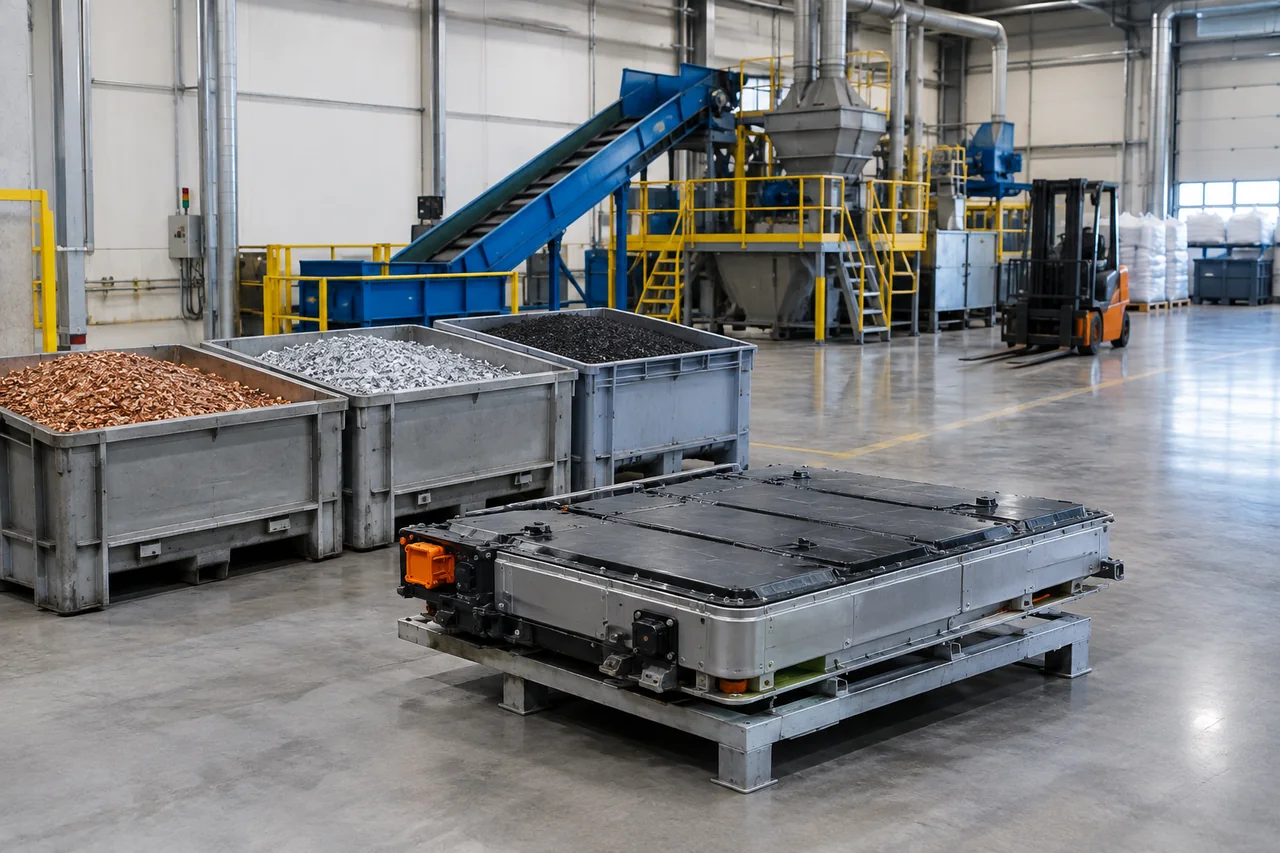
EV battery recycling sits at the end of a longer chain that starts with mineral extraction and cell production. The environmental footprint of battery materials includes mining, manufacturing emissions, and end-of-life recovery. Understanding EV battery environmental impacts, how much of a pack is recyclable, how the recycling process works, and how owners work with qualified recyclers helps separate resource recovery from the energy, transport, and waste that recycling still requires.
Where an EV Battery’s Environmental Footprint Comes From
The environmental story of an EV pack is not a single number. Mineral extraction, refining, battery manufacturing, and end-of-life recovery each leave different marks. EV battery mining can disturb land and consume water; refining and cell plants can add manufacturing emissions; recycling can recover metals but still uses energy and generates residuals. Greenhouse gases, water demand, habitat change, and local pollution are separate kinds of EV battery environmental impact, so a pack that looks favorable on carbon can still raise concerns about water or tailings at a mine.
Battery chemistry, pack size, the electricity used at plants, and how facilities manage chemicals all change the footprint from one vehicle to another. A larger pack stores more energy and usually contains more battery materials, while nickel-rich or iron-phosphate cells draw on different mineral mixes. Recycling a used pack can return lithium, nickel, cobalt, copper, and aluminum to industry, yet collection, transport, and processing still require energy and waste handling. Material recovery reduces the need for some new mineral extraction without erasing the remaining pollution and energy cost of the recycling step.
Battery Mining and the Amount of Lithium in a Pack
Lithium, graphite, copper, and aluminum appear in most traction packs, while nickel and cobalt depend on battery chemistry. Lithium ions move charge; graphite often forms the anode; copper and aluminum carry current in foils and cables. EV battery mines in the popular sense are rarely a single dedicated pit for one vehicle. Battery materials come from many extraction sites and supply chains, including brine and hard-rock lithium, copper concentrates, graphite operations, and nickel or cobalt laterites or sulfides when those metals are used.
Mineral extraction and processing can demand water, clear habitat, produce tailings, and risk contamination if process solutions or dust are poorly contained. Those EV battery mining impacts vary with ore grade, climate, and site controls, so pollution at one operation does not describe every source. The amount of lithium in an EV battery also cannot be stated as one mass for every pack. Elemental lithium content depends on capacity and chemistry, and it is much smaller than lithium carbonate equivalent or the total pack weight, which includes cells, cooling, structure, and electronics.
How Battery Manufacturing Creates Emissions and Waste
EV battery manufacturing pollution is spread across stages that are easy to lump together. Refining converts concentrates into battery-grade salts and metals. Active-material production then forms cathode and anode powders. Cell production coats, dries, stacks or winds, fills, and seals those materials. Pack assembly adds modules, cooling, wiring, and control electronics. Electricity and process heat drive much of the manufacturing emissions, so a plant powered by coal-heavy grids will typically leave a larger greenhouse footprint than one using lower-carbon power, even when the same battery chemistry is produced.
Process chemicals, solvents, and electrolytes create wastewater and air emissions that must be treated and contained rather than assumed to vanish. Production scrap from foil offcuts, rejected electrodes, and failed cells is another waste stream, and much of it can enter recycling before a battery ever reaches a vehicle. That early recycle path matters because manufacturing scrap is often cleaner and more uniform than a used traction pack. Facility practices, solvent recovery, and scrap routing therefore change both pollution and how much material is recovered long before an owner asks how to recycle an EV battery.
How Much of an EV Battery Can Be Recovered?
How much of an EV battery is recyclable depends on what the figure is measuring. Technical recyclability describes whether a material can be recovered in principle. Actual collection determines whether the pack reaches a processor. Recycling yield describes how much of a targeted metal or fraction comes out of a given process. Suitability for reuse in new batteries is stricter still, because recovered salts or metals must meet purity and particle requirements. A high recovery of copper or aluminum does not mean the same share of the whole pack becomes new cathode material.
A traction pack is a mix of casings, wiring, cells, electronics, plastics, coolants, and adhesives, and those parts follow different recovery pathways. Metals from busbars and housings may be separated mechanically, while electrode materials often travel as black mass into chemical or thermal treatment. Any recovery percentage should name the material, the measurement basis, the process, and whether it is a demonstrated result or a target. Claims that quote a single pack-wide percentage without those details mix unlike streams and can overstate how much becomes new battery chemistry.
What Happens During EV Battery Recycling
The EV battery recycling process begins with professional intake, identification, and assessment, not with an owner opening a pack. Trained facilities confirm chemistry, condition, and whether the pack is a candidate for reuse, repurposing, or material recycling. Not every retired pack qualifies for a second life; damage, age, and remaining capacity can send it straight to recycling. Controlled preparation then makes the pack safe for processing. Mechanical processing shreds or otherwise separates housings, foils, and electrode powders, producing black mass, a mixed concentrate of cathode and anode materials rather than a finished battery chemical.
From black mass, plants use different combinations of pyrometallurgy, hydrometallurgy, and direct recycling. Thermal processing can recover some metals in alloys while burning off organics. Chemical extraction dissolves targeted metals into solutions that are later precipitated as salts. Direct recycling aims to keep more of the cathode crystal structure intact so it can be relithiated rather than fully remade. Recovered materials still need refining to specification, and residual solids, wastewater, and air emissions still need management. EV battery recyclers therefore combine collection, processing, and refining rather than performing a single universal recycle step.
How Owners Can Arrange Recycling With a Qualified Provider
Owners who want to recycle an EV battery should start with the vehicle manufacturer, a qualified service center, or an established battery collection program. Those channels determine whether the pack is still under a take-back path, a dealer process, or a third-party recycler. What people call EV battery recyclers often includes several roles: collection providers, transport specialists, processors that produce black mass, and refiners that make battery-grade materials. Ask which battery types are accepted, what documents are required, how pickup is arranged, where the pack will go, and whether fees apply.
Owners should not open, remove, discharge, package, or ship a traction battery themselves. High voltage, stored energy, and damaged cells make untrained handling unsafe, and trained providers must arrange handling and transport. Collision damage, flooding, leaks, heat, or swelling call for professional assessment rather than attempted storage or repair at home. Smoke or a pack that is actively heating is an emergency: keep clear and contact emergency services. Arranging take-back through qualified channels is how recycling an EV battery happens in practice, and it keeps collection and processing inside facilities designed for those hazards.