EV Battery Heat Exchanger: Hybrid Thermal Role and Identification
What is the direct answer?
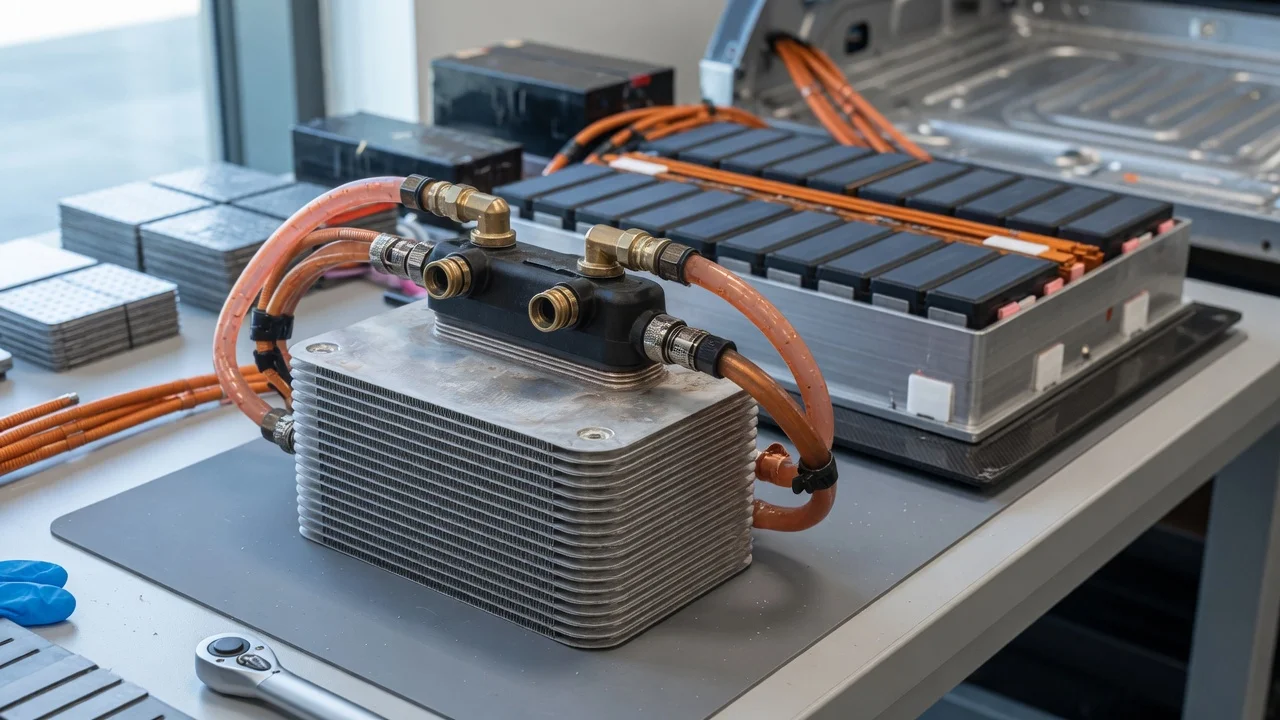
An EV battery heat exchanger is a component that transfers heat between the battery's thermal system and another fluid or surface. In many electric and hybrid vehicles, it is not a standalone battery-only part. It often appears as a combined chiller and heat exchanger that connects the battery coolant circuit to the air-conditioning refrigerant circuit. This lets the vehicle remove heat from the battery during charging or high-load driving and, in some systems, move heat back during cold conditions.
Why the term can mean more than one part
The name battery heat exchanger does not identify one universal component across every vehicle. The exact part and its location depend on the model year, market, drivetrain configuration, and thermal architecture. In some designs, the battery pack uses a coolant-to-air heat exchanger. In others, the relevant part is a refrigerant-to-coolant heat exchanger mounted outside the pack. Because manufacturers may describe these parts differently in service information, checking the factory terminology for the specific vehicle is more reliable than assuming one general name.
How it fits into a hybrid EV thermal system
In a hybrid EV thermal layout, the battery heat exchanger can serve as the junction between the low-temperature coolant loop and the air-conditioning system. A thermal expansion valve or similar refrigerant control may be used on the refrigerant side. When battery temperatures rise, the system can run the AC compressor and pass refrigerant through the heat exchanger. Thermal energy moves from the battery coolant into the refrigerant and is carried to the condenser. This is why battery cooling can sometimes activate the AC compressor even when cabin cooling is not requested.
Common related component names
When looking for service information or replacement parts, the following terms may be used. These are not automatically interchangeable, but they help narrow the search for a particular vehicle.
Practical diagnostic cautions
Do not diagnose the heat exchanger in isolation. Symptoms such as poor battery cooling, reduced charging speed in hot weather, or air-conditioning faults can come from the compressor, coolant pump, temperature sensors, control valves, refrigerant charge, or coolant system air pockets. A leak at the battery heat exchanger can affect both the refrigerant circuit and the coolant circuit, but only a proper pressure and leak test on the applied system can confirm that. Because the connection between the battery thermal circuit and the AC system is vehicle-specific, service procedures and refrigerant or coolant specifications must be taken from the manufacturer's data for that exact model and configuration.