Electronic Stability Control Sensors Explained: Types, Roles and Locations
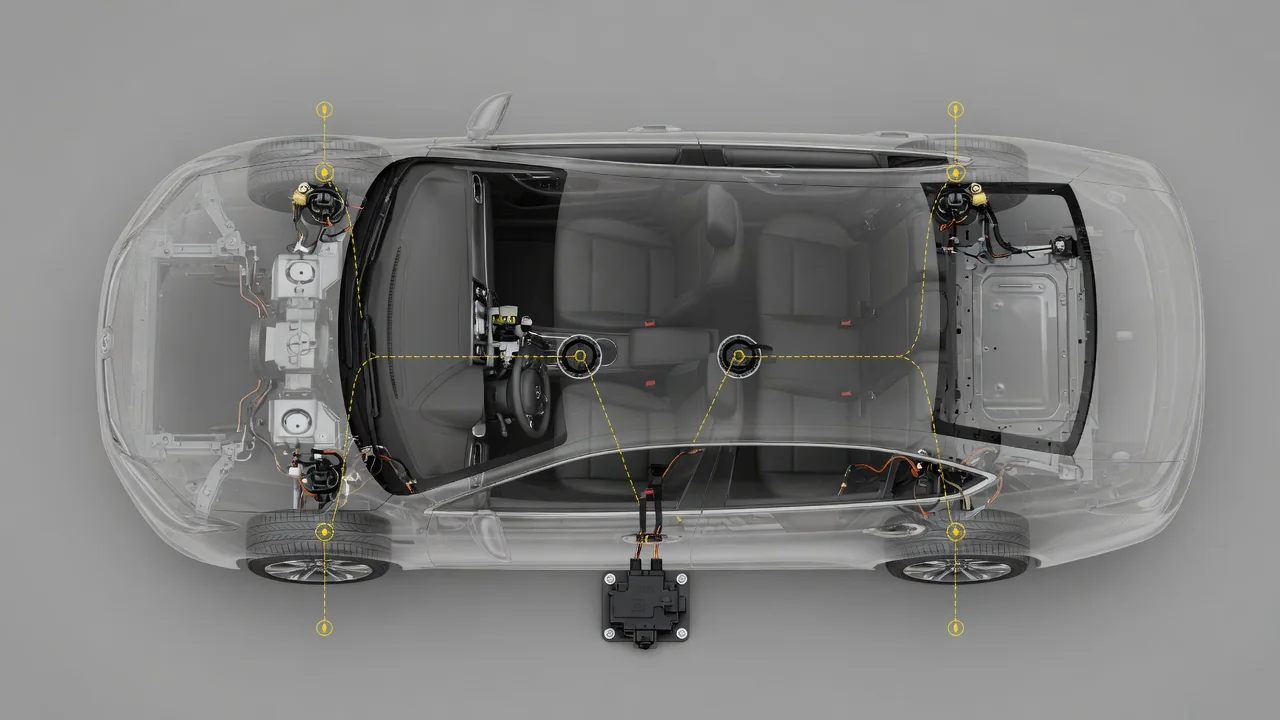
Electronic stability control sensors give a vehicle's stability control system the information it needs to keep the car pointed where the driver intends. Knowing which sensors are involved, what each one measures and where they are generally mounted helps owners understand an ESC warning light. It also helps them have a better conversation with a technician, without guessing at parts or taking risks with safety systems.
What Electronic Stability Control Sensors Do
At its core, ESC constantly compares two things: where the driver is steering and where the vehicle is actually heading. If the car begins rotating more sharply than the steering input suggests, it is oversteering; if it plows wide of the intended path, it is understeering. Sensors feed live data on wheel speed, steering position, body rotation and sideways force to a control module, which can brake an individual wheel or reduce engine power to pull the vehicle back toward the driver's chosen line.
ESC is not a standalone add-on. It builds on the hardware already used for anti-lock brakes and traction control, typically sharing the ABS module, hydraulic unit and wheel speed sensors, then adding steering and motion sensing on top. That shared foundation is why problems often show up across several systems at once. Sensor names, the number of sensors and the way they are integrated differ by manufacturer and model year, so you shouldn't assume one vehicle's layout matches another's.
Wheel Speed Sensors and Their Role in Stability Control
Wheel speed sensors report how fast each wheel is turning, usually by reading a toothed or magnetic tone ring that rotates with the hub or axle. By comparing all four signals, the system can spot a wheel spinning faster than the others under power or slowing abruptly toward lockup under braking. Passive sensors generally create their own alternating signal from the passing teeth. Active sensors are powered and produce a cleaner signal that remains usable at very low speeds. Which type a particular vehicle uses depends on its design.
Because these sensors sit near the wheels, they work in a harsh environment. Metallic debris stuck to a magnetic sensor tip, a cracked or corroded tone ring, excessive wheel bearing play, or chafed wiring can all distort the signal. The control module may then see an implausible speed and respond by shutting down functions it can no longer trust. That is why one faulty wheel speed signal can disable ABS, traction control and stability control together, often leaving several warning lights on at the same time.
Steering Angle, Yaw Rate and Lateral Acceleration Sensors
The steering angle sensor tells the system what direction the driver intends to go, reporting how far and how quickly the steering wheel is turned. The yaw rate sensor measures the vehicle's rotation around its vertical axis, which is essentially how fast the body is turning as seen from above. A lateral acceleration sensor detects the sideways forces built up during cornering. Together, these inputs let the module judge whether the car's actual motion matches the path the steering angle predicts.
On many modern vehicles, yaw and lateral sensing are combined in a single inertial measurement unit, sometimes alongside longitudinal acceleration sensing. That unit may be a separate box, or it may be built into another module such as the airbag or brake controller, and this varies by design. Depending on the manufacturer, some systems also read brake pressure, throttle position, engine torque or other inputs. As a result, the full picture behind a stability intervention can draw on data from several different sources.
Where Electronic Stability Control Sensors Are Typically Located
Where the electronic stability control sensors are located depends on the sensor type. Wheel speed sensors are usually found at each wheel, mounted in the hub, the steering knuckle or, on some rear axles, the axle housing. The steering angle sensor is generally on the steering column, often close to the clock spring area behind the steering wheel. Yaw rate and lateral acceleration sensors are typically mounted near the vehicle's center of gravity, such as under the center console or a seat, or built into another control module.
Exact locations vary by make, model and year, so confirm them in vehicle-specific service information before assuming where a part sits. Mounting also matters, because an inertial sensor that is loose or installed at the wrong angle can report motion that isn't happening. Do not take apart the steering column, clock spring area or airbag-related components to find a sensor. Those systems can deploy accidentally and cause serious injury, so this work belongs with a trained technician who follows the proper precautions.
Common Warning Signs of an ESC Sensor Problem
Typical signs include a lit ESC, traction control or ABS warning light, or a dashboard message saying stability control is off or needs service. The car may also behave differently. When a sensor reports bad data, the system may step in unexpectedly, braking a wheel or cutting power on a straight, dry road. It may also fail to intervene when traction is genuinely lost. Either pattern suggests the module is working from information it cannot rely on.
The same warning lights can come from causes other than sensors, including damaged wiring, corroded connectors, a module fault, or low system voltage from a weak battery or a charging problem. A driver can safely note a few details. Does the light come on at startup or only while moving? Does it follow a pothole, a sharp steering movement or wet weather? Does it clear after a restart? Those observations help a technician narrow down the cause much faster.
Diagnosis Limits, Calibration and When to See a Professional
ESC trouble codes and their definitions depend on the manufacturer, so check any code against vehicle-specific information before drawing conclusions. A code shows that a circuit or signal looked wrong, not necessarily that a part has failed. A basic code reader often reads only engine data and may not reach the chassis or brake modules. To see live sensor values, you may need a scan tool that can read ABS and stability systems, or a visit to a shop.
Steering angle and inertial sensors often need calibration or a relearn after a wheel alignment, steering work or sensor replacement, using the manufacturer's procedure. Even a small offset can make the system misjudge what the driver intends. Brake, steering and airbag-adjacent work belongs with a qualified technician. Until the problem is fixed, drive cautiously with ESC disabled. Leave extra following distance and slow down earlier for curves and slippery surfaces, because the system will not help you recover from a skid.