Electric turbocharger
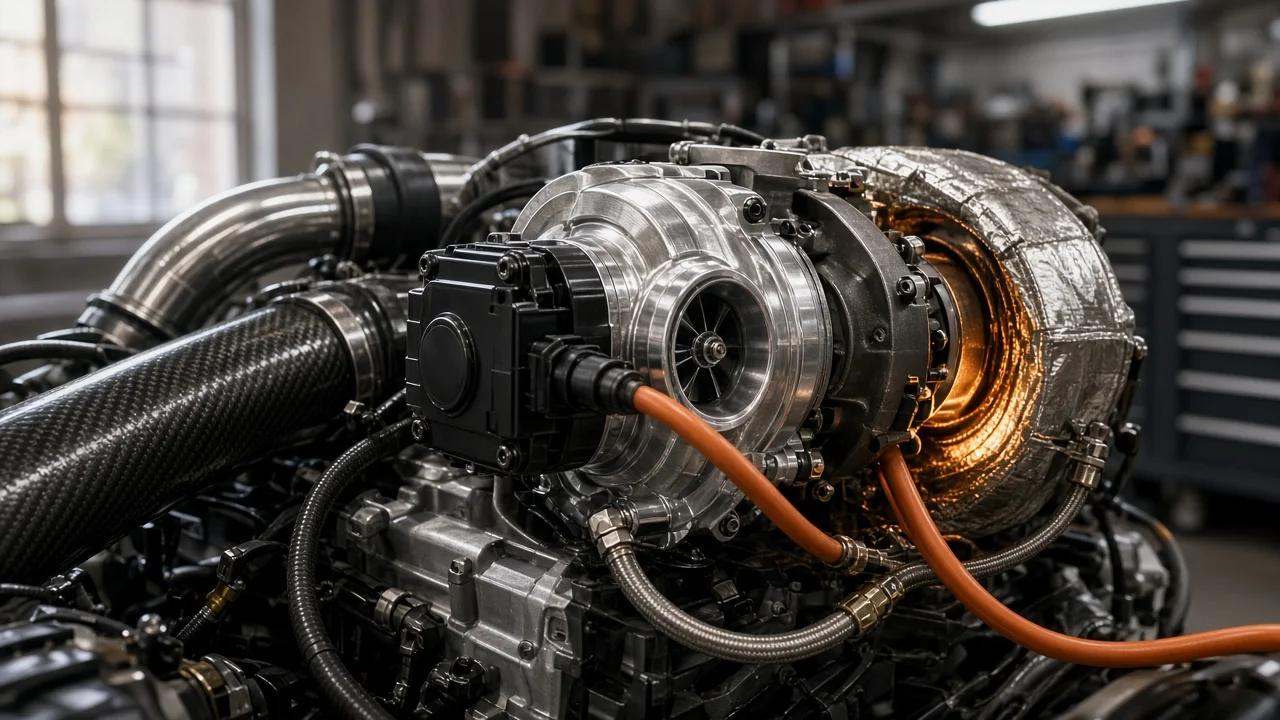
An electric turbocharger answers a persistent limit of conventional exhaust-driven boosting: the brief delay before boost pressure builds. For drivers researching a car electric turbocharger, the essential distinction is response. An electric motor assists the compressor, spinning it independently of exhaust flow or recovering energy that would otherwise be wasted. The result is a sharper throttle transition and better low-speed filling of the cylinders. Because the term also appears as electric car turbocharger, it is worth separating a turbo fitted to an internal combustion engine from any similar-sounding hardware discussed for battery-electric vehicles, where a conventional exhaust turbine has no source.
Essential answer
An electric turbocharger is a forced-induction device that integrates an electric motor with the turbo shaft, usually between the turbine and compressor wheels. The motor can spin the assembly before exhaust energy is strong enough, reducing the lag felt when the driver opens the throttle at low engine speed. On some designs the same motor acts as a generator, capturing surplus exhaust energy and returning it to the vehicle electrical system. That dual role is different from a normal turbocharger, which responds only to the pressure and velocity of the exhaust leaving the cylinders.
The phrase electric car turbocharger can create confusion. A battery-electric car does not generate a continuous stream of hot exhaust, so an exhaust-driven turbo is not relevant in the same way. In that query, the reader is usually asking about an electrically assisted turbo on a hybrid or combustion vehicle, or about electrified air-charging concepts. For a conventional engine, the useful benefit is not only peak power. It is the improved low-rpm cylinder filling and reduced transient delay, which changes how the car feels leaving a corner or merging from a stop.