Electric Supercharger Bypass Valve: Identifying the System
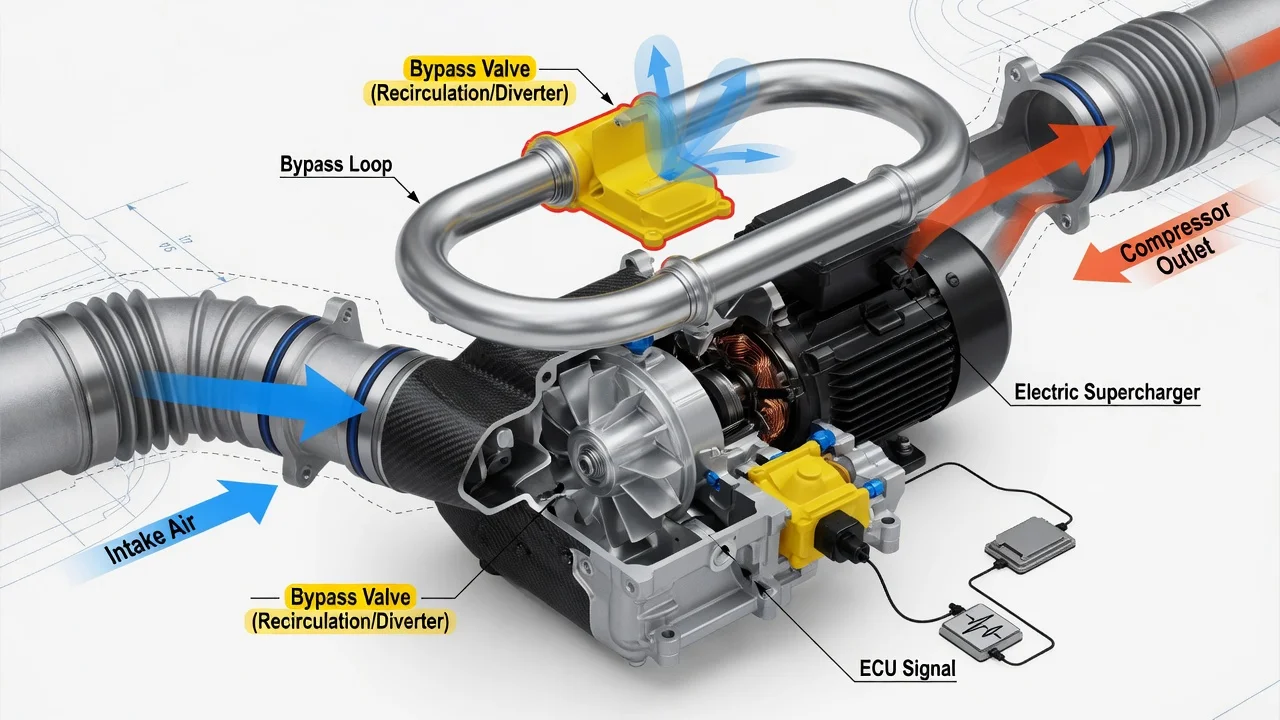
An electric supercharger bypass valve is easy to confuse with other boost-control parts. Several valves on a forced-induction engine have similar jobs and similar names. Before you diagnose a fault, order parts or interpret a warning, confirm which system your engine actually uses. This guide explains what the bypass valve does on an electrically driven compressor and how to recognize that layout. It also covers when the exact vehicle configuration and service information matter more than general rules.
The short answer
Some engines use an electric supercharger, also called an electric compressor or electrically driven compressor. On these engines, the bypass valve is a flap or valve in the intake tract that lets air flow around the compressor when the compressor is not running. When the engine computer commands electric boost, the valve closes. Intake air then has to pass through the spinning compressor instead of escaping around it. When the electric unit switches off, the valve opens again and air takes the low-restriction path. In other words, the valve decides whether the electric compressor is part of the airflow path at any given moment.
Not every vehicle described as supercharged has this part. Belt-driven superchargers often have their own bypass valve. Exhaust turbochargers use wastegates and blow-off or diverter valves. Many cars have none of these. The name on a parts listing is not enough to identify the component. The vehicle configuration, the engine code and the factory service information determine which part you are dealing with.
How the bypass valve works with an electric compressor
An electric compressor uses a motor, rather than a belt or exhaust gas, to spin its compressor wheel. It does not have to wait for exhaust flow to build, so its usual purpose is to add boost quickly at low engine speed or during a sudden request for power. Typically it covers the moment before an exhaust turbocharger produces useful pressure. Factory systems of this kind are commonly paired with a turbocharger. They are often powered by a higher-voltage electrical system, frequently 48 volts, because the motor needs more power than a conventional 12-volt circuit comfortably supplies.
Most of the time the electric unit is idle. Forcing all intake air through a stationary compressor wheel would add restriction, and the bypass path avoids that. When the control unit starts the compressor, it closes the bypass so the pressurized air goes toward the engine instead of circulating back to the compressor inlet. Once the turbocharger or engine speed can supply the requested boost, the compressor slows or stops and the bypass reopens. Depending on the design, the valve may be operated electrically or by another type of actuator. The engine management system may also monitor its position, so a sticking or unresponsive valve can show up as a stored fault rather than as an obvious noise.
Configurations that change the answer
Factory electric compressors, belt-driven superchargers and aftermarket electric boost devices are three different situations. On a belt-driven supercharger, the bypass valve typically opens at idle or light load to recirculate air and reduce pumping effort. It is usually controlled by engine vacuum or a control solenoid. The name is similar, but it belongs to a different system with different diagnostics. Turbocharger blow-off and diverter valves release or recirculate pressure when the throttle closes, which is another separate function.
Aftermarket products sold as electric superchargers range from simple fans placed in the intake to more complex kits. Their design, airflow capability and use of any bypass vary widely. Factory information does not apply to them, and the manufacturer's or installer's documentation is the only reliable reference. Factory systems also differ by engine family. The compressor's position in the intake path, the way the bypass is actuated, and how the system responds to a low 48-volt supply or a stored fault all depend on the specific engine. Operating conditions matter as well. The electric unit may run only briefly during certain demands, so a related fault can appear intermittently.
How to identify the system on your vehicle
Start with documents rather than the engine bay. The owner's manual, the original build data and the engine code in your service history usually show which induction system the engine has. It may be an electric compressor, a mild-hybrid 48-volt system, a turbocharger, a belt-driven supercharger or a combination. A dealer or independent shop can decode the vehicle identification number to confirm the exact configuration. This matters because similar models from the same year can carry different engines.
A visual inspection can support that confirmation. An electric compressor appears as a compressor housing in the intake ducting with an electrical connector and substantial power wiring. It has no drive belt and no exhaust connection. A valve or flap housing with its own connector or actuator sits nearby in the air path. A belt-driven supercharger is driven by the accessory belt and usually sits on or near the intake manifold. Look without disconnecting anything, especially wiring that belongs to a 48-volt system. Do not run the engine with intake ducts removed.
If you suspect a problem, write down what you observe. Note any warning light, any code read with a capable scan tool, and slower response when pulling away from a stop. Also note whether the change followed a battery or electrical repair. Check for cracked or loose intake hoses and disturbed connectors near the compressor. These observations, together with the maintenance schedule and recent work, give a technician a much better starting point than a guessed part number.
Limitations and when to get professional help
This explanation covers the general purpose of a bypass valve in an electrically boosted intake. It cannot give you the location, actuator type, test values or replacement procedure for a particular engine, and there is no universal service interval for this component. Those details come from the manufacturer specifications and factory repair information for your exact vehicle. The electric compressor, its control electronics and the 48-volt supply can produce the same symptoms as a faulty valve. A proper diagnosis may need to check all of them.
Use a dealer or a shop with manufacturer service data and suitable diagnostic equipment in three cases: the vehicle shows a related warning, it has reduced power, or it needs work on the 48-volt system. Bring the vehicle identification number, any stored codes you have read and a short description of when the symptom occurs. Confirming the system first keeps you from buying a belt-driven supercharger valve or a turbo diverter valve for an engine that uses neither.