Duramax Turbo Boost Control Position Sensor Location
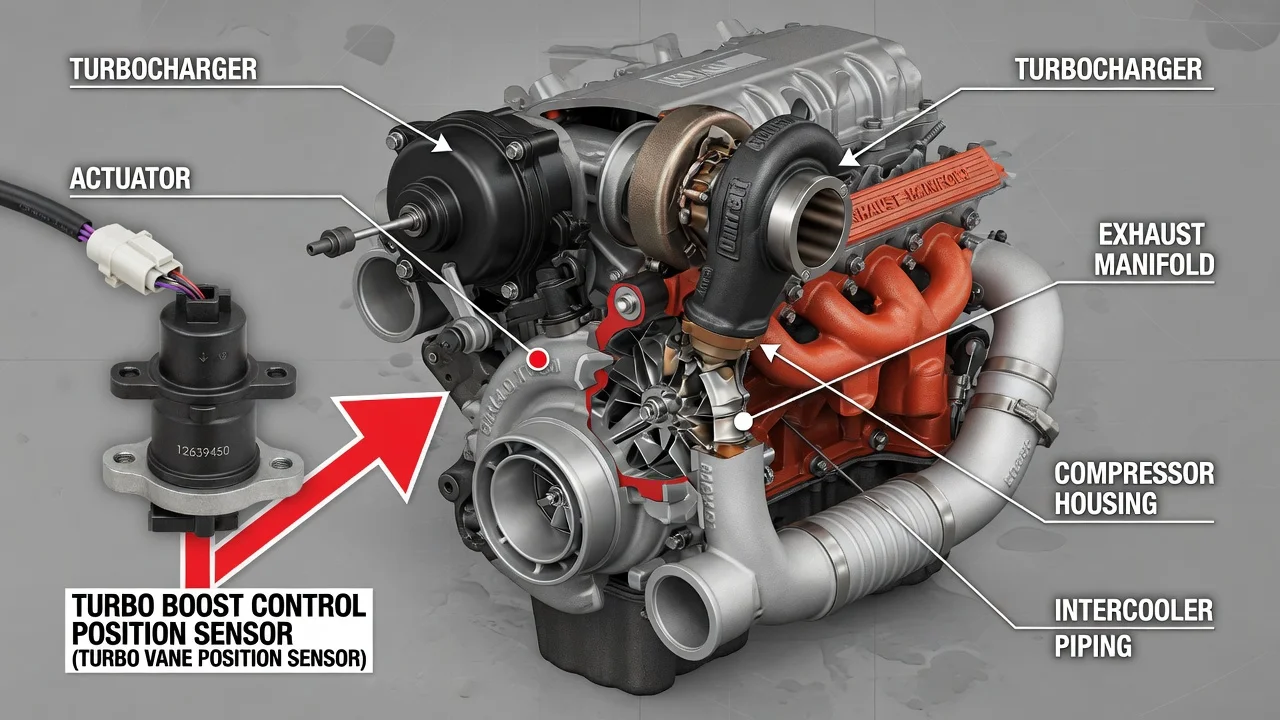
If your Duramax has set a code mentioning the turbocharger boost control position sensor, the first practical question is where that part actually lives. The short answer is that it belongs to the variable geometry turbocharger itself, not to the intake or the dashboard wiring. The exact mounting point, how it is serviced and how hard it is to reach all depend on which Duramax engine is under the hood, so it helps to know the engine code before you start pulling parts.
Where the sensor is located
On Duramax engines that use a variable geometry turbocharger, the boost control position sensor is mounted on the turbocharger, at or within the assembly that moves the turbine vanes. It is not a separate sensor out on the intake tract. GM service information and many scan tools also call it the turbo vane position sensor, which is the same function under a different name.
The turbocharger on these trucks sits deep in the engine compartment toward the firewall and is partly buried under intake, air-handling and other plumbing. In practice that means the sensor is rarely visible from a casual look under the hood, and reaching it usually requires removing surrounding components. Do not confuse it with the boost pressure or manifold pressure sensor, which reads air pressure in the intake rather than the position of the turbo vanes.
How the boost control position sensor works
A variable geometry turbocharger changes how exhaust gas strikes the turbine wheel by moving a ring of vanes. Closing the vanes speeds up exhaust flow and builds boost quickly at low engine speed; opening them reduces boost and back pressure at higher load. The engine control module commands a vane position through an actuator, then needs feedback to know whether the vanes actually moved where it asked.
That feedback is the job of the boost control position sensor. It reports vane position back to the control module, which compares the commanded and actual values. If the reading is out of range, does not change when it should, or disagrees with the command for too long, the module can set a diagnostic trouble code and may limit power to protect the engine and turbo. A fault code naming this sensor therefore does not automatically mean the sensor itself failed; it means the module saw a position signal it did not accept.
What changes the answer: engine generation and configuration
Vehicle configuration matters more than anything else here. The earliest Duramax, the LB7, used a fixed-geometry turbocharger without vane control, so it does not have a turbo boost control position sensor in this sense. Variable geometry turbos arrived with later engine generations, and the design of the vane actuator changed over time.
Middle-generation engines such as the LLY, LBZ and LMM use a vane control arrangement on the turbo with a position sensor associated with it, and on some of these applications the sensor is listed as its own service part. Later engines such as the LML and L5P use an electronic actuator on the turbocharger, and the position feedback is typically built into that actuator, so service may involve the actuator or the turbo assembly rather than a standalone sensor. Model year, truck or van platform and any aftermarket turbo changes can all alter what is actually installed, so match the part to the specific engine code and vehicle identification rather than to a general description.
Common causes behind a position sensor code
Because the sensor reports mechanical movement, problems with the vanes themselves often show up as sensor codes. Carbon and soot buildup can make vanes stick or move slowly, especially on trucks that spend a lot of time idling or doing short trips. The actuator that drives the vanes can wear or fail, and wiring or connectors near the hot turbo area can be damaged by heat, chafing or corrosion.
Operating conditions and service history give useful clues. A code that appears mainly after long idle periods, during cold starts or under heavy towing points in different directions than one that appears constantly. Previous turbo work, recent repairs near the back of the engine or a record of disconnected harnesses are worth noting before replacing anything.
What the owner can do
Start by reading the exact code and any freeze-frame data with a capable scan tool. Generic readers may only show a code number, while tools with GM-level data can display commanded versus actual vane position, which is far more useful than the code text alone. Write down the code, mileage and the conditions when it appeared.
With the engine off and cool, do a visual inspection of what you can reach: look for harness damage, melted insulation, loose or corroded connectors and oil or soot contamination around the turbo area. Check that the turbo-related connectors are fully seated. If the code is intermittent and nothing obvious is found, record whether it returns after a clear and under what conditions, since that pattern guides the next diagnostic step.
Avoid buying a sensor or actuator based only on the code name. Confirm the engine code and part fitment first, and remember that a sticking vane mechanism or wiring fault can produce the same code as a failed sensor. Following the maintenance schedule and manufacturer specifications for oil changes and air filter service supports overall turbo health, but it is not a guaranteed fix for an existing fault.
Limitations and when to get professional help
This explanation covers the general layout and logic, not the exact removal steps, torque values or wiring diagrams for your truck. Those details vary by engine generation and model year, and they belong to the vehicle-specific service information for your exact configuration. Access to the turbocharger often requires removing intake and other components, and some actuator replacements may require calibration or learn procedures with a scan tool.
If the truck is in reduced power, the code returns quickly, or diagnosis points toward the turbo vanes or actuator, a shop with diesel experience and proper scan equipment is the sensible next step. They can command the vanes, compare commanded and actual positions and decide whether the issue is the sensor, the actuator, the wiring or the turbocharger itself before any parts are replaced.