Driveshaft Balancing: When It Is Needed and How It Works
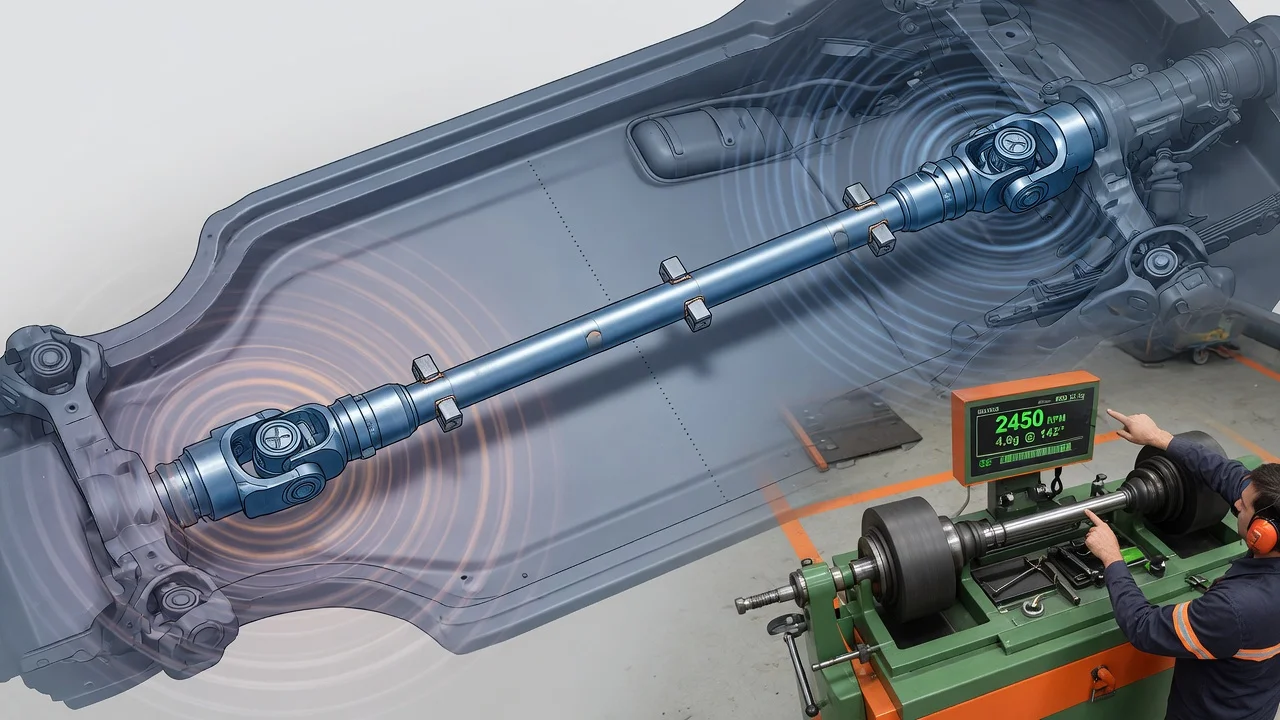
A driveshaft turns faster than the wheels whenever the axle ratio multiplies its speed, so even a small heavy spot on the tube can make a car or truck shake at highway speed. Balancing a driveshaft corrects that uneven mass, but it is not a cure for every driveline vibration. This guide explains when balancing makes sense, how the process works, and what you can check yourself before taking the vehicle to a driveline shop.
When a driveshaft needs balancing
A driveshaft needs balancing when its mass is no longer evenly spread around its axis of rotation, or after work that could have changed that distribution. Common triggers include replacing universal joints or yokes, installing a new tube, shortening or lengthening the shaft, losing a factory balance weight, or denting the tube. A rebuilt or aftermarket shaft should also be balanced before it goes in. For most vehicles, driveshaft balancing is not a routine item on the maintenance schedule; it is done in response to a cause or a symptom. The typical symptom is a vibration that rises with road speed regardless of which gear the transmission is in, often felt through the floor or seat rather than the steering wheel.
The important qualification is that balancing only fixes imbalance. It will not solve worn U-joints, a failing center support bearing, incorrect driveline angles or a shaft that is bent. A bent shaft must be straightened or replaced first, and worn joints should be replaced before balancing, because a loose joint lets the shaft move off its true center and makes any balance reading meaningless.
How driveshaft balance works
Any heavy spot on a spinning part creates a force that pulls outward as it rotates. That force grows with the square of rotational speed, which is why a shaft can feel smooth around town and then start to buzz or shudder once you reach highway speed. The force is transmitted through the joints into the transmission output, the axle pinion and eventually the body. Good driveshaft balance means the mass is distributed so these forces largely cancel out at each end of the shaft.
In a shop, the shaft is removed and mounted in a balancing machine that supports it by its own ends or yokes, much as it is supported in the vehicle. The machine spins it and measures how much imbalance exists and where, usually at each end separately. The technician then attaches small weights at the indicated positions, typically by welding steel weights to a steel tube, and uses a method suited to the material on aluminum or composite tubes. The shaft is spun again and corrected until it meets the shop's tolerance for that type of shaft. A careful shop will also check runout, or straightness, and joint condition before balancing.
What changes the answer
Vehicle configuration matters. A one-piece shaft is simpler to diagnose than a two-piece shaft with a center support bearing, where a worn bearing mount can mimic imbalance. Some shafts use constant-velocity joints instead of U-joints, which changes what wears and how the shaft is serviced. Tube material also matters: steel, aluminum and carbon fiber shafts are repaired and weighted differently, and some composite shafts are treated as replace-only parts according to manufacturer specifications. On four-wheel-drive vehicles, the front shaft may keep turning even in two-wheel drive, depending on the drivetrain design, so its condition can still affect ride quality.
Operating conditions and modifications change the picture as well. Off-road use can dent the tube or pack mud and undercoating onto one side of it, which adds uneven weight; sometimes cleaning alone removes the vibration. Lift kits and lowering kits change driveline angles, and a vibration caused by angles will not be fixed by balancing. Service history is another clue: a vibration that started right after U-joint replacement or after the shaft was removed for other work points toward the joints, a missing weight, or the shaft being reinstalled in a different rotational position on its flange. Some shafts are indexed to the pinion flange, and reversing that position can change the net balance of the assembly.
What the owner can check
Start by observing the symptom carefully. Note the speed at which the vibration begins, whether it changes with engine speed when you shift gears, and whether it differs between accelerating and coasting. A vibration that follows road speed and is felt in the floor or seat points toward the driveline or tires. One that follows engine speed regardless of road speed usually points elsewhere. A shake that appears mainly under acceleration and fades when coasting often suggests a joint or angle problem rather than simple imbalance. Rule out tire and wheel balance as well, since that is a frequent cause of speed-related vibration.
With the vehicle safely supported on stands, never just a jack, a visual inspection can reveal a lot. Look for spots where a balance weight used to be, such as bare weld marks with nothing attached. Check the tube for dents, flat spots and caked mud or undercoating. At each joint, look for rust-colored dust around the bearing caps, torn boots on CV joints, and any play when you try to twist or lift the shaft by hand against its yoke. On two-piece shafts, inspect the center support bearing rubber for cracks or separation.
If you or a shop will remove the shaft, mark its position relative to the pinion flange and the slip yoke before removal so it can go back in the same orientation. Some technicians use a hose clamp on the tube as a temporary test to see whether moving a small weight changes the vibration. That can help confirm imbalance, but it is not a substitute for proper machine balancing.
Limitations and next step
Driveline vibrations overlap with tire, wheel, axle and mount problems, and you cannot confirm actual driveshaft balance without measuring equipment. Correct driveline angles, fastener torque, indexing marks and whether a particular shaft is serviceable all depend on the exact vehicle, so use the factory service information for your model rather than general rules. If the vibration is severe, worsening, or accompanied by clunking when shifting or a squeak that changes with speed, limit driving and have it inspected promptly; a failing joint can let the shaft separate.
The most useful next step is to write down your symptom observations and recent service history, then take the vehicle to a shop that has driveline balancing equipment. Ask whether they will inspect the joints, check runout and look at driveline angles before balancing. That order of work gives the best chance of fixing the actual cause on the first visit rather than paying for a balance that does not stop the vibration.