Driveshaft Balancing Machines: What to Consider
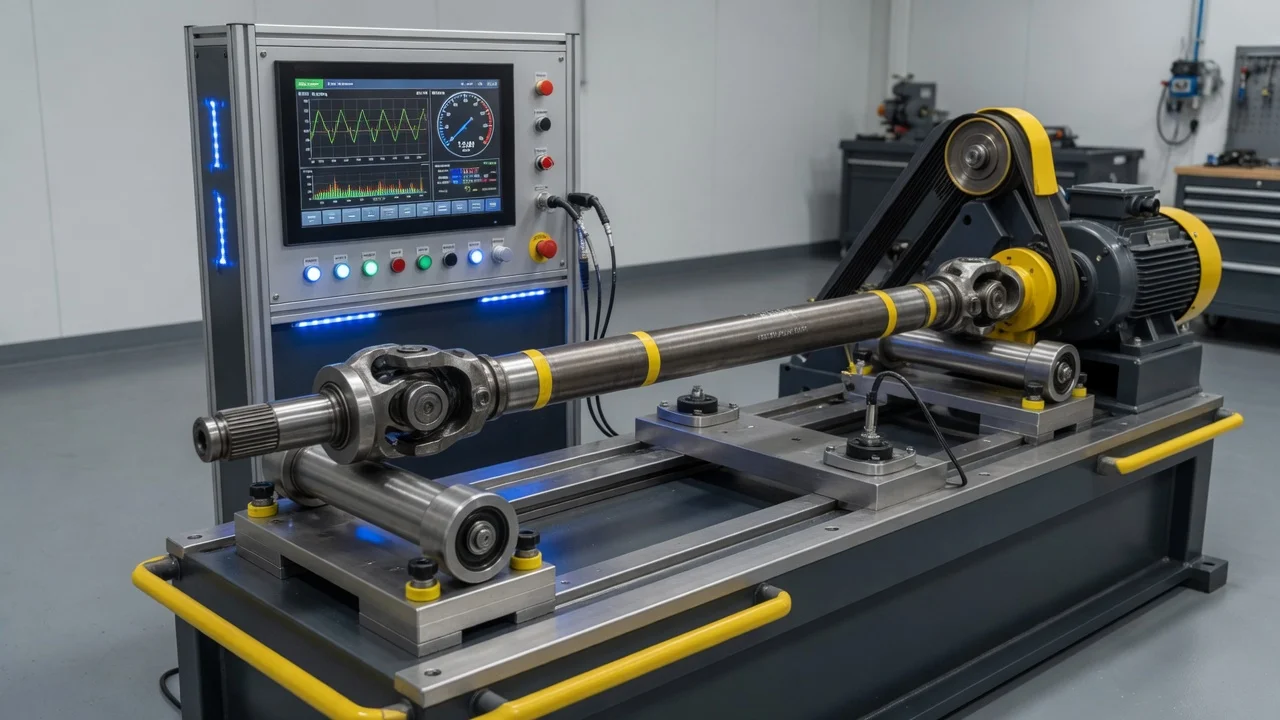
A driveshaft balancer is the machine a driveline shop uses to spin a shaft, measure where it is heavy and show where correction weight belongs. Whether you are choosing a shop to rebuild your shaft or considering a machine for your own garage, the equipment matters less than whether it can hold your specific shaft correctly and whether the operator checks straightness and joint condition first. This guide covers what to look for and what balancing cannot fix.
The Short Answer
The right driveshaft balancing machine is one that fits the shaft in question. That means its length, weight, tube diameter and end fittings, mounted on fixtures that locate the shaft the way it runs in the vehicle. Accuracy depends as much on those adapters and on careful setup as on the electronics. A capable shop balances the complete assembly with yokes and universal joints installed, measures runout before spinning it, and corrects imbalance at both ends when the shaft requires it.
If you are weighing the cost of buying a balancer against paying a driveline shop, the purchase rarely makes sense for a single vehicle. These machines are built for repeated professional use, need a range of fixtures for different yoke and flange styles, and require proper welding or bonding skills to attach weights. For a one-time repair, the more useful question is which shop has equipment suited to your shaft type and a technician who can explain what was measured and corrected.
How Driveshaft Balancing Works
The machine supports the shaft at each end, usually through adapters that copy the flanges, slip yoke or bearing surfaces it uses in the vehicle. A drive motor spins the assembly while sensors at the supports pick up the force or movement caused by uneven mass distribution. A reference sensor tracks rotation, so the software can relate the vibration signal to an angular position and show how much correction is needed and where it should go.
Most driveshafts are long enough that a single correction point is not enough. Two-plane balancing measures and corrects near each end, separating the effect of a heavy spot at the front from one at the rear. Machines are often described as hard-bearing or soft-bearing. Hard-bearing designs use rigid supports and measure force, which suits shops handling varied work, while soft-bearing designs let the supports move and measure displacement. Either type can produce good results when it is calibrated and set up correctly.
Correction is made by attaching small weights to the tube, then spinning the shaft again to confirm the reading. That final check run, not the first measurement, is what shows whether the job is finished.
What Changes the Answer
Vehicle configuration has the biggest influence. A one-piece shaft is the simplest case. A two-piece or multi-piece shaft with a center support bearing needs a machine and fixtures that can support the center section and hold the joints in correct phase, otherwise the reading will not reflect how the shaft behaves when installed. Long shafts from trucks and vans also need a machine with enough length and weight capacity, and slip yokes or constant velocity joints call for different adapters than standard flange yokes.
Tube material matters too. Steel, aluminum and composite shafts each require correction weights and an attachment method suited to that material, and the wrong method can weaken the tube or let a weight come loose. The manufacturer specifications for your shaft, where available, are the reference for acceptable repair methods. A tube that is dented, bent or out of round usually has to be straightened or replaced before balancing is meaningful.
Operating conditions shape the result as well. Lifted or lowered vehicles, changed driveline angles, heavy towing and sustained highway speeds all affect how a shaft behaves. A perfectly balanced shaft can still vibrate if the joint angles are wrong, so a balancing machine addresses only part of a driveline vibration problem.
Questions to Ask a Driveline Shop
Before leaving a shaft with a shop, ask whether their machine and adapters fit your shaft type, including any center bearing or constant velocity joints. Ask whether they check runout before balancing and what they do if the tube is not straight. Find out whether they install new universal joints before the balance run, since replacing joints afterward can change the result. It is also reasonable to ask whether they record readings before and after correction, which gives you evidence of the work beyond a sticker on the tube.
What the Owner Can Do
Start with careful observation. Note when the vibration appears, whether it follows road speed rather than engine speed, and whether it changes under acceleration, cruising or coasting. Check your service history for recent work such as tire replacement, suspension changes, joint replacement or a shaft that was removed and reinstalled. A visual inspection can reveal missing balance weights, dents, mud or undercoating stuck to the tube, play in the universal joints or a worn center support bearing.
If you remove the shaft yourself, mark its orientation relative to the pinion flange and mark the halves of a multi-piece shaft before separating anything, so it can go back indexed the same way. Keep the original fasteners together and follow the vehicle service information for removal, installation and torque values. Some universal joints have grease fittings, so check whether your maintenance schedule calls for lubrication. After reinstallation, test drive under the same conditions that produced the original vibration to confirm the result.
Limitations and Next Step
Driveline vibration has many possible sources, including tires and wheels, axle bearings, engine and transmission mounts and incorrect joint angles. Balancing corrects only the mass distribution of the shaft, and it does not repair worn joints, a failing center bearing or a damaged tube. There is no universal interval for balancing a driveshaft; it is typically done after a repair, joint replacement or damage, or when inspection points to the shaft as the cause.
If vibration remains after balancing, have the driveline angles measured and the rest of the drivetrain inspected by a qualified technician, using information specific to your vehicle. All-wheel-drive and four-wheel-drive systems add more shafts and joints, which makes professional diagnosis more valuable. A clunk, sudden heavy vibration or visible damage to the shaft is a reason to stop driving and have the vehicle inspected, because a driveshaft failure at speed can be dangerous.