Double Cardan U-Joints: How the Assembly Works and What Can Fail
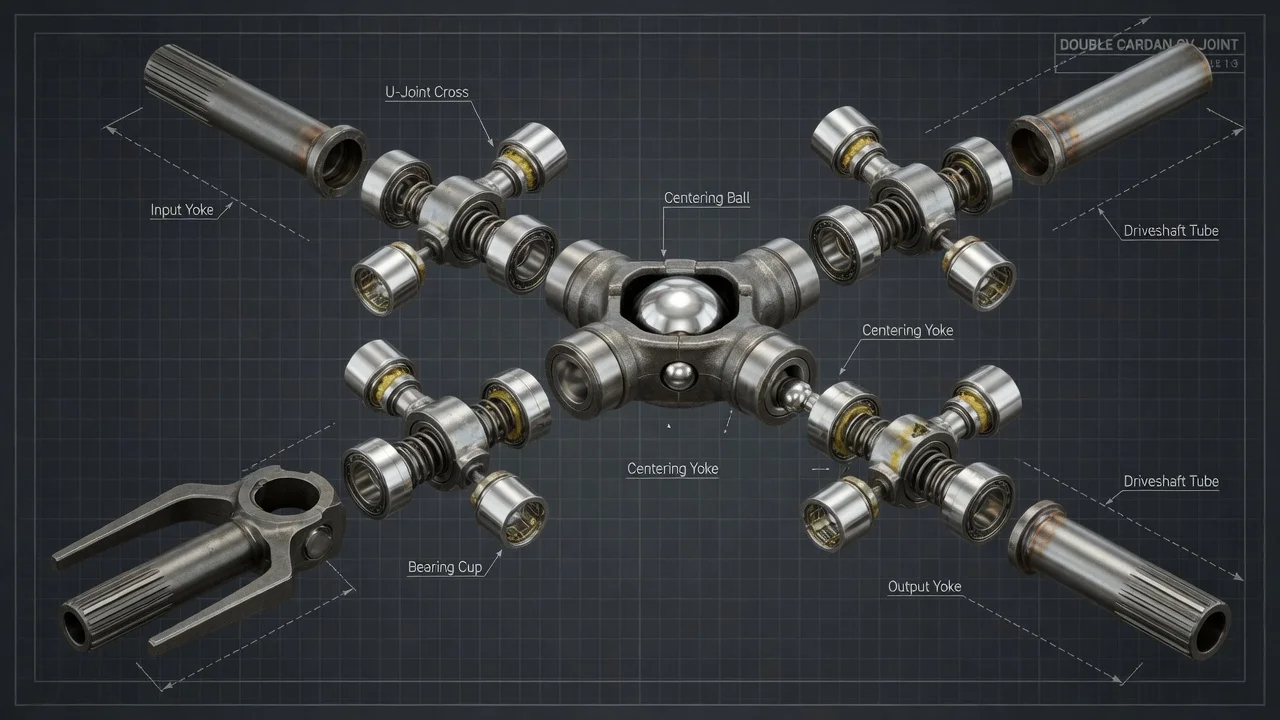
A double cardan U-joint is the compact, two-cross assembly found on many four-wheel-drive driveshafts where the shaft runs at a steep angle. It looks like two ordinary universal joints bolted together, but the parts between them do real work. This guide explains how the assembly keeps the driveshaft turning smoothly, which components wear, and which signs point to trouble. It does not assume that a single service interval applies to every vehicle.
The Short Answer
A double cardan joint links two single U-joints through a center coupling yoke and a centering device, usually a ball and socket. It splits the total driveshaft angle evenly between the two crosses. This cancels most of the speed fluctuation that a single U-joint creates at an angle, so the shaft delivers nearly constant velocity. The parts that fail are predictable: the needle bearings in either cross, the centering ball and its socket or spring, and the seals that hold grease in. Common symptoms include vibration that changes with road speed, a clunk when the drivetrain takes up load, squeaking at low speed, and rust-colored dust near the bearing caps.
The details depend on the vehicle configuration. Several things vary by manufacturer and by modifications such as a lift: whether the joint is greasable, how it is set up relative to the axle pinion, and whether it can be rebuilt or must be replaced with the shaft. Use the general picture here as a guide for inspection and for discussions with a shop. Confirm part numbers and procedures against the manufacturer specifications.
How a Double Cardan Joint Works
A single U-joint running at an angle does not turn its output at a steady speed. Even when the input spins evenly, the output speeds up and slows down twice per revolution, and the effect grows as the operating angle increases. In a conventional driveshaft with a joint at each end, the shaft is arranged so that the fluctuations from the two joints cancel. The cancellation breaks down when the angle at one end becomes too steep, which often happens at the transfer case on short, high-angle shafts. Vibration follows.
The double cardan joint solves this problem in one place. Two crosses sit back to back inside a center coupling yoke, and each takes roughly half of the total angle. The yoke itself phases the two joints, and they run at matching angles, so the second joint offsets the fluctuation from the first. The output turns at a nearly constant speed, even though the overall angle is larger than a single joint could handle smoothly.
The centering device keeps those two angles equal. On many designs, a ball on one yoke rides in a spring-loaded socket in the other. This holds the joint halves aligned as the suspension moves and the shaft changes length and angle. If the ball or socket wears, the angles stop splitting evenly, the cancellation weakens, and vibration returns. A worn centering ball can therefore cause shake even when both crosses still feel tight.
What Changes the Answer for Your Vehicle
Driveshaft geometry matters most. A shaft with a double cardan at the transfer case and a single U-joint at the axle is usually set up differently from a shaft with single joints at both ends. With the double cardan design, the axle pinion is commonly aimed close to the line of the shaft so the rear joint runs at a small angle. Lift kits, worn suspension bushings and incorrect pinion shimming can all change these angles and cause vibration even when the joints are healthy. The reference is the angle specified for your vehicle, not a generic number.
Construction also varies. Some factory joints are sealed and have no grease fittings. Others have fittings on the crosses and the centering ball, and some of these need a needle-point adapter to reach. Some assemblies accept rebuild kits for the crosses and centering parts, while others can only be serviced by replacing the driveshaft or through a driveline shop. Double cardan joints also appear in some steering shafts, where wear shows up as looseness, notchiness or clunking in the steering rather than as driveline vibration.
Operating conditions affect how fast wear develops. Water crossings, mud, road salt, heavy towing and sustained articulation at high angles all stress the seals and the lubrication. Service history matters too: a joint greased on schedule ages differently from one that was never serviced. Check the maintenance schedule for your vehicle. Where lubrication intervals exist, the manufacturer sets them, and they often differ for severe service.
What You Can Check and Do
Start with what you notice while driving. Note the speed range where vibration appears, whether it changes between acceleration and coasting, and whether a clunk occurs when shifting into gear or applying throttle. A squeak at parking-lot speeds that follows wheel rotation often points to a dry bearing. These observations help a technician separate joint wear from tire balance, wheel bearing or driveline angle problems.
For a hands-on inspection, park on level ground, set the parking brake, chock the wheels and let the exhaust cool. If you need to rotate the shaft by hand, do it only with the vehicle secured against rolling, and follow the safety guidance for your vehicle. Grasp the shaft near the joint and try to twist and lift it. Any clunk, click or movement at the bearing caps indicates wear. Move the joint through its angle and feel for roughness or binding. Check the centering area for looseness. Look for torn seals, missing or broken fittings, flung grease, and reddish-brown dust that suggests a bearing running dry.
If the joint has fittings, grease it with the lubricant the manufacturer specifies. Pump slowly until fresh grease appears at the seals, and include the centering ball fitting if there is one. If you find wear, choose between a rebuild kit, a replacement driveshaft or a driveline shop. Before removing the shaft, mark the yokes and flanges so it goes back in the same orientation, because altering phasing or balance can create new vibration. A rebuilt shaft may also need professional balancing.
Limitations and When to Get Help
A visual check cannot measure everything. Slight centering ball wear, small angle errors and balance problems are hard to judge without proper tools, and vibration can come from several sources at once. Driveshafts spin fast and carry high torque, so a failed joint can cause loss of drive or damage brake lines, the floor or the transfer case. If you find noticeable play, hear a new clunk, or feel vibration that is getting worse, limit driving and have the shaft inspected promptly.
Before you visit a shop, gather your exact vehicle configuration, including the drivetrain, any lift or suspension changes, and tire size, along with the driveline service history. A driveline specialist can measure working angles, inspect the centering parts, check runout and balance, and advise whether rebuilding or replacing the shaft makes sense. For torque values, grease points and angle settings, rely on the manufacturer specifications and factory service information rather than generic figures.