Does Engine Oil Expire, Freeze, or Catch Fire? Shelf Life and Storage
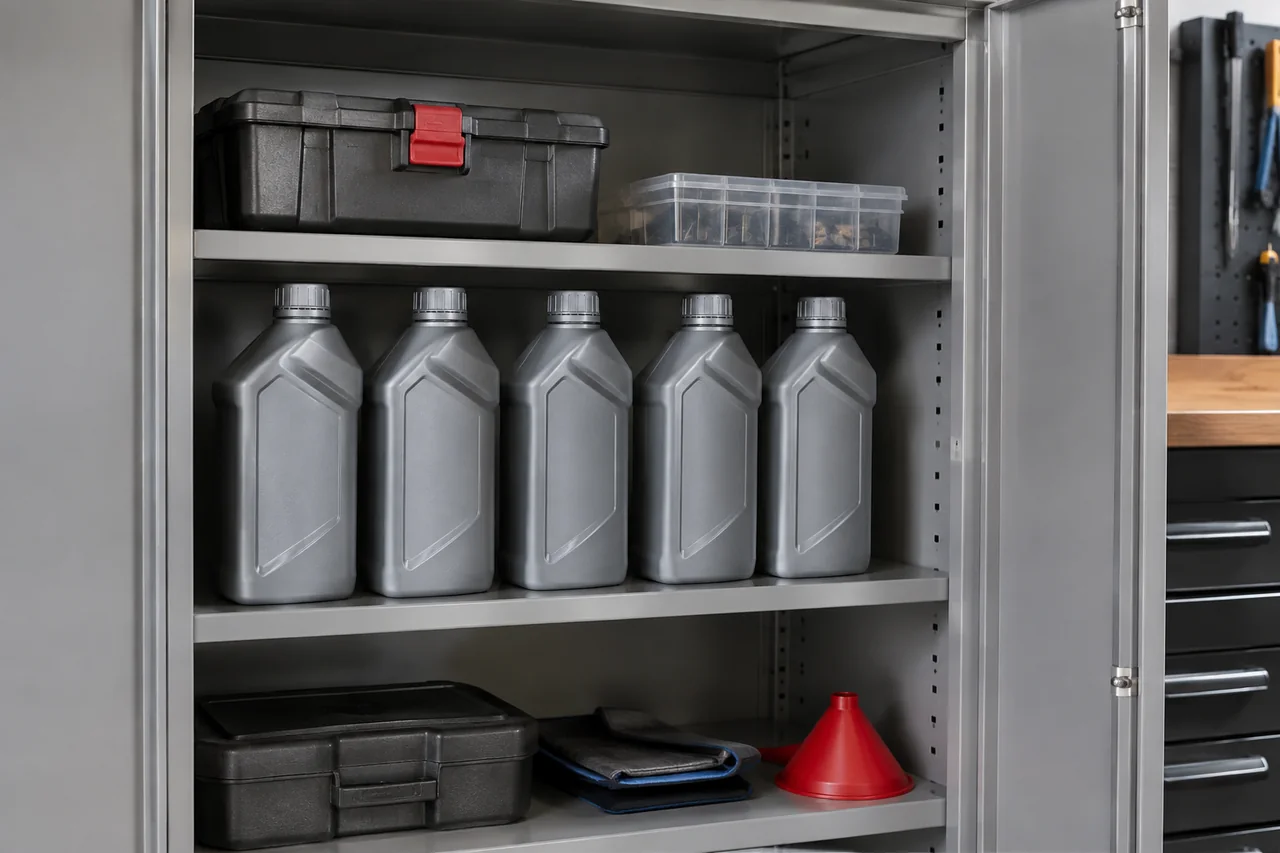
Can engine oil expire? It can slowly go bad, and a bottle that looks fine on a garage shelf may have lost some of its protective qualities. Engine oil shelf life depends on how the oil was stored. Cold temperatures change how well it flows, and it can burn under the right conditions. Knowing these facts helps you decide whether a leftover quart still belongs in your car or should go to recycling.
Can Engine Oil Expire or Go Bad?
Does engine oil expire in the sense of a hard cutoff date? Not exactly. Motor oil is a blend of base oils and additives, including detergents, dispersants, anti-wear compounds and antioxidants, and additive stability varies from one formulation to another. Over time, some additives can settle or react, and the base oil can slowly oxidize. Because formulations and storage conditions differ so widely, no single expiration period applies to every product. The honest answer to whether engine oil goes bad is yes, it can, but how fast depends on the oil and its history.
Many containers carry a production date or batch code rather than a plain expiration date. Those codes are not the same thing as a manufacturer's stated shelf life. If you can't interpret an unfamiliar code, ask the oil maker what it means. Even then, bottle age alone can't prove the oil is still suitable, because a newer bottle stored badly may be worse than an older one kept well. Oil that is within its shelf life is only useful if it matches the viscosity and specifications your vehicle manufacturer requires.
Shelf Life of Sealed and Opened Engine Oil
A sealed oil container keeps out most humidity, dust and air. That is why unopened oil generally holds its quality longer than opened engine oil. The seal doesn't make storage life indefinite, however. Repeated heating and cooling, long exposure to temperature extremes and the slow chemistry of the oil itself still play a role. Shelf life also varies by brand and product line, so the most reliable figure is the one the manufacturer publishes for that product, not a rule of thumb that supposedly covers all oils.
Once the cap comes off, every pour and every reopening lets in air carrying humidity, along with any grit clinging to a funnel or the bottle's neck. Moisture contamination is a particular concern because water can interfere with additives and promote corrosion. Suitability is hard to judge when a bottle has an unknown storage history or a damaged seal. The same is true when the label is too faded to show the grade and specification. In those cases, buying fresh oil is usually wiser than gambling with an engine.
How to Store Oil and Assess an Old Bottle
Good storage helps oil last as long as the product allows. Keep bottles upright in their original containers with the caps tightly closed. Store them somewhere dry, out of direct sunlight, and away from freezing garages and hot attics. When you open one, write the date on it in marker, but keep the product label and batch information readable. Those details identify the grade and help the manufacturer answer questions later. Don't pour leftover oil into unlabeled jugs, which invites mix-ups and contamination.
Don't use oil that shows contamination, cloudiness, separation that doesn't go away, or unusual sediment or deposits. The same goes for oil in a cracked or swollen container. Ask the manufacturer for guidance instead. Normal-looking oil isn't proof of good oil, though. Shaking a suspect bottle until it looks uniform doesn't show that the additives still work as intended. If the oil is unusable, take it in its container to a local used-oil collection site or recycling center. Never pour it into drains, storm sewers or onto the ground.
Why Oil Also Deteriorates Inside an Engine
Shelf life stops mattering once oil goes into the engine, because driving ages it far faster than storage does. Heat speeds up oxidation. Moisture from condensation, unburned fuel and combustion byproducts that slip past the piston rings dilute the oil, make it more acidic and use up its additives. Frequent short trips are hard on oil because the engine may not get warm enough to drive off water and fuel. A vehicle that sits for long periods can also see oil condition change, though no single rate of deterioration applies to every engine.
For that reason, the date on a bottle has no bearing on your oil-change interval. Follow the time and mileage guidance in your owner's manual. If the vehicle has an oil-life monitor, follow the manufacturer's instructions for it, including any time limit that applies even when mileage is low. Oil color is a poor guide to how much service life is left. Oils with detergents often darken quickly while still doing their job, and clean-looking oil can still be overdue for a change.
Can Engine Oil Freeze in Cold Weather?
Can engine oil freeze the way water does? Not in a simple sense. As temperatures fall, oil viscosity rises steadily. Eventually the oil becomes too thick to flow properly through the pickup, the oil pump and narrow passages. There is no single freezing temperature for all engine oil, because base oils and additives differ. Pour point is the lowest temperature at which a sample still flows in a laboratory test. It describes how the oil flows, not a guaranteed safe starting temperature for your engine.
The W in a grade such as 5W-30 stands for winter. It reflects standardized cold cranking and pumping tests, not a literal freezing point. Choose a viscosity your vehicle manufacturer allows for the temperatures you expect. Avoid makeshift fixes such as open flames or heat guns under the vehicle, and don't use unapproved additives to thin the oil. If the engine cranks abnormally in severe cold, or an oil-pressure warning stays on after it starts, stop trying and get qualified help before running it any further.
Can Engine Oil Catch Fire?
Is engine oil flammable? It can burn when heated enough, but the formal classification depends on the product and the standard being applied. Some oils are classed as combustible liquids rather than flammable liquids, so check the label. Flash point is the temperature at which vapors above the oil can ignite when exposed to a flame or spark under specified test conditions. That is different from spontaneous ignition, where a substance catches fire without any outside flame or spark, at a much higher temperature.
Real-world fire risk usually comes from leaks. Oil dripping onto exhaust manifolds, turbochargers or other very hot parts can smoke or ignite. Oil sprayed as a fine mist catches fire far more easily than a puddle does. Store bottles away from pilot lights, grinders and other ignition sources, and check the label or safety data sheet for handling guidance. If you see smoke or suspect oil is reaching hot parts while driving, stop safely and have the vehicle inspected. If flames appear, move away and call emergency services.