Dodge Ram 1500 Transfer Case Linkage: Identification and Diagram
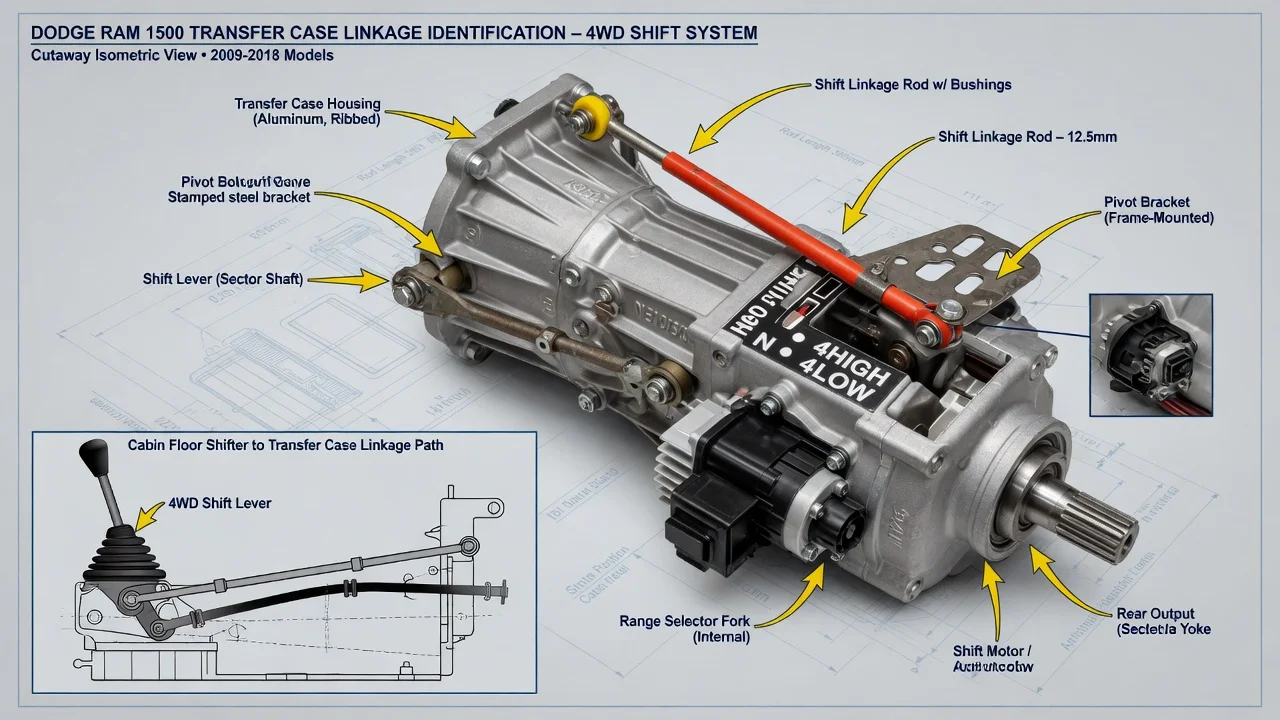
On a 2004 Dodge Ram 1500 4x4 with a floor-mounted shifter, the transfer case linkage is the short mechanical path between the lever in the cab and the range lever on the transfer case. When it wears or slips out of adjustment, the truck may refuse to engage four-wheel drive, show the wrong indicator, or jump out of a range. This guide explains how to identify the parts, how they connect, and what an owner can reasonably check.
The short answer
On a manual-shift Ram 1500 of this generation, the linkage is made up of a few basic parts: the shift lever and its pivot bracket, a metal shift rod, an adjustable swivel or trunnion where the rod is clamped, and a bushing that connects the rod to the range lever on the transfer case. To find it, follow the shifter down through the floor and trace the rod rearward to the lever on the side of the case. Most linkage complaints come from that connection point, where a worn or missing bushing lets the rod move without fully moving the case lever.
Before buying parts, confirm the exact vehicle configuration. The 2002 through 2005 Ram 1500 trucks share the same basic generation, so the layout is broadly similar across those years, but the specific transfer case and linkage parts depend on how the truck was built. The identification tag on the transfer case and the VIN give a parts counter or dealer what they need to match the correct components.
How the linkage works
When you move the floor lever, it pivots on its bracket and pushes or pulls the shift rod. The rod rotates the range lever on the transfer case, which moves the internal shift mechanism between positions such as two-wheel drive, four-wheel drive high, neutral and four-wheel drive low. Each position has a detent inside the case. The linkage is only correct when a fully seated lever in the cab corresponds to a fully seated detent at the case. If the rod is too long, too short or loose at a joint, the cab lever can feel like it is in gear while the case is partly between positions.
Reading the layout as a diagram
If you picture the linkage as a simple diagram, it runs in this order: shift knob and lever in the cab, boot and floor opening, pivot bracket, upper end of the shift rod, adjustment swivel with its clamp bolt, the rod itself, the bushing at the lower end, and finally the range lever splined or bolted to the transfer case. A position switch on the case usually reports the selected range to the four-wheel-drive indicator. Do not assume a particular gate order; the shift pattern is normally marked on the knob or boot, and that marking is the reference for your truck.
The bushing deserves special attention. It is a small part that absorbs vibration and holds the rod end snugly in the range lever. Once it hardens, cracks or falls out, the rod can rattle, the lever can feel vague, and the case may not reach a full detent even though nothing else is broken.
What changes the answer
The biggest difference is how the truck selects four-wheel drive. If your Ram uses a dash-mounted switch instead of a floor lever, there is no mechanical shift rod to adjust, and shifting problems point to the electrical side instead. Among lever-shift trucks, the transfer case model, whether it offers a part-time or full-time mode, and the cab and drivetrain combination can all affect which linkage parts fit. A rod or bracket taken from a different configuration may look right and still fail to line up the detents.
Operating conditions and service history matter too. Mud, road salt and rust can seize the swivel or pivot, a lift kit or worn body or transmission mounts can change the geometry between cab and case, and earlier repairs may have left a mismatched bushing or an improvised fastener. A truck that rarely uses four-wheel drive can also develop stiffness simply from sitting in one position for a long time.
What the owner can do
Start with a visual inspection. Park on level ground, set the parking brake, chock the wheels and shut the engine off. If you need to go underneath, support the truck securely on stands rather than a jack alone. Have a helper move the shifter slowly through each position while you watch the lower end of the rod. Look for movement at the bushing before the case lever starts to turn, a bent rod, a loose clamp bolt at the swivel, missing retaining clips and heavy corrosion at the pivots. Note whether the case lever actually reaches each detent.
Use the shift procedure in the owner's manual, especially for four-wheel drive low, which typically requires the truck to be stopped or rolling very slowly with the transmission in neutral. Avoid forcing the lever. In part-time four-wheel drive on dry pavement, driveline binding can make the lever hard to move; driving straight for a short distance or briefly reversing on a loose surface often releases it. If the bushing is worn, replacing it is a common and inexpensive repair.
If the linkage needs adjustment, follow the factory service procedure, which specifies the position to place the cab lever and case lever in before tightening the swivel. Guessing the setting can leave the case partly engaged, which risks gear damage. Record any linkage work in the truck's service history so the next technician knows what was changed.
Limitations and next step
This guide describes the general layout and does not replace manufacturer specifications such as adjustment positions, fastener torque or part numbers for your exact build. If the linkage moves cleanly and the case lever reaches every detent but the truck still will not drive all four wheels, the cause is likely elsewhere, such as the position switch, front driveline engagement, fluid condition or internal transfer case wear. At that point, an inspection by a technician with the service information for your VIN is the sensible next step.