Diesel Fuel Contamination Insurance Claims: Documentation and Coverage Questions
What this question actually covers
Whether diesel fuel contamination is an insured loss depends on the policy wording, the cause of the contamination, and what failed as a result. There is no single industry rule that every diesel claim is paid or denied. Comprehensive coverage on a personal auto policy sometimes treats a sudden contamination event as a covered peril. Many policies still exclude mechanical breakdown, gradual deterioration, and damage from using the wrong fuel or poor-quality fuel. The fuel in the tank is often not reimbursed even when related parts are. Commercial auto, motor-truck cargo, equipment-breakdown, and dealer or fleet policies can treat the same event differently from a personal auto policy.
Contamination in this context usually means water, gasoline or other non-diesel product, sediment, microbial growth, or off-spec biodiesel blending that reaches the tank, filters, high-pressure pump, injectors, or aftertreatment system. The claim is about the resulting mechanical damage and the cost to flush, repair, or replace those parts, not about the fuel as a commodity. Who sold the fuel, whether the vehicle was misfuelled by the driver, and whether damage was sudden or developed over time are the facts that most often change the answer.
Coverage questions to settle first
Ask the insurer to identify the coverage part being considered, the deductible, and any exclusion that might apply before you authorize major work. Personal auto comprehensive coverage, if present, is the usual place a sudden contamination or misfuel event is reviewed. Collision coverage generally does not apply unless the contamination is tied to a collision. Mechanical-breakdown or vehicle-service-contract coverage, if you have it, is a separate contract with its own definitions and is not the same as auto physical-damage insurance.
Cause of loss: a one-time bad fill, misfuelling at the pump, a supplier or station error, water ingress after flooding, or a long-running tank or filter problem. Sudden accidental contamination is more likely to be treated as a claim than wear, neglect, or fuel left sitting in a tank. What is damaged: tank, pickup, filters, lift pump, high-pressure pump, injectors, lines, and in some diesels the diesel particulate filter or other aftertreatment parts. Insurers often want a line-item distinction between contaminated fuel removal and failed components. Who introduced the fuel: the vehicle operator, a fuel station, a bulk supplier, or an unknown source. Operator error and station error are not treated the same way, and the insurer may later pursue the seller even if it first pays you. Policy exclusions: language that bars damage from contaminants, wrong fuel, inadequate maintenance, or mechanical failure. The exact phrase in your declarations and exclusions controls; a verbal summary from a call center does not. Deductible and limits: comprehensive deductibles apply if the loss is accepted as comprehensive. Actual cash value, betterment, and OEM-versus-aftermarket parts rules can reduce the check below the repair estimate. Other contracts: new-vehicle warranty, extended service contract, and credit-card or fuel-card purchase protections may respond instead of, or in addition to, the auto policy. Those programs have their own notice windows and proof rules.
A material qualification is jurisdiction and policy form. State-required auto forms, commercial endorsements, and insurer-specific contamination or misfuelling endorsements are not interchangeable. Coverage that applied on one vehicle or one prior claim does not establish coverage on another. Flood-related water in the tank can also implicate flood definitions and waiting periods that a ordinary bad-fill claim does not.
Documentation insurers commonly request
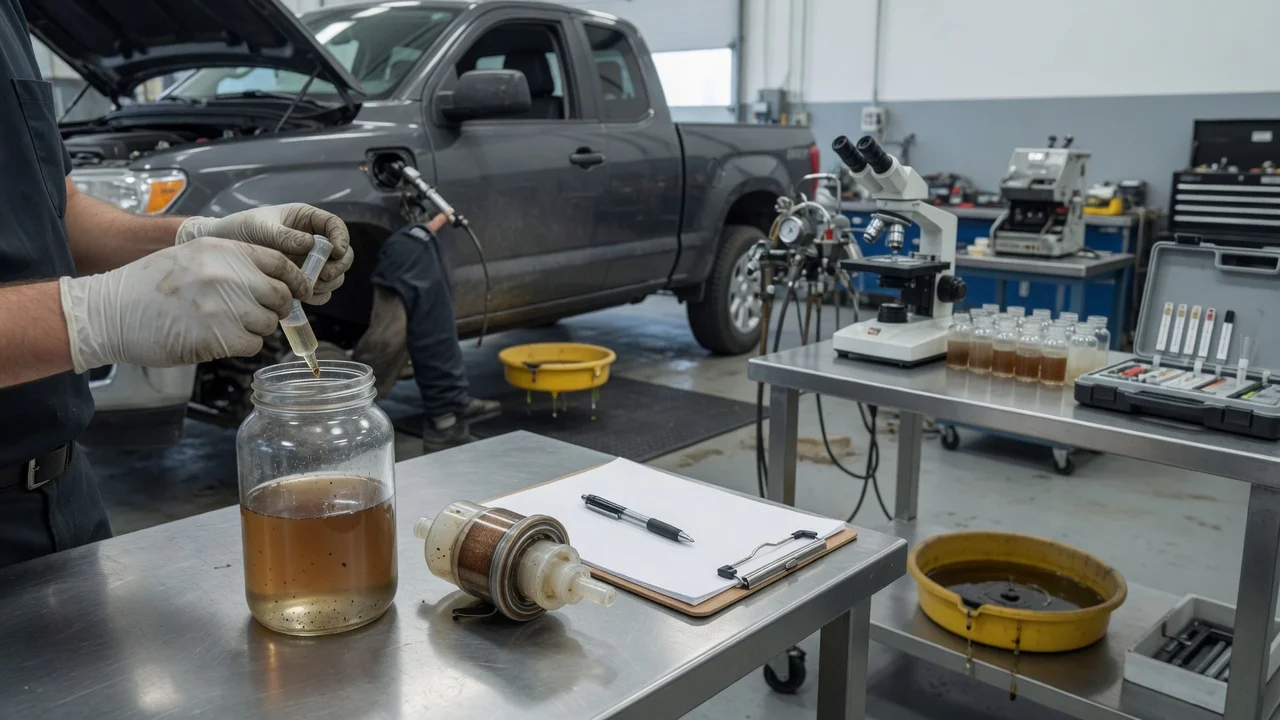
A contamination claim is decided on paper as much as on the vehicle. Incomplete proof of where the fuel came from, what the shop found, and what was replaced is a frequent reason a file stalls or is closed without payment. Keep the contaminated fuel and failed filters if the shop can store them safely; photographs and a written diagnosis are the minimum if samples cannot be retained.
Policy identifiers: named insured, vehicle year, make, model, VIN, mileage, and the coverage part you believe applies. Event narrative: date, time, location of the fill or discovery, how the problem showed up (hard start, misfire, stall, warning lamp, loss of power), and whether the tank was filled by you, another driver, or a commercial pump. Fuel purchase proof: receipt or card statement showing station, product grade (diesel, not gasoline), gallons, and time. If the fill was bulk or on-site, keep the delivery ticket and supplier name. Station or supplier details: business name, pump number if known, and any report you filed with the seller. Do not rely on a verbal admission; get a written incident note if the station will provide one. Shop diagnosis: written findings that the fuel or a fuel-system component is contaminated or damaged, the test method used, and a cause statement that separates contamination from unrelated wear. Repair estimate and invoices: drain and flush, filter replacement, pump and injector work, tank cleaning or replacement, programming or coding if required, and towing. Itemize parts and labor. Photographs: filler neck, pump handle if relevant, fuel in a sample container, clogged filters, and damaged components. Date-stamp or keep original file metadata if you can. Fuel or filter lab analysis, if obtained: a laboratory report can support that the product was gasoline, water, sediment, or off-spec diesel. Absence of a lab test does not automatically defeat a claim, but it leaves more room for dispute about cause. Prior service records: recent filter changes, tank work, and any earlier fuel complaints. These help show whether the condition was sudden. Other insurance or warranty notices: copies of any claim opened with a warranty administrator, card issuer, or the fuel seller’s insurer, so duplicate-payment issues can be sorted later.
Public-adjuster, attorney, or shop-assignment paperwork is a later step if the claim is disputed. For the first notice of loss, the items above are the ones that let an adjuster open a file without immediately requesting a recorded statement solely because the facts are missing.
How claims are typically handled in practice
After first notice, the insurer will usually confirm coverage, apply the deductible if the loss is accepted, and either inspect the vehicle or rely on the repairing shop’s photos and estimate. An independent appraiser or origin-and-cause review is more likely when the repair is large, injectors and a high-pressure pump are involved, or the fuel source is contested. Payment, if made, is commonly actual cash value of the damaged parts and necessary labor, less deductible and any betterment the policy allows.
If the insurer believes a station or supplier caused the loss, it may still pay you under your policy and then seek recovery from that third party. That subrogation process does not require you to sue the station yourself, but you may be asked to preserve evidence and to avoid signing a release that would cut off the insurer’s rights. If your policy excludes the loss, a direct claim against the seller, a state weights-and-measures complaint, or a small-claims action is a separate path; those remedies are not insurance coverage and their success is fact-specific.
Misfuelling by the driver (gasoline into a diesel tank, or the reverse) is the scenario most likely to be denied under a mechanical-breakdown or wrong-fuel exclusion, and the scenario some comprehensive forms still accept as accidental damage. Water from a flooded road or a submerged tank is often reviewed under comprehensive or flood language rather than as a fuel-quality dispute. Microbial growth or sludge after long storage is more often treated as maintenance. Those patterns are editorial observations about how files are commonly sorted; they are not a substitute for the form you hold.
Gaps you should not fill with assumptions
No uniform payment rate, average repair cost, or guaranteed covered-parts list is stated here because those figures vary by engine family, model year, injector design, and local labor rates, and they were not supplied as documented specifications. Whether a particular insurer, warranty, or fuel-card program will pay a given diesel claim cannot be inferred from another company’s practice. Aftertreatment damage (diesel particulate filter, oxidation catalyst, NOx system) is especially model- and calibration-dependent; coverage for those parts should be confirmed in writing on the estimate, not assumed from a filter or pump approval.
The supported next action is to read the physical-damage and exclusion pages of the policy in force on the date of loss, give prompt notice, preserve fuel and filters, and obtain a written diagnosis that states cause. Until the insurer or another contract administrator accepts or denies the loss in writing, treat coverage as unsettled rather than as a promised repair authorization.