Diagnose Oil on Engine Spark Plugs
The short answer
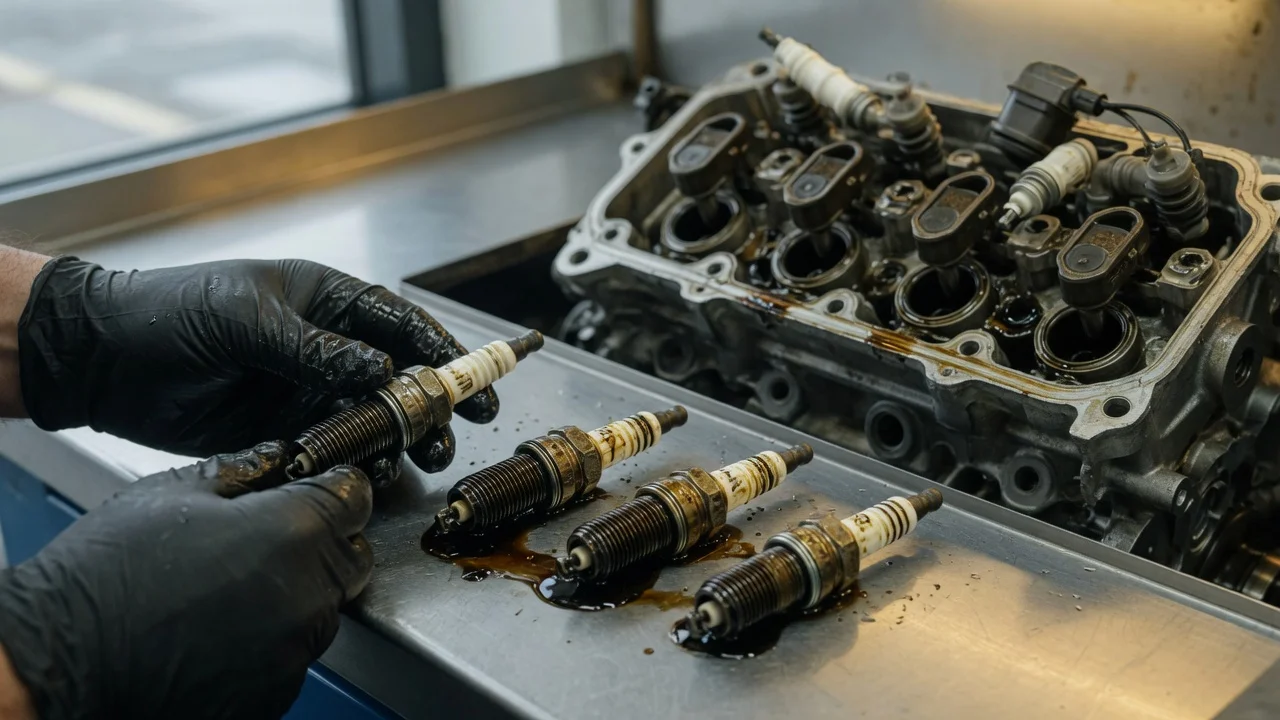
Oil on a spark plug is not one problem. It is two, depending on where the oil sits. Oil on the outside of the plug, around the hex, the ceramic insulator or in the spark plug well, usually comes from an external seal leaking from above, such as a valve cover gasket or a spark plug tube seal. Oil on the firing end, the tip that sits inside the combustion chamber, means oil is reaching the cylinder and being burned. That points to internal wear or a ventilation or turbocharger fault.
The first job is to decide which of these you have. External leaks are typically less serious and cheaper to fix, although they can still cause misfires. Oil fouling at the firing end usually calls for further testing to find the source before you replace parts.
This guide covers conventional spark-ignition petrol engines in general terms. No model-specific data was supplied for it. Seal designs, common failure points, plug specifications and inspection procedures vary by manufacturer, engine family, model year and market. Confirm details in the service information for your engine before you act on any general guidance here.
Step one: identify where the oil is
Remove the ignition coil or plug lead and look into the spark plug well before you remove the plug. Then remove the plug and examine it along its length. Where the oil appears separates the two broad groups of causes.
Location of oil | What it usually indicates | Typical next check; Pooled in the spark plug well or on the coil boot, with the plug exterior wet | Oil entering the well from above, often a spark plug tube seal or valve cover gasket | Inspect the valve cover area and the tube seals, and check coil boots for oil damage; Wet, black, oily deposits on the firing end (electrodes and insulator nose) | Oil entering the combustion chamber and not fully burning | Compare all cylinders, then check the PCV system, oil level and compression; Oily firing end on one cylinder only | A fault localised to that cylinder, such as valve stem seals, valve guides or rings on that cylinder | Compression test, followed by a leak-down test if needed; Oily firing ends on several or all cylinders | A cause common to the whole engine, such as a PCV fault, overfilled crankcase, turbocharger seal leak or general wear | Check oil level and the PCV system, inspect intake tract for oil on turbo engines, and test compression across all cylinders
Light, dry deposits are different from a wet, oily coating. Plug appearance can suggest a cause but cannot confirm one. Treat it as evidence that tells you what to test next.
Oil in the spark plug well: external leaks
On many overhead-cam engines the spark plugs sit in tubes or wells that pass through the valve cover. Seals around these tubes keep engine oil out of the wells. When the seals harden or the valve cover gasket deteriorates, oil can seep into the wells and collect around the plug and coil.
Oil in the well does not usually reach the combustion chamber, because the plug's own seat seals the cylinder. However, it can soften or degrade the rubber coil boot or plug lead. This can let the spark track to ground instead of jumping the plug gap, which causes a misfire. Oil pooling near hot engine parts is also a potential fire risk.
Check whether the oil is in one well or several. Several wells usually point toward the valve cover gasket or tube seals generally. Look for wet oil on the outside of the valve cover and around its edges, which supports a gasket leak. Inspect coil boots or plug leads for swelling, softening or carbon tracking (thin dark lines where the spark has arced across the surface). Check that the oil filler cap is fitted and sealing, and that the oil was not spilled during a recent top-up or service. In engines where the tube seals are combined with the valve cover gasket, a gasket replacement typically addresses both. Confirm the parts and procedure for your engine.
After repairing the leak, clean the wells and dry the plug and coil. Replace any coil boots or leads that show oil damage or tracking, because a damaged boot can keep causing misfires after the leak is fixed.
Oil on the firing end: oil entering the cylinder
An oil-fouled firing end means oil is getting past the parts that normally keep it out of the combustion chamber. The main candidates are below. The checks that follow help you narrow them down.
Valve stem seals or valve guides: worn seals or guides let oil run down the valve stem into the cylinder, often most noticeably after the engine has been sitting or during deceleration. Piston rings or cylinder wear: worn, stuck or broken rings let oil from the crankcase pass up into the combustion chamber and allow combustion gases to escape down. Positive crankcase ventilation (PCV) system fault: the PCV system recirculates crankcase gases into the intake. A stuck valve or blocked hose can raise crankcase pressure and push oil mist or liquid oil into the intake, affecting several cylinders. Turbocharger oil seals, on turbocharged engines only: a leaking turbo seal can send oil into the intake tract and from there into the cylinders. Overfilled crankcase: too much oil can increase oil carried into the PCV system and, in some cases, past the rings. Head gasket failure: less commonly a cause of oil fouling alone, but possible on some designs where an oil passage runs near a cylinder. It is more often associated with coolant loss or mixing of fluids.
What to check next, and what each result suggests
Oil level and consumption
Check the dipstick with the car level and the engine at the condition the handbook specifies. An oil level above the maximum mark points to overfilling, which is easy to correct. To judge consumption, top up to a known level and recheck over a recorded distance. Your manufacturer may publish an acceptable consumption figure for your engine. No figure was supplied for this guide, so compare against your own vehicle's documentation.
Exhaust smoke
Blue or blue-grey exhaust smoke indicates burning oil. When it appears can help, though it is only an indication. A puff on start-up after the car has stood, or on deceleration, is commonly associated with valve stem seals or guides. Smoke that continues under load or acceleration more often suggests ring wear or a turbocharger leak. Thick white smoke with a sweet smell suggests coolant rather than oil and needs separate investigation.
PCV system
Inspect the PCV valve and hoses for blockage, cracks or heavy oil residue. On engines where the PCV valve is a separate part, a valve that is stuck or does not behave as its service information describes is a likely contributor. Some engines integrate the PCV function into the valve cover or an oil separator, so the inspection method depends on the design. A PCV fault is a relatively inexpensive cause to rule out before you suspect internal engine wear.
Intake tract on turbocharged engines
On turbocharged engines, check the hose between the turbo and the intake, and the intercooler if fitted, for liquid oil. A light oily film can be normal on some engines because of PCV routing. Pooled oil or oil dripping from joints points more strongly toward turbocharger seal wear or excessive crankcase pressure. Turbo shaft play and seal condition should be assessed against manufacturer criteria, ideally by a professional.
Compression test
A compression test measures the pressure each cylinder builds while the engine is cranked. Compare the readings between cylinders and against the specification for your engine. A cylinder that reads noticeably lower than the others has a sealing problem.
A common follow-up is the wet test. Add a small amount of engine oil to the low cylinder and retest. If compression rises noticeably, the oil is temporarily sealing the rings, which points toward ring or cylinder wear. If compression stays low, the leak is more likely at the valves or head gasket. Even compression across all cylinders alongside oil fouling suggests the problem is less likely to be the rings, which makes valve seals, the PCV system or a turbo leak more likely.
Leak-down test
A leak-down test pressurises each cylinder with compressed air at top dead centre and measures how quickly it escapes. Listening for where the air escapes helps pinpoint the cause. Air at the oil filler or PCV points to rings. Air at the intake points to an intake valve. Air at the exhaust points to an exhaust valve. Bubbles in the coolant point to a head gasket. This test needs a dedicated gauge set and care, and many owners will prefer a workshop to carry it out.
Fault codes
An oil-fouled plug often causes misfires, which the engine computer may record. Under the generic OBD-II scheme used in many markets, P0300 indicates random or multiple misfires and P0301 onward indicate a misfire on a specific cylinder. Manufacturer-specific codes and numbering can differ. A misfire code tells you which cylinder is affected, not why. The cause could be the fouled plug, a damaged coil boot, a failing coil or a mechanical fault. Use the code to direct your inspection, not as proof that a particular part has failed.
Replacing the plug is not a repair
Fitting a clean or new plug may restore smooth running for a while. If oil is still reaching the cylinder, the new plug will foul again and the underlying wear or fault will continue. Use plug replacement to confirm a diagnosis or as a temporary measure. Use the plug type, gap and tightening torque specified for your engine, as these vary by model and engine.
When to stop driving or seek professional diagnosis
A flashing check engine light or malfunction indicator: on many vehicles this signals a severe misfire that can overheat and damage the catalytic converter. Reduce load and stop driving as soon as it is safe. An oil pressure warning light, or an oil level that drops quickly between checks: running low on oil risks serious engine damage. Heavy blue smoke, oil dripping onto the exhaust, or a burning-oil smell from the engine bay: there is a risk of fire as well as engine damage. White smoke, coolant loss, or oil that looks milky on the dipstick or filler cap: these can indicate a head gasket or related failure. On turbocharged engines, heavy oil in the intake or unusual turbo noise: a failing turbo can deteriorate quickly. Low compression or a leak-down result pointing to rings, valves or the head gasket: these repairs usually involve internal engine work and are best confirmed and carried out by a qualified technician.
Gaps in this guide
No vehicle-specific documentation, test findings or measurements were supplied for this article. It does not include compression specifications, acceptable oil consumption figures, plug gaps or torque values, and it cannot say which engines are prone to particular failures. Those details depend on the engine, model year and market, so check them in the manufacturer's service information or with a technician familiar with your vehicle.