Diagnose Honda Accord Head Gasket Failure
The Short Answer
A failing head gasket on a Honda Accord usually shows up as unexplained coolant loss, overheating, white exhaust smoke with a sweet smell, bubbles in the coolant reservoir, or a milky residue in the engine oil. None of these signs proves the gasket has failed on its own, because several other faults produce the same symptoms. A confident diagnosis comes from combining what you observe with confirming tests, mainly a combustion leak (block) test, a cooling system pressure test, and a compression or leak-down test.
The head gasket is the seal between the engine block and the cylinder head. It keeps combustion pressure in the cylinders and keeps coolant and oil in their own passages. When it fails, these can mix or escape, which is why the symptoms span the cooling system, the oil, and engine running quality.
Scope: Which Accords This Applies To
The Accord has been built across many generations with naturally aspirated four-cylinder engines, V6 engines, turbocharged four-cylinder engines, and hybrid powertrains. The diagnostic approach below applies to any liquid-cooled Accord engine, because the underlying principles are the same. Specifications such as acceptable compression readings, cooling system test pressure, and head bolt torque vary by engine and model year, so use the factory service information for your specific vehicle rather than general figures.
No model-year failure-rate data was available for this guide, so it does not identify particular Accord years or engines as more prone to head gasket problems. If you are researching a specific generation, check for manufacturer service bulletins, recalls, or extended warranty coverage for that vehicle through a Honda dealer using the VIN.
Symptoms That Point Toward a Head Gasket
Coolant level drops repeatedly with no visible external leak. Engine overheats, especially under load or on longer drives. White exhaust smoke that persists after warm-up and smells sweet. Bubbles rising in the coolant reservoir or radiator while the engine runs. Upper radiator hose feels hard and pressurized soon after a cold start. Milky, light-brown sludge on the dipstick or inside the oil filler cap. Rough running or misfire, often worst right after a cold start. Coolant visible on a spark plug, or one plug noticeably cleaner than the others. Oil weeping externally along the seam between the head and block.
What Else Could Cause These Symptoms
Before concluding the gasket has failed, rule out more common or cheaper explanations. Each symptom has look-alikes.
Symptom | Possible causes other than the head gasket | What helps tell them apart; Coolant loss | Leaking radiator, hoses, water pump, heater core, or reservoir cap | Pressure test with a visual check for drips, crusty residue, or wet carpet on the passenger side; Overheating | Stuck thermostat, failed cooling fan, clogged radiator, water pump failure, air trapped in the system | Check fan operation, hose temperatures, and coolant flow before testing for combustion gases; White exhaust vapor | Normal condensation on cold or humid days | Condensation clears once the engine is fully warm; coolant smoke continues and smells sweet; Milky oil cap | Condensation from frequent short trips | Residue limited to the cap with normal dipstick oil suggests condensation; milky oil on the dipstick is more serious; Misfire | Faulty spark plug, ignition coil, or injector | Swap the coil or plug to another cylinder and see if the misfire follows the part; Coolant and combustion issues together | Cracked cylinder head or block, often after severe overheating | Requires teardown or professional inspection to confirm
Checks to Do Next
1) Inspect coolant and oil
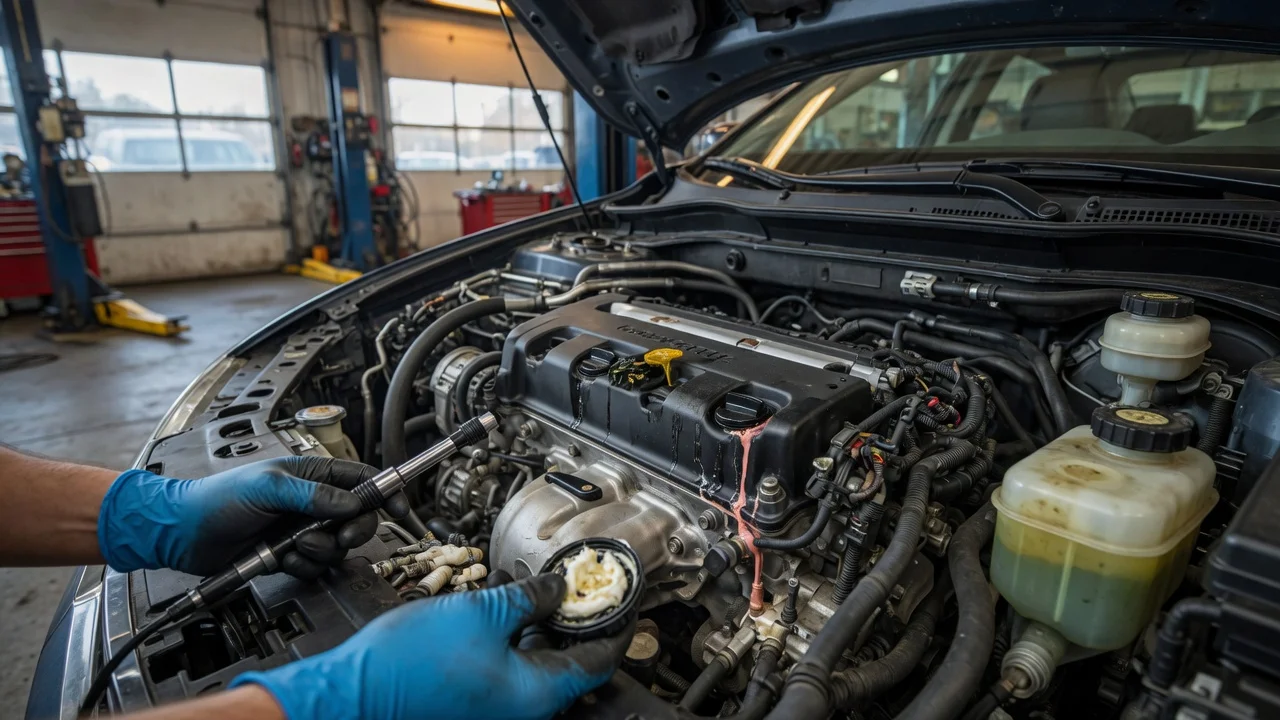
With the engine fully cold, check the coolant level in the reservoir and, if accessible, the radiator. Never open a hot radiator or pressurized cap. Pull the dipstick and look at the oil color and consistency, then look under the oil filler cap. Oil that looks like a milkshake on the dipstick indicates coolant contamination and is a strong warning sign. Note how much coolant you add between checks to establish whether loss is ongoing.
2) Watch the reservoir and exhaust
Start the engine cold and watch the coolant reservoir. A steady stream of bubbles, or coolant being pushed up and out as the engine warms, suggests combustion gas entering the cooling system. At the same time, observe the exhaust once the engine reaches operating temperature: persistent white smoke points to coolant burning in a cylinder.
3) Combustion leak (block) test
A block test kit uses a fluid that changes color when exposed to exhaust gases drawn from the cooling system. A color change indicates combustion gases in the coolant, which is consistent with a head gasket breach or a cracked head. A negative result makes a combustion-side leak less likely but does not rule out every failure mode, such as a coolant-to-oil leak or an external leak. Many shops can also sample the cooling system with an exhaust gas analyzer.
4) Cooling system pressure test
A pressure tester pressurizes the cooling system to the specification for your engine and shows whether it holds pressure. If pressure drops and you can find an external drip, the problem is likely a hose, radiator, water pump, or similar component. If pressure drops with no visible leak, coolant may be leaking internally into a cylinder or the oil, which shifts suspicion toward the head gasket or head. Testing the radiator cap separately is worthwhile, since a weak cap can cause coolant loss and overheating.
5) Compression and leak-down tests
A compression test measures the pressure each cylinder produces. Low readings in two adjacent cylinders are a classic sign of a gasket breach between them. A leak-down test pressurizes each cylinder with air and shows where the air escapes: bubbles in the coolant point to a head gasket or cracked head, air from the intake suggests an intake valve, air from the exhaust suggests an exhaust valve, and air from the oil filler suggests worn rings. Compare results against the specification for your engine.
6) Spark plug inspection
Removing the plugs can reveal a cylinder where coolant is entering. A plug that looks steam-cleaned compared with the others, or shows white deposits, suggests coolant burning in that cylinder. This is supporting evidence, not proof on its own.
Interpreting Fault Codes
A failing head gasket does not have its own fault code. It may trigger related codes, such as misfire codes for one or more cylinders or codes related to engine coolant temperature. Treat any code as a pointer for further testing rather than proof that a particular part has failed. A misfire code, for example, is far more often caused by a plug, coil, or injector, and should be investigated with the swap and inspection checks above before suspecting the gasket.
When to Stop Driving
Continuing to drive with a suspected head gasket failure can turn a gasket replacement into a warped cylinder head or a ruined engine. Stop driving and arrange towing or professional diagnosis if any of the following occur:
The temperature gauge climbs toward hot or an overheating warning appears. Milky oil is visible on the dipstick, since coolant in the oil degrades lubrication and can damage bearings. The oil pressure warning light comes on. White smoke is heavy and continuous. The engine misfires severely or the check engine light flashes. Coolant is being lost faster than you can reasonably top it up.
Hybrid Accords add a high-voltage system and electric coolant circuits. Leave diagnosis on those models to a qualified technician unless you are trained to work around high-voltage components.
Next Steps After Diagnosis
If tests confirm a head gasket failure, the usual repair involves removing the cylinder head, checking it for flatness and cracks, machining or replacing it as needed, and installing a new gasket and head bolts to the factory procedure. Because the cost depends heavily on the engine, labor rates, and any additional damage found, get a written estimate after diagnosis. On an older or high-mileage car, weigh that estimate against the vehicle's value and overall condition. Chemical sealers are sometimes offered as a low-cost alternative; their effectiveness varies and evidence on long-term results was not available for this guide, so treat them as uncertain rather than a reliable fix.
If tests do not confirm a combustion leak, focus on the external cooling system, thermostat, fan, and radiator cap, which together account for many overheating and coolant-loss complaints that resemble head gasket failure.