Diagnose Coolant Going Into the Engine
The short answer
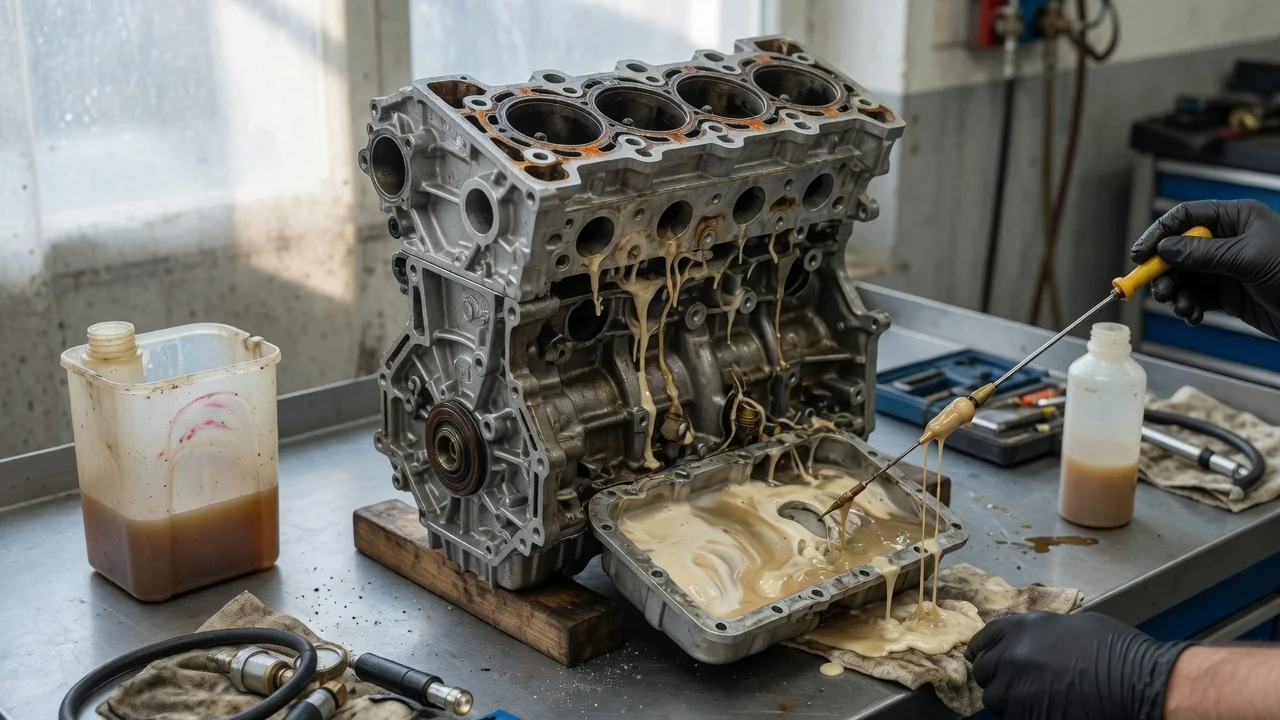
When coolant disappears into an engine rather than dripping onto the ground, it is going to one of two places: the combustion chambers, where it is burned and leaves through the exhaust, or the oil, where it mixes with the lubricant. Both indicate an internal leak between the cooling system and another part of the engine. Common causes include a failed head gasket, a cracked cylinder head or block, and, depending on engine design, a leaking intake manifold gasket, oil cooler or exhaust gas recirculation (EGR) cooler. Which of these is possible depends on how your specific engine routes coolant, so the same symptom can point to different parts on different vehicles.
An internal coolant leak is not something to keep driving on while you wait to see if it gets worse. Coolant in the oil weakens lubrication and can damage bearings. Coolant in a cylinder can cause misfires, overheating and, in severe cases, hydrolock, which is a condition where liquid in a cylinder stops the piston and can bend internal parts. Confirming where the coolant is going is the first step toward deciding whether the repair is minor or major.
First, confirm the coolant is actually going inside
Before assuming an internal leak, rule out external ones. Coolant can escape through hoses, the radiator, the water pump, the heater core or the reservoir cap and evaporate from hot surfaces without leaving an obvious puddle. Check with the engine cold, because opening a hot pressurized cooling system can cause serious burns.
Look for crusty white, green, orange or pink residue around hose connections, the radiator, the water pump and the reservoir. Check for a sweet smell or fogging inside the cabin, or a damp passenger footwell, which can indicate a heater core leak rather than an engine leak. Inspect the reservoir cap seal; a weak cap can let coolant escape as vapor. Mark the coolant level on the reservoir when cold and recheck it over several days to establish how quickly it is dropping.
If the system is clean externally and the level still drops, an internal leak becomes the more likely explanation.
Symptoms and what they suggest
Symptom | What it may indicate | Caveat; Persistent white exhaust smoke with a sweet smell | Coolant burning in one or more cylinders | Thin white vapor on a cold morning that clears as the engine warms is usually normal condensation; Milky, light-brown or foamy oil on the dipstick | Coolant mixing with oil | Short trips can leave condensation residue under the oil filler cap without any coolant leak; Coolant loss with no external leak | Internal leak into cylinders or oil | Evaporation from a small external leak can look similar; Bubbles in the reservoir with the engine running, or hard, pressurized hoses | Combustion gases being forced into the cooling system | Air trapped after a coolant service can also produce bubbles at first; Overheating, especially under load | Combustion gases displacing coolant, or coolant level too low | Many unrelated faults also cause overheating; Rough running or misfire right after a cold start | Coolant seeping into a cylinder while the engine sits | Ignition and fuel faults cause the same symptom; Rising oil level on the dipstick | Coolant or fuel diluting the oil | Fuel dilution is another possible cause on some engines
Likely causes, and where each applies
Head gasket failure. The head gasket seals the joint between the cylinder head and the engine block, separating combustion chambers, coolant passages and oil passages. When it fails, coolant can enter a cylinder, mix with oil, or allow combustion gas into the cooling system. It is a common cause on many engine types, and overheating is a frequent trigger.
Cracked cylinder head or block. Severe overheating or freezing coolant can crack castings. The symptoms overlap closely with a head gasket failure, and a crack is often only confirmed once the engine is disassembled and the parts are inspected.
Intake manifold gasket. This applies only to engines where coolant passes through the intake manifold, which is the case on some V-configuration engines. A failed gasket there can draw coolant into the intake ports or let it seep into the oil. On engines without coolant passages in the intake manifold, this cause does not apply.
Oil cooler failure. Many engines use a coolant-to-oil heat exchanger. If its internal seal or core fails, coolant and oil can mix without any coolant reaching the cylinders, so you may see contaminated oil but no white exhaust smoke.
EGR cooler failure. Engines with a coolant-cooled EGR system, common on modern diesels and fitted to some gasoline engines, route exhaust gas through a small heat exchanger. A cracked EGR cooler can leak coolant into the intake and from there into the cylinders, producing white smoke and coolant loss while the head gasket is intact. Whether your engine has one depends on the model, engine and market.
Exact designs vary by model year, engine code and market. Your vehicle's service information is the reliable way to confirm which of these components your engine has.
Checks that narrow down the cause
The tests below move from simple observation to tools a well-equipped DIYer or a workshop would use. No single result proves a specific part has failed. Each one adds evidence.
Oil inspection: Check the dipstick and the underside of the filler cap. Milky or foamy oil throughout the sump is more significant than residue only under the cap. Oil analysis: A laboratory oil test can detect glycol and coolant-related elements in the oil, which helps confirm coolant contamination when visual signs are ambiguous. Combustion leak test (block test): A tester draws air from above the coolant into a chemical fluid that changes color in the presence of exhaust gases. A positive result indicates combustion gas is entering the cooling system, consistent with a head gasket breach or crack. It does not detect a leak in the other direction, or into the oil, as directly. Cooling system pressure test: A hand pump pressurizes the system to the cap's rated pressure with the engine off. A pressure drop with no visible external leak points to an internal leak. Spark plug inspection: A plug that looks unusually clean or steam-cleaned compared with the others, or shows white deposits, suggests coolant entering that cylinder. Compression and cylinder leak-down tests: Low compression in adjacent cylinders can suggest a gasket failure between them. During a leak-down test, bubbles in the coolant while a cylinder is pressurized point to a path between that cylinder and the cooling system. Borescope inspection: A small camera inserted through the spark plug hole can show a steam-cleaned piston crown in the affected cylinder.
How to read the results together: a positive combustion leak test plus coolant loss and white smoke strongly suggests a head gasket or casting crack. Contaminated oil with a negative combustion leak test and no smoke shifts suspicion toward an oil cooler or, where applicable, an intake manifold gasket. White smoke and coolant loss with healthy compression on an engine fitted with an EGR cooler makes that cooler worth testing before condemning the head gasket.
What fault codes can and cannot tell you
An internal coolant leak rarely sets a code that names the cause. More often you will see misfire codes, coolant temperature warnings or, on some vehicles, a low coolant level warning. A misfire code on one cylinder after a cold start is a useful clue that the cylinder may be taking in coolant, but the same code can come from ignition, injector or mechanical faults. Treat any code as a direction for further testing, not as proof that a particular part has failed.
When to stop driving and get professional help
The temperature gauge climbs toward the red or an overheating warning appears. The oil is milky or foamy throughout, or the oil level is rising. Thick white smoke is continuous, or the engine is misfiring heavily. The engine cranks with difficulty, stalls abruptly or makes knocking noises, which can indicate liquid in a cylinder or bearing damage. Coolant needs topping up frequently, or hoses are hard and pressurized shortly after starting.
In any of these cases, continuing to drive risks turning a gasket or cooler repair into an engine replacement. If coolant has reached the oil, the engine generally needs the leak fixed and the oil system flushed before it runs for any length of time. A workshop can perform leak-down, combustion gas and pressure tests together and confirm the source before parts are replaced, which matters because head gasket and EGR cooler repairs differ substantially in labor.
Gaps to keep in mind
This guide covers general diagnostic logic. It does not give cooling system pressure ratings, test thresholds or repair costs, because these vary by vehicle and are not supported by the information available here. Which components are present, such as an EGR cooler, a coolant-carrying intake manifold or an oil cooler, also depends on the specific engine, model year and market. Confirm those details in the service information for your vehicle before testing or buying parts.