DD15 Wastegate Actuator: Identification and Checks
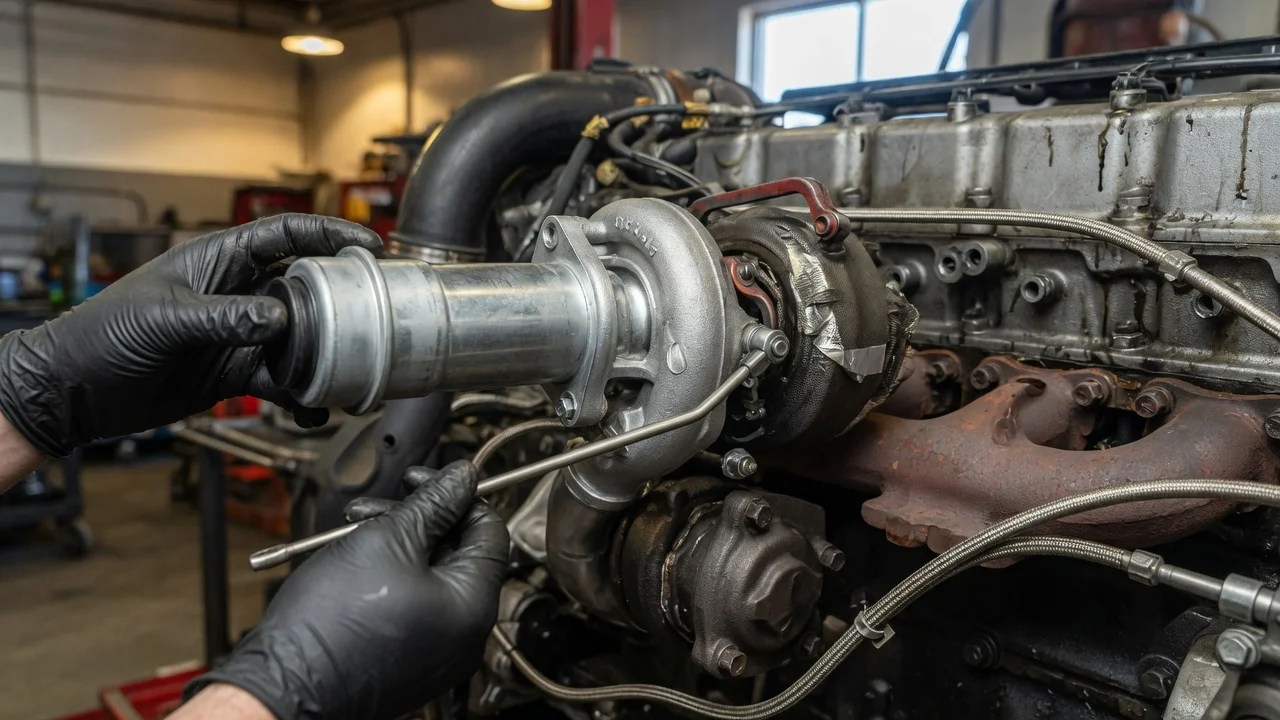
Establish the symptoms
Begin by recording exactly when the suspected wastegate actuator problem appears. Note whether boost response feels weak only under hard acceleration, during sustained grade climbing, at cold start, or across all engine loads. Pay attention to associated signs such as low turbocharger boost, elevated exhaust gas temperature, black smoke under load, an underboost or overboost fault, unusual air-management noise, or a change in fuel consumption. Also document recent work that could affect the system: turbocharger replacement, charge-air-cooler repairs, exhaust manifold work, air filter changes, software updates, or any repair around the actuator linkage and vacuum or pressure lines.
Record the vehicle configuration and service history where available. The DD15 may use different turbocharger and wastegate arrangements depending on model year, emissions package and application. Knowing whether the actuator is pneumatic, electronic or mechanically controlled helps avoid checking the wrong component. A recent service history that includes cleaning or replacement of sensors, exhaust aftertreatment work, or previous turbocharger repairs can change which faults are more likely.
Distinguish plausible causes
A wastegate actuator symptom can overlap with several other faults. A sticking or split wastegate valve can produce low boost even when the actuator moves correctly. A leaking charge-air cooler, loose boot, cracked intercooler duct or restricted air filter can also reduce boost. An exhaust leak before the turbocharger, damaged turbine wheel, or excessive exhaust back pressure from the aftertreatment system can create boost and temperature complaints without any actuator failure.
Observations help separate these causes. If the actuator rod is visibly moving during a commanded test, a failure is less likely to be inside the actuator itself and more likely to involve the wastegate valve, linkage, boost leak or exhaust restriction. If the rod does not move but the command signal, air supply or vacuum supply is present, the actuator or its internal diaphragm may be suspect. If no command is reaching the actuator, the fault may be in the engine control module, wiring, sensor input or air-system control strategy. A noise or rattle from the turbocharger area can support a wastegate linkage issue rather than a sensor problem.
Checks in a useful order
Start with safe visual checks with the engine off and the turbocharger cooled. Inspect the actuator, rod, clevis, pin, retaining clips and wastegate lever for looseness, corrosion, cracking, missing hardware or contact wear. Check pneumatic hoses, fittings and the pressure or vacuum source for rubbing, heat damage, kinks, looseness or oil contamination. Inspect the charge-air cooler pipes, boots and clamps for splits, oil spray or loose connections. Look for soot traces around the exhaust manifold, turbocharger mounting and wastegate area that may indicate an exhaust leak.
Only where the manufacturer procedure allows, perform a slow movement check by hand with the linkage disconnected and the engine off. The wastegate lever should move through its designed travel without binding. Do not force a linkage that is difficult to move, because internal wastegate contact or a seized shaft can be damaged further.
Tests requiring diagnostic equipment should follow the manufacturer service information. A scan tool can read active and stored turbocharger, boost pressure and actuator-related faults, compare commanded position with actual position, and run an actuator test where supported. The technician can monitor boost pressure and exhaust temperature under controlled load, check wiring continuity and reference voltage at the actuator connector, and test pneumatic or vacuum supply with a calibrated gauge. Compare all measurements with the manufacturer specifications for the exact engine configuration. Do not use a universal test interval or assume that a reading from another engine family applies to a DD15.
Use the maintenance schedule and operating conditions only to judge whether neglect is likely. A heavily loaded vocational truck operating in dusty conditions may show earlier boot, filter or cooler degradation than a highway tractor with a different service history. This changes inspection priority, but it does not replace the vehicle-specific measurements.
Interpret the findings
A moving rod during a commanded actuator test establishes that the control side can drive the actuator, but it does not prove that the wastegate valve seats correctly. The wastegate may still be cracked, warped or held open by carbon, or the lever may be worn. Conversely, a stationary rod with good wiring and correct supply pressure points toward the actuator, but only after the command signal and mechanical linkage have been ruled out.
A boost leak found during inspection can explain low boost even if the actuator is functioning. Repair and retest before condemning the actuator. An exhaust leak or high exhaust restriction may also change turbine behavior and should be corrected or investigated before replacing parts. Do not treat a stored underboost or overboost code as proof that the actuator is defective; the code identifies a system condition, not a specific failed part.
Urgency and next action
Stop use and arrange inspection if the actuator rod is disconnected, the wastegate lever is seized, the linkage has missing retaining hardware, a charge-air pipe is blown off, or there is visible exhaust leakage near the turbocharger. Continued operation with uncontrolled boost or an open intake connection can damage the turbocharger and engine. Do not estimate a safe remaining mileage.
Before repair, have the exact engine serial number or vehicle configuration, the active and stored fault codes, observed boost and actuator test results, and the outcome of the visual checks. A qualified technician should use the manufacturer service information for the specific DD15 application to confirm whether the actuator can be replaced separately or whether the turbocharger assembly requires service. After repair, the system normally needs a functional check and, where specified, a calibration or fault-code clearing procedure rather than a road test alone.