Fluid Leaking at a CV Axle: How to Locate the Source
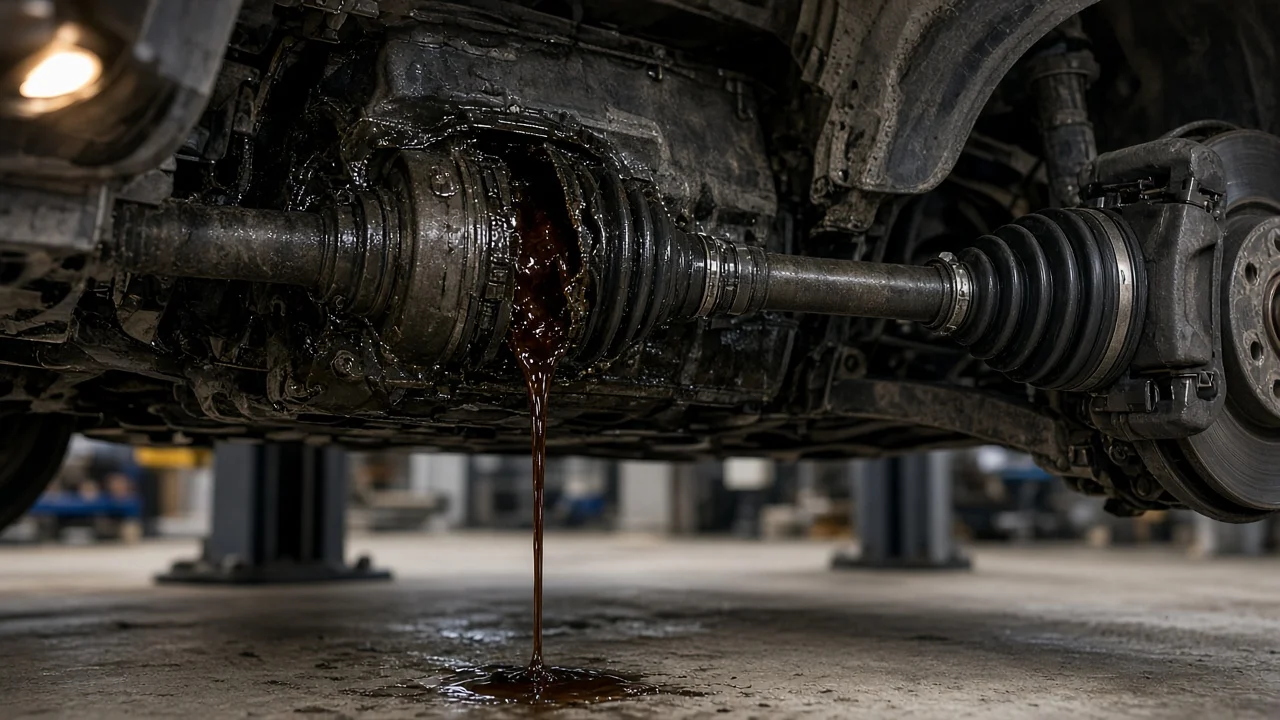
A wet, dark mess around a front wheel is often called a CV axle leak, but the axle shaft itself holds no fluid. What you see is usually grease escaping from a CV joint boot, fluid from the seal where the axle enters the transmission or differential, or a different leak running down onto the axle. Locating the true source before buying parts saves money and keeps you from missing a more serious problem.
Establish the symptoms
Start by recording what the residue looks like and exactly where it sits. Note the side of the vehicle and whether the wetness is at the inner end of the axle, near the transmission or differential, or at the outer end, near the wheel hub. Texture matters more than color. Thick, sticky grease flung outward in a ring onto the wheel well, control arm or steering parts behaves very differently from thin fluid that drips. Fluid colors vary by manufacturer, type and age, so treat color and smell as clues rather than proof.
Next, note when the problem shows up. A spot that forms under the parked car points to a dripping fluid, while a spray pattern that appears only after driving suggests something spinning and slinging grease. Write down associated signs: clicking during tight turns, vibration under acceleration, changes in how the transmission shifts or engages, a warning light, or a brake pedal that feels different. Finally, list recent changes from the service history, such as axle or transmission work, a fluid service, suspension repairs, or driving through deep water or over rough terrain.
Distinguish plausible causes
A torn or loose CV boot is the most common reason people search for a leaking CV axle. Evidence that supports it includes a visible split or crack in the boot folds, a slipped or broken clamp, and dark grease spattered in a radial pattern around nearby parts. That explanation is weakened if the boot is intact and dry and the residue is a thin liquid rather than grease.
An axle seal leak at the transmission, transaxle or differential output is the second main candidate. Supporting signs are thin fluid wetting the case right where the axle enters, drips forming at that point, and a fluid level that drops over time. Seals can be damaged when an axle is removed and reinstalled, and they can wear faster if the axle or output shaft has excessive movement. Some layouts use an intermediate shaft with its own seal and bearing. If the case face around the axle is dry and the wetness clearly starts higher up, a seal leak becomes less likely.
Many leaks only end up on the axle. Engine oil from the oil pan, filter or upper engine gaskets, transmission pan or cooler line leaks, power steering fluid, coolant and a seeping strut or shock can all run down onto it. Near the outer end, a brake caliper or hose leak is a possibility that must not be overlooked. Airflow and gravity carry fluid rearward and downward, so the wettest point is often below and behind the actual source.
Checks in a useful order
Begin with observations that need no lifting. Park on level ground, slide clean cardboard underneath overnight and note where drips land relative to the wheel. Turn the steering to full lock and use a flashlight to look at the outer boot and the back of the wheel. Check only the fluid levels that the owner's manual lets you check, such as engine oil, brake fluid and the coolant reservoir. Never open a hot cooling system.
Looking underneath requires proper equipment: support the vehicle on jack stands at the manufacturer's lift points, never on a jack alone. Clean the area with a suitable degreaser, keeping it off brake parts, then drive briefly and recheck to find the highest point where fresh wetness appears. Inspect both boots all the way around, including inside the folds, and look at the case face where the axle enters the transmission or differential.
Some checks depend on manufacturer specifications or a qualified technician. Many modern transmissions have no dipstick, and their fluid level must be checked through a fill or check plug at a specified temperature using a procedure specific to your vehicle configuration. Fluorescent dye tracing, measuring axle play and judging whether a joint is worn also benefit from experience. Seal replacement usually means removing the axle, which involves torque values and parts that should come from the service information for your exact vehicle.
Interpret the findings
Grease spray combined with a split boot confirms a boot failure, but it does not tell you whether the joint is still healthy. Once a boot opens, dirt and water can enter and grease escapes. A technician judges the joint by noise, looseness and the condition of the remaining grease. That assessment, along with labor and parts cost, decides between a boot kit and a complete axle.
A wet seal area that rewets from that spot after cleaning points to the axle seal. Before replacing it, confirm the fluid matches what that unit uses and find out why it failed: axle movement, a damaged sealing surface, a worn bearing or a blocked vent can all cause a repeat leak. If the seal area stays dry while fluid appears above it, the source is elsewhere, and replacing the axle will not stop it.
When results conflict, such as wetness everywhere or two plausible sources, clean again and recheck after a short drive, or use dye. Avoid replacing parts based on color alone or on a single look at an old, spread-out residue.
Urgency and next action
Stop driving and arrange a tow if fluid near the wheel might be brake fluid, if the brake pedal feels soft or low, or if a brake warning appears. The same applies to grease or oil on the brake rotor or pads, transmission slipping or delayed engagement, a rapidly growing puddle, loud clunks or severe vibration, or smoke from fluid landing on hot exhaust parts.
A torn boot without noise, or a slow seep with no other symptoms, is less urgent but not stable. Contamination keeps reaching the joint and fluid levels keep dropping, and no one can promise how much distance remains. Schedule an inspection soon rather than waiting for noise or a warning light.
To get an accurate diagnosis and quote, bring the year, make, model, engine, transmission type and drivetrain, plus which side is affected and whether the inner or outer end is wet. Photos taken before cleaning help, along with when you first noticed the leak, any fluid level readings and recent service history such as axle, transmission or suspension work. This lets the shop confirm whether the boot, the seal, the axle or another component is responsible and order the correct parts.