CV Axles With ABS Tone Rings: Checking What Is Included
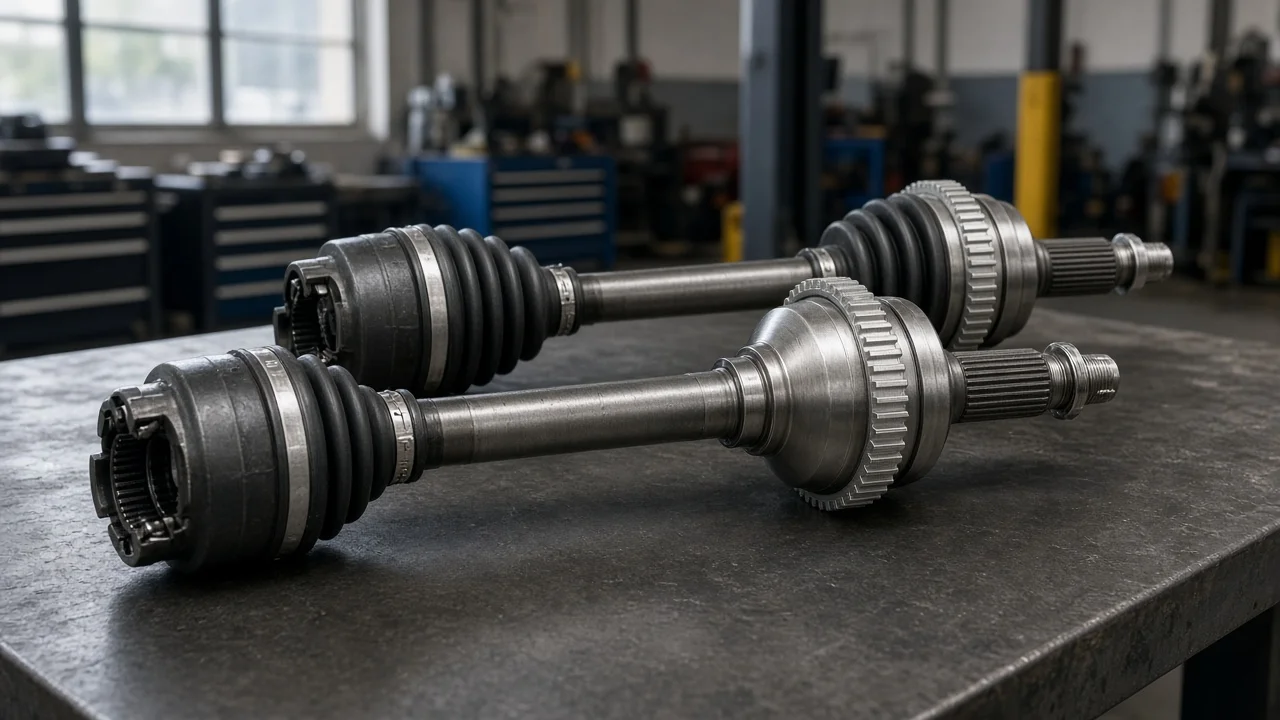
A replacement CV axle may or may not come with an ABS tone ring, and the difference matters. On many vehicles the toothed ring pressed onto the outer joint is what the wheel speed sensor reads, so a missing, mismatched or damaged ring disables ABS and often traction and stability control. This guide covers how to recognize the problem, separate it from other causes, check the axle and sensor in a sensible order, and decide when the vehicle should not be driven.
Establish the symptoms
Start by noting exactly when the fault appeared. A tone ring problem on a CV axle almost always shows up right after the axle was replaced or the hub area was disassembled. Typical signs are an amber ABS warning light, a traction or stability control light, and a stored wheel speed sensor code for one wheel. Some systems pass their startup check and set the fault only once the car rolls, because they compare the wheel speeds against each other. Others show ABS pulsing during gentle stops on dry pavement, or an erratic speedometer on vehicles that derive road speed from the wheel sensors.
Record the associated details as well: which wheel the code names, whether the light is constant or intermittent, and whether it changes with speed, steering angle or bumps. List everything done during the recent repair. If the caliper and brake rotor were removed to reach the hub, if brake pads were replaced, or if the sensor was unplugged or pulled from the knuckle, those steps are part of the evidence. Clicking in turns, vibration under acceleration or grease thrown around the wheel well point to the axle itself rather than only its ring.
Distinguish plausible causes
The most direct cause is a new axle supplied without a tone ring on a vehicle that needs one. The case for it is strong when the code appeared immediately after installation and the scan tool shows no speed at all from that wheel. It weakens considerably if the original axle had no ring either, because many vehicles read wheel speed from a toothed ring or magnetic encoder built into the hub bearing instead. In that design, an axle with a ring does no harm, but an axle without one is not the fault.
A ring that is present but wrong is the next suspect. A different tooth count produces a speed reading that is consistently off compared with the other wheels, which can trigger false ABS activation. A ring pressed at the wrong position or with a different diameter can leave the sensor air gap too large for a clean signal, especially at low speed. Rings can also crack when pressed on or split later as corrosion forms underneath; that usually gives an intermittent fault with a once-per-revolution pattern.
Causes outside the axle must stay on the list. Sensors are easily damaged when a seized unit is pried out, connectors are sometimes left unlatched, and harnesses can be stretched or pinched when the knuckle is swung out for axle removal. Metallic debris stuck to a magnetic sensor tip can distort the signal. Visible wiring damage, a fault that changes when the harness is moved, or a ring that matches the original all point away from the axle.
Checks in a useful order
The cheapest check happens before installation: put the old and new axles side by side. Confirm that the new one has a ring if the old one did, that the outer diameter and tooth count match, and that the ring sits at the same distance from the joint face. Compare overall length and spline counts at the same time, since vehicle fitment problems often travel together. If the axle is already installed, look through the sensor opening or around the knuckle with a light, and confirm the sensor connector is fully seated and the wiring follows its original clips.
Tool-based checks come next. A scan tool that displays ABS live data lets you compare all four wheel speeds during a slow, controlled roll; the suspect wheel should track the others closely. Where the service information gives an air gap specification, measure it with a non-magnetic feeler gauge. Sensor electrical tests depend on the type: older passive sensors can often be checked for resistance and AC output, while active sensors generally cannot be judged with an ohmmeter and need the manufacturer's procedure. Support the vehicle on proper stands for any work under it.
Some steps belong with a qualified technician: pressing a tone ring on or off a joint housing, replacing a hub bearing with an integrated encoder, diagnosing the ABS module, and any brake work that requires opening the hydraulic system or a scan-tool bleed procedure.
Interpret the findings
A missing ring on the new axle where the original had one establishes the cause for that wheel; the fix is a correctly equipped axle, followed by clearing codes and confirming live data. A tooth count or diameter mismatch means the part does not suit the vehicle and should be exchanged rather than modified. A matching, intact ring with a persistent code shifts attention to the sensor, wiring, air gap or bearing encoder, and the axle should not be replaced again on suspicion alone.
Live data narrows things further. One wheel reading zero while the others rise together indicates no signal reaching the module, which fits a missing ring, a failed sensor or an open circuit. A reading that appears but drops out, spikes or runs consistently high or low suggests damaged teeth, the wrong ring or an excessive gap. A cleared code that stays away through a test drive repeating the conditions that first set it is reasonable evidence of a repair; a light that stays off during a short trip across a parking lot is not.
When buying, treat a tone ring included claim as something to verify rather than assume. Check that the listing matches the exact year, engine, drivetrain and side, and compare the part with the original in hand. Transferring the old ring is possible on some designs, but it risks cracking the ring or seating it at the wrong depth without the correct press tooling and position specification.
Urgency and next action
An ABS light on its own usually means the base brakes still work but anti-lock function, and often traction and stability control, are switched off. Stopping and steering control on wet, icy or loose surfaces can be noticeably worse, so arrange the repair promptly and drive gently in the meantime only if the owner's manual and conditions allow. No remaining distance can be called safe without inspection.
Stop using the vehicle and have it inspected or towed if the red brake warning light is on, the pedal feels low or soft, brake fluid is leaking or below the minimum mark, there is grinding or the car pulls under braking, or the new axle clunks, vibrates or has a torn boot. The same applies if there is any doubt that the caliper, rotor and pads were reinstalled and torqued correctly, or that the pads are within their wear limits.
For the repair, bring the VIN or exact year, make, model, engine and drivetrain, the affected wheel, the stored codes and any live data captured, photos of the old and new axle showing the ring area, the replacement part number, and a list of everything done during the original job. That information lets a technician confirm fitment and test the ring, sensor and wiring without repeating work that already rules something out.