Cupped, Wavy or Scalloped Tire Wear: Struts, Shocks, Loose Parts and Imbalance
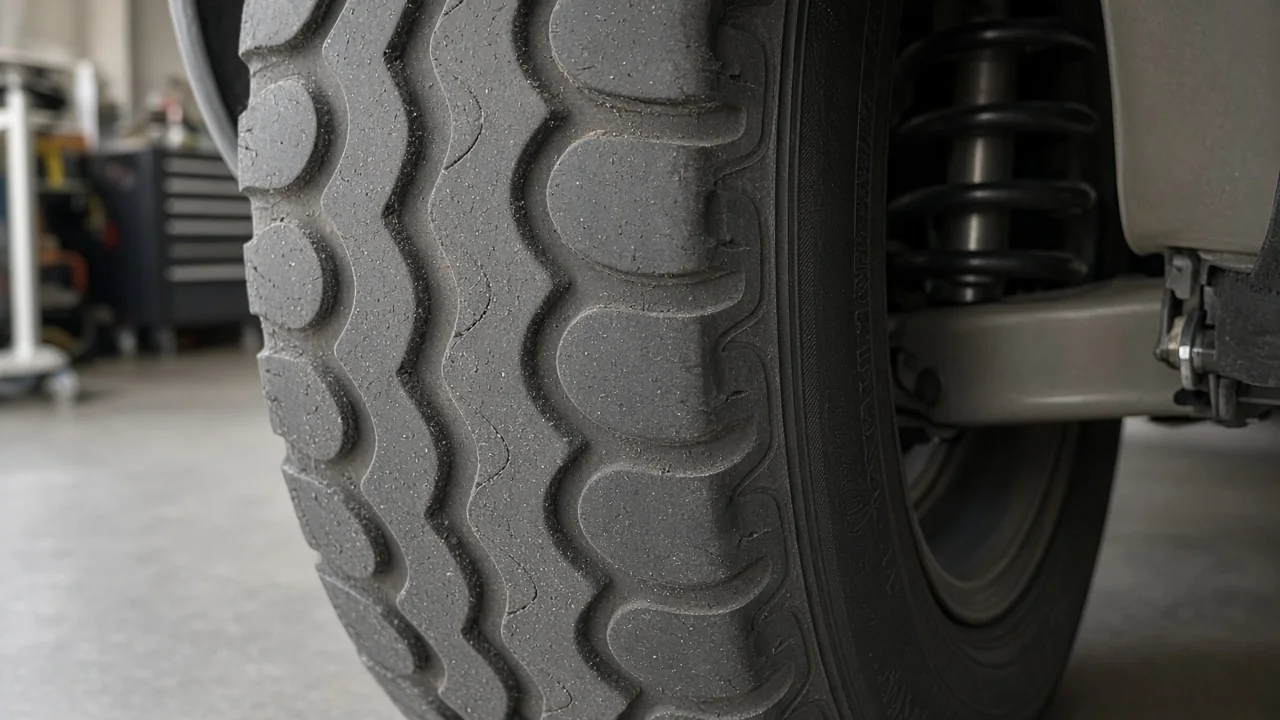
Uneven tire wear from suspension faults, imbalance, or dampers produces distinctive tread shapes that are often confused with bearing or alignment issues. A cupped, wavy, or scalloped tire is usually a sign that the wheel assembly is moving in ways the suspension cannot control. Understanding how struts, shocks, loose parts, and balance each contribute helps owners inspect efficiently and avoid replacing components that are not the root cause.
What Cupped, Wavy and Scalloped Tread Wear Looks and Feels Like
Cupped, wavy, or scalloped wear appears as alternating high and low spots around the tread circumference, unlike even tread depth across the width. To check safely, run a flat hand lightly around the tread of a parked vehicle and compare all four tires; look along the tire at a low angle for shadows or dips. This pattern often results from the tire bouncing or wobbling as it rolls, scraping tread away in patches rather than uniformly.
Typical symptoms include a rhythmic hum or growl that changes with speed and may be mistaken for wheel bearing noise, plus vibration felt in the steering wheel or seat. The noise can be especially noticeable on smooth roads. The pattern alone cannot confirm the cause; it points toward a group of possible causes, including worn dampers, loose parts, imbalance, or a tire defect, and a closer inspection is needed to separate them.
How Suspension Problems Cause Uneven Tire Wear
The suspension keeps the tire pressed evenly on the road, and when components wear, the tire can bounce and scuff in patches, wearing troughs into the tread. Cupping and scalloping from poor damping or loose parts occur because the tire loses consistent contact pressure; a wheel that moves too freely follows irregular paths, grinding rubber away in localized bands. This is different from even, full-width wear caused by alignment angles changing slowly.
Loose or worn parts such as ball joints, tie rod ends, control arm bushings, and wheel bearings allow play that can let the tire wobble or shift under load. Each can produce aunique pattern depending on which motion is uncontrolled, so a single worn part may not account for all the wear. Several problems can happen at once, meaning one repair might reduce but not eliminate uneven wear until all loose points are addressed.
Worn Struts and Shocks: Signs They Are Behind the Tire Wear
Worn dampers let the wheel oscillate after bumps, bouncing repeatedly before settling. Because the tire keeps rotating while bouncing, the tread contacts the road inconsistently, carving a repeating scalloped pattern around the circumference. A damper that no longer controls spring movement allows the wheel to hop at the natural frequency of the suspension, producing low spots that match the bounce cycle. This explains why strut and shock wear often causes cupped tires.
Observable signs include extra bouncing after bumps, nose dive under braking, body sway in corners, and fluid wetting on the strut or shock body where internal seals have failed. Damaged mounts can also cause noise and movement. The bounce test on a parked car is only a rough guide because modern suspension designs and low-profile tires can mask weakness; a professional inspection with the vehicle lifted is more reliable. Since struts are part of the spring and steering assembly on many vehicles, replacement is not a DIY job for most owners: the coil spring is under dangerous tension. After strut work, an alignment check is often needed because mounting points and angles change, and owners should confirm this with the shop for their specific vehicle.
Unbalanced Wheels and Tires: How Imbalance Leaves Its Own Wear Pattern
Imbalance makes the wheel hop or wobble at speed, often showing as a vibration felt in the steering wheel or seat within a specific speed range. Over time, the repeated uneven loading can wear patchy or scalloped spots on the tread, especially when combined with worn suspension parts that fail to damp the wheel motion. A missing wheel weight, recent tire work, or pothole damage often precedes this type of wear.
Related causes that feel similar include a bent wheel, a tire that is not perfectly round, or a shifted internal belt; a balancer or road-force check can help find these because they cause forces that a standard spin balance may not detect. Rebalancing can stop further damage but cannot restore tread that is already cupped, so the tire may remain noisy and the uneven wear will be visible until the tire is replaced.
Telling the Causes Apart Before Replacing Parts
Compare clues side by side: speed-related vibration that peaks in a range suggests balance, while bounce and float after bumps suggest worn dampers, and clunks or play when turning or braking suggest loose parts.Intermittent noise over rough surfaces can also hint at loose suspension, whereas a constant growl that changes with cornering often points to a wheel bearing. Patterns help, but they overlap because several conditions can produce similar symptoms.
The location of uneven wear matters: one tire suggests a local problem like a bent wheel or damaged component, an axle pair suggests shared suspension or balance issues, and all four often indicates worn dampers or chronic underinflation, though none of these patterns is conclusive. Noisy cupped tires can sound like a failing wheel bearing, and a road test plus a lift inspection is needed to tell them apart. Owners should not jack up the car or pry on suspension parts to check for play; checking for looseness safely needs a lift and trained staff because the vehicle can fall or parts can move unexpectedly.
What to Ask a Shop to Inspect and When to Get Help Quickly
Ask the shop to inspect tire condition and pressures, wheel balance including a road-force check if available, strut and shock condition, steering and suspension joints, bushings, bearings, and alignment. Request that they explain which parts show looseness or leakage and how each relates to the observed tread pattern. A road-force check is especially useful because it can find tire uniformity issues that a standard balance misses.
Get help promptly if there is a clunk over bumps, the steering wanders, braking feels unstable, vibration gets worse, or the tread or sidewall is damaged. A cupped tire may stay noisy after the suspension or balance repair, and whether to replace it depends on remaining tread depth and condition; a deeply scalloped tire may produce enough vibration and noise to accelerate wear on new parts. Ask for the inspection results and measurements in writing before approving parts so work is justified and documented.
Preventing Wavy Tire Wear After the Repair
Check tire pressure regularly using the values on the vehicle's placard, not the sidewall maximum, because inflation that is too low or high changes the tire's contact patch and can make any existing suspension weakness produce uneven wear more quickly. Pressure should be checked when tires are cold for an accurate reading, and all four should be compared since one low tire can alter handling and loading on other corners.
Rotate tires according to the owner's manual so that early signs such as slight cupping or feathering show up on a tire in a different position rather than being hidden for thousands of miles. Rebalance when a new vibration appears, after tire service, or after hitting a hard pothole, because impact can knock off a wheel weight or bend a rim. Look at the tread for new cupping between services and pay attention to changes in noise or ride control; catching a worn damper or loose joint before it ruins a set of tires is cheaper and safer.