Cruise Control Not Working After Battery Replacement: Causes and Checks
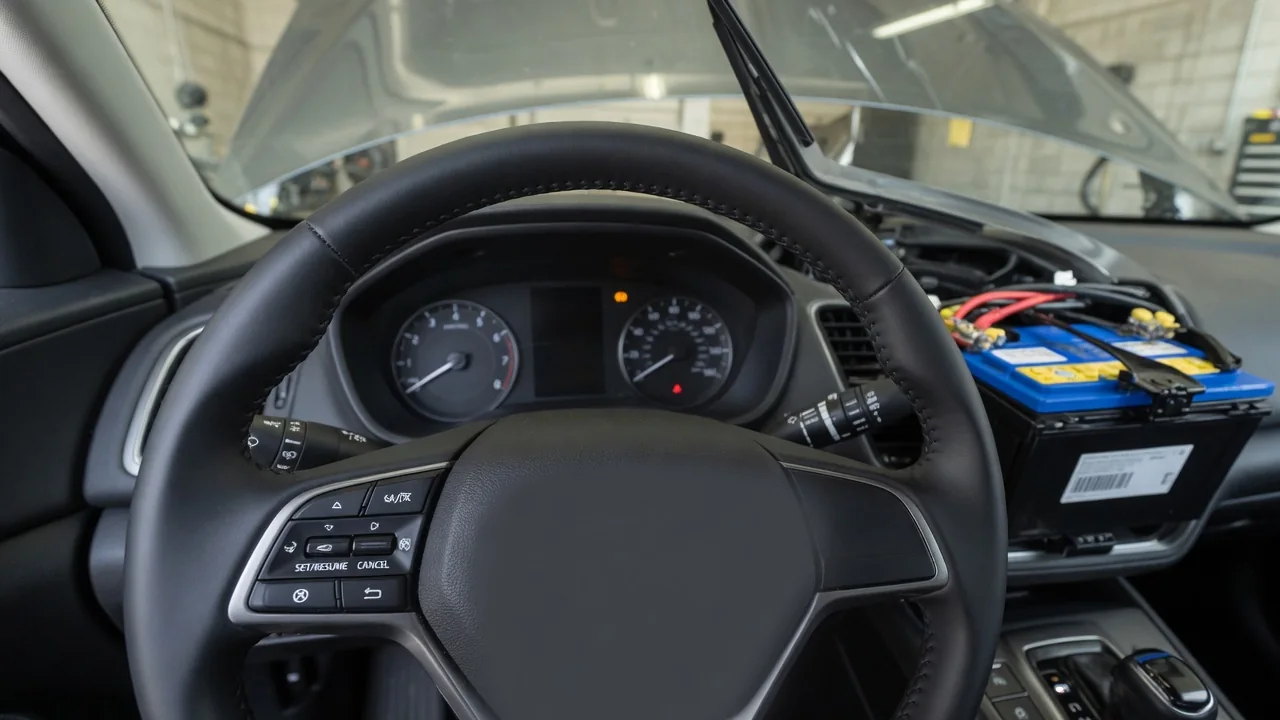
Cruise control not working after a battery change is a common complaint on modern vehicles, and it rarely means the cruise system itself has broken. Disconnecting power can erase learned values, upset related systems or simply expose a problem that was already developing. This overview explains the likely causes, the safe checks an owner can make and when professional testing makes sense.
Why a Battery Change Can Leave Cruise Control Inactive
Many modern vehicles store learned values in their control modules, such as idle airflow adaptations, throttle positions and steering angle references. When the battery is disconnected, some of that module memory can be lost. Until the values are relearned or reinitialized, the vehicle may temporarily disable driver assist features, including cruise control, as a precaution. Cruise control also relies on inputs from several other systems, including throttle control, braking, vehicle speed and stability signals, so a disturbance in any one of them can switch the feature off.
What happens next differs between vehicles. Some restore normal function on their own after a short period of ordinary driving, while others stay disabled until a specific procedure has been carried out, and neither outcome can be assumed for a particular car. It is also worth remembering that a battery change can coincide with an unrelated fault. A worn switch or failing sensor may show itself the same week purely by chance, so the timing alone does not prove the battery work caused the problem.
Symptoms to Note Before Drawing Conclusions
Careful observation narrows the possibilities before anything is touched. During normal driving, note whether the cruise indicator illuminates when the system is switched on, whether it accepts a set speed, and whether it holds that speed or cancels unexpectedly. A cruise control light not coming on at all suggests the system is being blocked or is not receiving a required signal. A system that engages and then drops out points in a different direction, often toward an intermittent input or a voltage problem that appears under certain conditions.
Write down every dashboard warning light or message that appeared after the battery work, especially stability control, traction control, brake or engine warnings, because these often identify the system that is holding cruise control off. Other changes are useful clues too. Reset radio presets, a clock showing the wrong time, power windows that no longer operate with one touch, or an idle that feels rough or unsteady all suggest that modules lost memory when power was removed, which makes a relearn issue more plausible.
Simple, Safe Checks After a Battery Replacement
Start with what can be seen without tools. Confirm that the new battery is the correct type for the vehicle, since some cars are designed around a particular battery technology and capacity, and look to see that the terminals appear clean and firmly seated. The owner's manual may include a note about resetting systems after a battery disconnect, so it deserves a read. A weak or poorly charged new battery, or low system voltage from a charging problem, can make electronics behave erratically, and a voltage test at a parts store or shop can rule this out.
Brake lights deserve attention as well, because many cruise systems use the brake light circuit to decide when to cancel. A brake light switch fault or an inoperative lamp circuit can keep cruise from engaging on some vehicles. With the vehicle safely parked, a helper can stand behind it and watch the lights while the driver presses the pedal. Beyond these checks, restraint is wise. Probing wiring, pulling fuses at random or unplugging modules without the right knowledge and tools can create new faults and make the original one harder to trace.
Relearn and Initialization Procedures Vary by Vehicle
After a loss of power, some vehicles need an idle relearn, a throttle body relearn, a steering angle sensor calibration or a similar initialization before all systems return to normal. Which of these applies, if any, depends entirely on the make, model and year. One vehicle may sort itself out with no intervention, while another keeps a stability control warning lit and cruise disabled until the steering angle reference is restored. The symptoms can look similar from the driver's seat even though the underlying requirement is quite different.
For that reason, the correct procedure has to come from the owner's manual, official service information or a dealer, not from a routine written for a different vehicle. Drive cycles, key sequences and timing steps that work on one platform may do nothing on another, and following the wrong sequence can waste time while the real requirement goes unmet. Some initializations cannot be performed from the driver's seat at all and can only be completed with a scan tool that communicates with the relevant module.
Warning Lights and Stored Codes: Verify the Vehicle-Specific Meaning
A scan tool can read stored trouble codes from the engine and chassis modules, and this is often the quickest route to an answer. Cruise control may be switched off because of a fault logged somewhere else, such as in the stability or brake control system, even when no cruise-specific code exists. A code is evidence to interpret, though, and not proof that a named part has failed. Manufacturer-specific codes in particular must be looked up for the exact make, model and year before any conclusion is drawn, since their meanings are not universal.
Clearing codes without understanding them is tempting but can be counterproductive. Erasing them removes the record of which module set the fault and the conditions under which it happened, information a technician may need to find the cause. It also helps to know that codes set at the moment the battery was disconnected, including low voltage or lost communication entries, may be historical and no longer active. A professional can tell stored history apart from a fault that is still present and judge which entries matter.
When to Get Professional Testing
If cruise control stays inactive after the owner's manual guidance has been followed and the battery and charging system have tested healthy, professional diagnosis is the sensible next step. Inspection should be prompt if brake, stability or other safety-related warning lights remain on after the battery change, because those systems affect far more than convenience. Technicians can check module communication, live sensor signals and calibration status with dealer-level or equivalent equipment that most owners do not have, and they can carry out any relearn that requires a scan tool.
Sharing clear observations shortens the diagnosis. Tell the shop when the problem started relative to the battery replacement, which warnings appeared, whether the cruise indicator lights up, and whether settings such as the clock or radio presets were lost. Mention any battery test results and who fitted the battery. Until the cause has been confirmed, do not rely on cruise control, even if it works now and then. Drive normally with your foot controlling speed, and treat any remaining warning lights as a reason to have the vehicle checked.