Cruise Control Codes P0525 and P0564–P0593: Switches, Servo, and Inputs
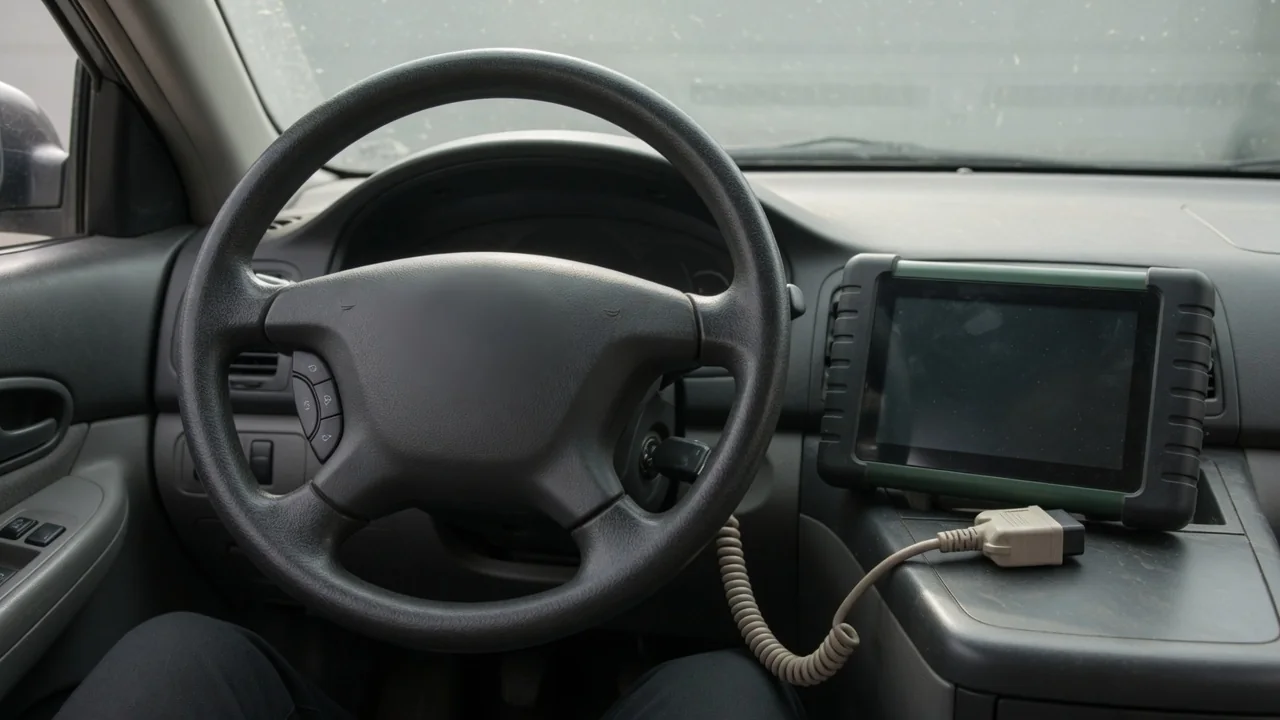
Cruise control codes in the P0525 and P0564 through P0593 range point to how the system reads switches, servo commands, and related inputs rather than proving a single failed part. A stored P0581, P0575, or similar code can explain why cruise will not engage, drops out, or ignores set and resume signals. Confirm each definition for the vehicle before treating circuit labels as interchangeable.
Confirm the Code Definition and Record Why Cruise Will Not Engage
A P0575 or P0577 code must be verified against the diagnostic procedure for the vehicle's year, make, model, and cruise control system before anyone assigns a failed part. Manufacturer-dependent circuit labels can describe different wiring, modules, or switch arrangements on otherwise similar vehicles. After that confirmation, P0575 is associated with a cruise control input-circuit fault, and P0577 with an input-circuit high condition. Those labels still describe a monitored electrical state, not a proven switch failure.
Record whether cruise never engages, drops out after it holds speed, or ignores individual buttons, and note any warning lights plus the speed, brake, and temperature conditions when the problem appears. Preserve stored, pending, and history codes and freeze-frame data before clearing anything. Freeze-frame data captures engine and vehicle operating conditions at the moment a monitor failed, which later helps a technician compare live values. A code identifies a monitored condition; it does not prove which component failed.
Multi-Function Input Codes P0564, P0579, and P0581
Once the vehicle definition is confirmed, P0564 refers to a multi-function input circuit fault, P0579 to multi-function input A range or performance, and P0581 to multi-function input A circuit high. Circuit high describes an electrical signal sitting above the expected voltage window, not vehicle speed and not how firmly a button is pressed. A P0581 code therefore reports a monitored voltage condition on that input, which may come from switch contacts, wiring, a connector, or a shared circuit rather than from a single failed cruise control switch.
Switch contacts, harness damage, connector corrosion, or a shared supply or ground can all change how the controller recognizes set and resume signals and other multi-function input states. That is why a technician compares commanded button states in scan data with the vehicle's circuit specification before recommending switch replacement. If live data already shows the expected command while the circuit remains out of range, the cruise control switch itself may not be the source of the P0564, P0579, or P0581 condition.
Signal Correlation and Input B Codes P0585, P0591, and P0593
After vehicle-specific confirmation, P0585 reports multi-function input A and B correlation, P0591 reports input B range or performance, and P0593 reports input B circuit high. Inputs A and B must be identified on that vehicle; they do not automatically mean two separate physical buttons. Some systems encode several switch functions on related circuits, so correlation monitoring checks whether those signals keep an expected relationship as the driver uses cruise. An implausible relationship can disable cruise even when neither circuit is fully open or shorted.
A professional evaluation compares related live-data signals, shared supplies, grounds, and wiring rather than treating a P0585 code plus a P0591 or P0593 code as proof of multiple failed parts. Signal correlation can fail because one circuit is stuck, both circuits share a damaged connector, or the controller sees values that no longer match the programmed relationship. Circuit high on input B still means an electrical condition, so the same caution applies: confirm what that circuit actually carries on the vehicle before replacing hardware.
On, Off, Resume, Set, and Coast Signal Codes P0565–P0569
When the vehicle definition matches, P0565 refers to the cruise on signal, P0566 to off, P0567 to resume, P0568 to set, and P0569 to coast. An unrecognized command can prevent engagement, cancel an already held speed, or make one function appear dead while others still work. The affected button alone cannot establish the fault location, because the same symptom can come from the switch, clock-spring or steering-column connections, wiring, or the controller's interpretation of that signal. A P0567 code or P0568 code therefore still requires circuit confirmation.
Safe parked observations can note visible button damage, sticking, or evidence of a spill without removing steering-wheel trim or airbag components. Those visual clues help a technician later, but they do not prove the command never leaves the switch. Professional scan-data checks establish whether on, off, resume, set, and coast commands reach the controller and whether cruise inhibit status from another system is blocking engagement even when the buttons look healthy. If the request never appears in data, the path from the switch still needs diagnosis.
P0525 and the Cruise Servo Control Circuit
P0525 is verified as a cruise control servo control circuit range or performance condition, but the vehicle's actual actuator arrangement must be identified first. Some systems use a dedicated servo, while others command throttle through a drive-by-wire actuator, so a servo label on a scan tool is not always a separate vacuum unit. A commanded actuator response outside expected limits can prevent cruise operation without proving the servo itself has failed. Wiring, connector resistance, actuator feedback, or a controller output that never matches the command can all produce the same P0525 result.
Professional testing evaluates the servo control circuit and any available actuator feedback with the applicable service procedure, comparing commanded position or duty cycle with returned position when that data exists. That comparison separates a circuit that never leaves the controller from an actuator that does not follow a valid command. Manual throttle manipulation, actuator energizing, linkage adjustments, and improvised bypass tests are not appropriate, because they can create unintended throttle movement. Leave actuator work to a technician who can isolate the circuit safely.
Cruise Inhibits, Safe Checks, and Professional Follow-Up
Vehicle speed input, brake inputs, and related controller faults can inhibit cruise even when switch codes are not present, but those conditions require supporting codes or data and are not established by every code in this family. Record dashboard messages and, while parked, check that brake lamps light when the pedal is applied. Normal lamps do not prove every brake-input circuit is healthy, because the cruise controller may read a separate switch, pressure sensor, or lamp-driver circuit. Leave cruise unused until the fault is assessed.
Seek prompt professional help for unexpected acceleration, abnormal braking, or loss of normal pedal control rather than continuing to use cruise. Repair verification uses the same code and live-data checks that identified the original P0575, P0564, or P0525 condition, then a controlled functional test only when it is safe to confirm engagement, set, resume, and cancel behavior. Clearing a code alone does not confirm a repair, because the monitor may not have run again. Matching freeze-frame data to current operation shows whether the original condition is gone.