Collapsed Brake Hose Symptoms: How to Identify a Restriction That Keeps the Caliper Applied
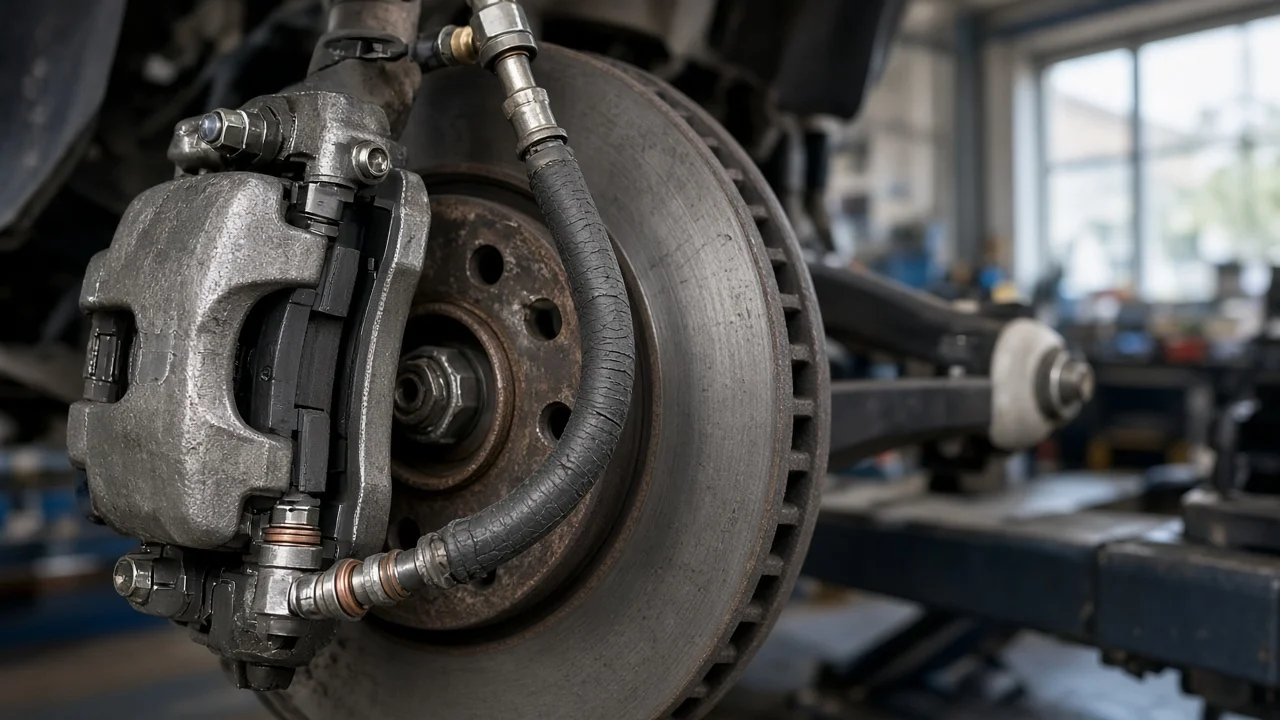
A flexible brake hose can fail from the inside long before it looks damaged. When the inner lining weakens or separates, it can restrict fluid flow or act like a one-way valve. Pressure still reaches the caliper, but it cannot fully return when you release the pedal, so one brake stays partly applied. This guide explains how to recognize the signs, tell a hose restriction apart from other causes, and decide what to do next.
Establish the symptoms
The classic symptoms of a collapsed brake hose point to a single wheel. The vehicle may pull toward one side under braking, and the pull can continue while cruising after a few stops. That wheel often runs noticeably hotter than the others, and you may notice a burning smell, light smoke after hard use, or a vehicle that slows quickly when coasting in neutral. Over time, the brake pads on that corner wear faster than those on the opposite side, and the rotor can show heat discoloration. A telling pattern is a drag that builds with repeated braking and then eases after the car has been parked for a while, because the trapped pressure slowly leaks back through the restriction.
Write down when the problem appears: after the first stop, only after highway braking, or only in hot weather. Note which wheel is affected, whether it clears after sitting, and how the pedal feels. Recent changes matter too: new pads or a replacement caliper, suspension work that may have stretched or twisted the hose, or a repair where someone clamped the hose with pliers to stop fluid loss, which can damage the inner lining. Also be aware that a hose restricted in both directions produces the opposite effect: that wheel brakes weakly and the car pulls away from it.
Distinguish plausible causes
An internally collapsed hose is supported by drag on one wheel that releases when hydraulic pressure is relieved at the caliper, by a hose of considerable age, and by any history of clamping. A seized caliper piston or corroded slide pins can produce very similar heat and pull, but the drag usually persists even after pressure is released, and pad wear often differs between the inner and outer pad or shows a tapered pattern. Pads that bind in a rusty caliper bracket behave the same way. These mechanical causes weaken the hose theory when the wheel stays tight with the bleeder open.
On a rear wheel, a sticking parking brake cable or mechanism can hold the brake on regardless of hydraulic pressure, especially on calipers with an integrated parking brake. If all four wheels drag, a single hose is unlikely; that pattern points toward a master cylinder that is not releasing, an incorrectly adjusted booster pushrod, or brake fluid contaminated with a petroleum product, which swells rubber seals throughout the system. A fault in the ABS hydraulic unit can also hold pressure on one circuit, though this is less common and needs a scan tool and service information to confirm.
Checks in a useful order
Start with observations that need no tools. After a short drive with normal braking, park safely on level ground and compare the wheels by holding your hand near each one without touching it, since a dragging brake can be hot enough to burn. Check for a burning smell. With a flashlight, inspect each flexible hose for cracks, bulges, chafing, twisting, seepage, or tension at full steering lock. Check the fluid level and appearance in the reservoir. As for what a collapsed brake hose looks like, the honest answer is that it often looks normal; the damage is internal, so a clean exterior does not clear it.
The next tests require tools, jack stands and familiarity with the hydraulic system. With the vehicle supported safely and the drag present, try to turn the affected wheel by hand. If it is tight, open the caliper bleeder screw briefly with a hose leading into a container. If fluid spurts out under pressure and the wheel then spins freely, pressure was trapped upstream of the caliper. If the wheel still drags, the problem is mechanical at the caliper, pads or parking brake. Never clamp a suspect hose to test it. Opening the system admits air, so it must be bled afterward with the fluid type your manufacturer specifies.
Leave the remaining checks to a qualified technician if you lack the equipment or service data: freeing and lubricating slide pins, measuring pads and rotors against the wear limits for your vehicle, scanning the ABS system, and checking master cylinder release and pushrod adjustment.
Interpret the findings
A wheel that frees up once the bleeder is opened establishes a restriction somewhere upstream of the caliper, but it does not prove which part. On a single wheel the flexible hose is the most likely culprit, yet a kinked rigid line or an ABS valve can produce the same result. A technician can narrow it down by relieving pressure at the joint between the rigid line and the hose: if the drag clears there, the restriction is further upstream; if it clears only at the caliper, the hose is implicated. If the wheel never frees with pressure released, the hose is not the cause.
Before replacing parts, confirm that the caliper piston retracts and the slides move freely, because a new hose will not fix a mechanical bind. Also assess heat damage from the period of dragging: glazed or overheated friction material, a discolored or distorted rotor, and darkened fluid may each need attention, or the pull can remain after the hose is changed. Many technicians replace hoses in pairs on an axle so both sides match in condition. Choose parts by confirmed vehicle fitment, use new sealing washers where the design requires them, follow the specified torque values, and bleed the system fully.
Urgency and next action
Stop driving and arrange a tow if you see smoke from a wheel, smell strong burning, notice a soft or sinking pedal, find fluid leaking, see a brake warning light, or feel a strong pull or vibration. A brake that stays applied can overheat the caliper and boil the brake fluid, which may lead to sudden fade when you need the brakes most. There is no safe remaining distance that can be promised for a dragging brake, so treat these signs as a reason to stop rather than to monitor.
To speed up diagnosis, give the repair shop the year, make, model and VIN for correct fitment, the affected wheel, when the drag starts and how it clears, the result of any bleeder test you performed, recent brake or suspension work, whether a hose was ever clamped, and any warning lights. That information lets a technician confirm the restriction quickly and replace only the parts the evidence supports.