Choosing Clark Forklift Transmission Fluid: How to Match the Right Fluid to Your Truck

There is no single fluid that fits every Clark forklift transmission. The correct fluid depends on which truck you have, what transmission it uses, and when it was built. The reliable way to choose is to identify the truck by model and serial number, find the fluid specification listed for that transmission, and buy a fluid that meets that specification. This guide covers how to do that, how the common fluid types differ, and what to watch for if the wrong fluid has already gone in.
The short answer
Use the fluid named in the operator's manual, service manual, or dipstick label for your specific Clark model and transmission. Depending on the truck, that may be an automatic transmission fluid (ATF) of a particular type, a dedicated powershift or torque-converter fluid, or a proprietary Clark-branded fluid. Brand matters less than specification. An aftermarket fluid that clearly states it meets the required specification is generally acceptable. A fluid that only claims to be 'compatible' or 'universal' without naming the specification is a gamble.
One distinction changes the answer completely. Internal-combustion Clark forklifts (gasoline, LPG, or diesel) usually have a powershift transmission with a torque converter, and that transmission uses transmission fluid. Electric Clark forklifts usually have no conventional transmission. Their drive units or drive axles use gear oil or another lubricant listed for that component. If you own an electric truck, look for the drive axle or gearbox lubricant specification instead of a transmission fluid.
Start by identifying the transmission type
Clark has built many truck families over several decades, and their drivetrains differ. Before buying fluid, confirm what you are working with:
Model and serial number: These are on the truck's data plate, usually near the operator's compartment. The serial number matters because specifications can change partway through a production run. Power source: Internal combustion versus electric decides whether you need transmission fluid or drive-unit lubricant. Transmission design: Most IC trucks use a powershift unit with a torque converter. Some are one-speed and some are multi-speed. Older and newer designs may call for different fluids. Shared or separate reservoirs: On some lift trucks the transmission has its own sump. Confirm whether your transmission shares fluid with any other system before choosing a product, because a shared system needs a fluid that suits both. Service history: Records or a sticker from a previous service may show what fluid was used. Treat this as a clue to check against the specification, not as proof that it was correct.
If the manual is missing, a Clark dealer or forklift parts supplier can usually look up the specification from the model and serial number. Used and rebuilt trucks also need attention to fitment: a replacement or rebuilt transmission may not be the unit the truck originally shipped with.
Understanding the fluid specification
A fluid specification is a performance standard. It defines friction behavior, viscosity, oxidation resistance, seal compatibility, and other properties the transmission was engineered around. In a powershift transmission, the fluid does several jobs at once. It transmits power through the torque converter, applies the clutch packs that select direction and gear, lubricates gears and bearings, and carries heat away. If the fluid has the wrong friction characteristics, clutches can slip or grab even when the fluid is otherwise high quality.
Specifications usually take one of these forms:
An ATF type designation, naming a particular automatic transmission fluid standard. An industry or OEM drivetrain specification used for powershift and torque-converter equipment. A Clark part number or Clark-branded fluid name, sometimes alongside an equivalent specification. A viscosity grade, which may be listed with a performance standard. Viscosity alone is not enough to pick a fluid.
When reading a product label, look for the exact specification your manual names. Wording like 'suitable for many forklifts' or 'meets most powershift requirements' does not confirm that the fluid meets yours.
Comparing your fluid options
Once you know the specification, the choice usually comes down to a few product categories. These are general characteristics, not test results for particular brands.
Option | When it fits | Advantages | Cautions; Clark-branded or dealer-supplied fluid | Your manual names a Clark fluid or part number | No guesswork about fitment; simple for warranty and fleet records | Often costs more; availability depends on dealer network; Aftermarket fluid that states the required specification | The label names the same specification the manual lists | Widely available; often cheaper; works for bulk fleet purchasing | Check the exact specification, not just the product category; General ATF | The manual specifies ATF, and the product meets the named ATF type | Easy to find | Not interchangeable with powershift-specific fluids; ATF types differ from each other; Multi-purpose or 'universal' tractor or hydraulic fluid | Only when the manual or a qualified supplier confirms it meets the specification | Convenient where one fluid serves several machines | Friction properties may not match; a common source of shift complaints; Engine oil or unrelated hydraulic oil | Only if explicitly specified | None, unless specified | Generally not a substitute for transmission fluid
For a single truck, the dealer fluid or a clearly labeled equivalent is usually the simplest choice. For a mixed fleet, a fleet manager may prefer one aftermarket product that covers several machines. That works only if the product's stated specifications genuinely cover each transmission. If they don't, stocking a second fluid is cheaper than repairing clutch packs.
Checking and topping up correctly
Many powershift transmissions must be checked under specific conditions, often with the fluid warm and the engine idling, with the truck in neutral and the parking brake set. Other designs are checked cold or with the engine off. The procedure for your truck is usually printed in the manual and sometimes marked on the dipstick. Checking the wrong way can make a correct level look low, which leads to overfilling.
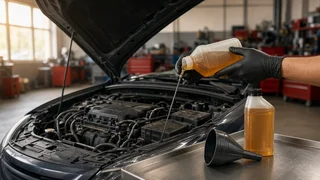
Park on level ground, lower the forks, and set the parking brake before checking. Clean around the dipstick or fill cap so dirt cannot enter. Contamination is a common cause of transmission wear. Add fluid in small amounts and recheck. Overfilling can cause foaming, which reduces clutch apply pressure and lubrication. Note the fluid's color and smell. Dark, burnt-smelling, milky, or gritty fluid points to a problem that topping up will not fix. Record what fluid you added and when. That service history helps the next technician.
Signs of the wrong or degraded fluid
Fluid problems often appear first as changes in shift behavior. None of these symptoms proves the fluid is at fault, since the same signs can come from worn clutches, control valve problems, or electrical faults. They are still reasons to check the level and condition before anything else:
Delayed engagement when shifting between forward and reverse. Harsh or jerky direction changes, or a thump on engagement. Slipping, where the engine revs but the truck is slow to move or struggles on ramps. Overheating, or a transmission temperature warning during sustained work. Whining, foaming at the fill point, or fluid leaking from the breather. On trucks with electronic transmission controls, warning lights or diagnostic codes on the display.
Diagnostic code meanings vary by model and control system, so read them using the documentation or service tool for your truck rather than generic code lists. A code pointing to pressure, temperature, or clutch engagement makes fluid level, condition, and type worth checking early.
If the wrong fluid has already been added
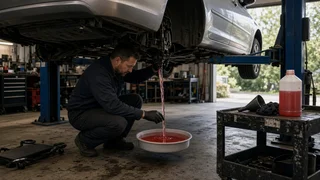
A small top-up with a near match may cause no obvious trouble, but it changes the fluid's properties in ways that are hard to predict. If you know or suspect the wrong fluid went in, the usual fix is to drain the transmission and refill it with the specified fluid, along with any filter change the service procedure calls for. Severe mixing may need more than one drain and refill, because a single drain usually leaves some fluid in the torque converter and lines. Keep operating the truck as little as possible until the fluid is corrected, especially under heavy load.
Repair options when symptoms persist
If shifting problems continue after the fluid is at the correct level and meets the specification, the cause is likely mechanical or electrical. The usual next steps are:
Pressure testing by a forklift technician to check clutch and converter pressures. Inspecting and replacing the transmission filter, and checking for debris that suggests internal wear. Checking electronic controls, sensors, and wiring on trucks with electronically controlled shifting. Repairing or rebuilding worn clutch packs or seals. Replacing the unit with a new, rebuilt, or used transmission. Confirm the replacement is the correct fitment for your model and serial range, and note which fluid it requires.
Key takeaways
Identify the truck by model and serial number, and confirm whether it is internal combustion or electric. Find the fluid specification for that transmission and buy a product that explicitly meets it. Clark-branded fluid removes guesswork. A properly labeled aftermarket equivalent is a reasonable alternative. Don't treat ATF, powershift fluid, universal tractor fluid, and hydraulic oil as interchangeable unless the specification allows it. Check the level using the correct procedure, and keep a record of what fluid was used. If shifting problems persist with the correct fluid at the correct level, have the transmission diagnosed.