Chrysler Pacifica Check Engine Light: Causes and Diagnostic Next Steps
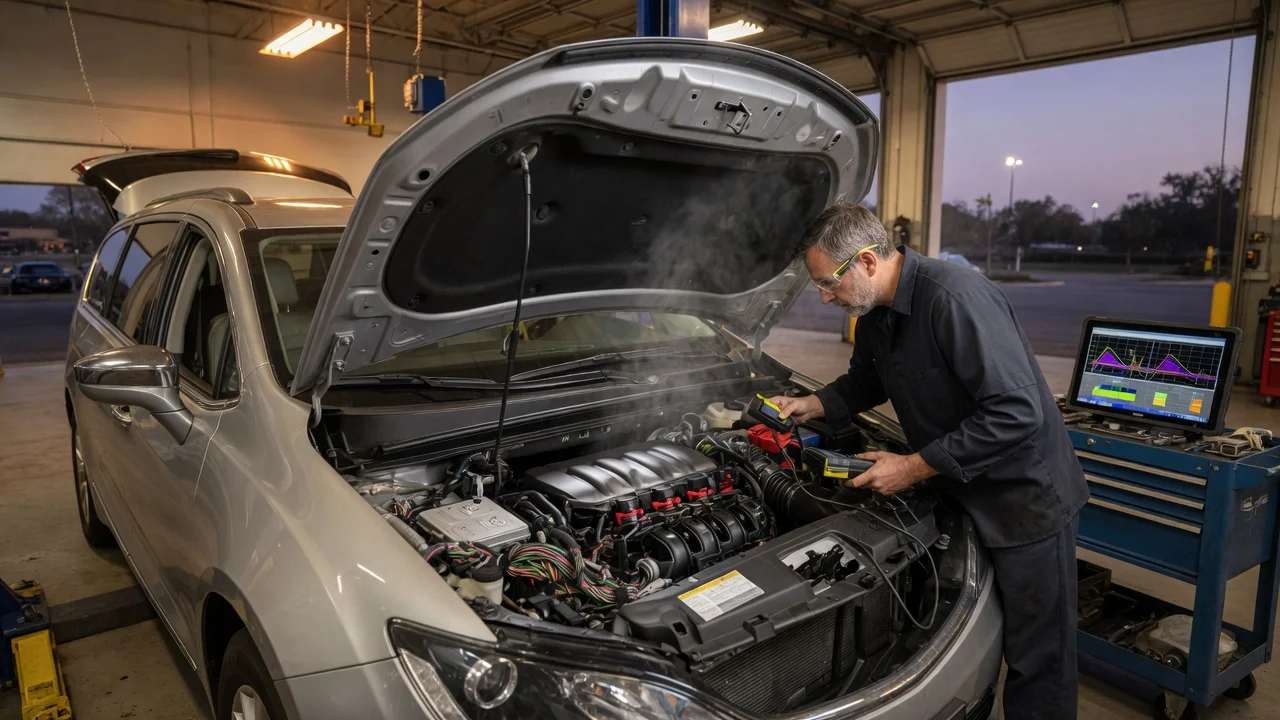
What the check engine light means in a Chrysler Pacifica
The check engine light is the Pacifica's way of reporting that the powertrain control module has detected a condition outside expected operating parameters. It does not identify the failed part by itself. A stored diagnostic trouble code is evidence to investigate, not proof that a specific component is bad. The meaning and urgency can differ by model year, generation and powertrain, so any diagnosis should begin with the specific vehicle rather than a generic code definition.
The light may appear as a steady glow or a flashing warning. A steady light generally allows continued short-term driving if the vehicle is running normally. A flashing check engine light signals a condition that can damage the catalytic converter, typically an engine misfire that is still occurring. In that case, reduce load and have the vehicle diagnosed promptly. If the light is accompanied by overheating, severe misfire, smoke, unusual smells, reduced power, limp-mode behavior or a low-oil-pressure warning, stop driving and have the vehicle towed.
Common causes on the Chrysler Pacifica
Some check engine light causes are simple, while others require professional equipment. The following are commonly investigated categories, but the list is not a substitute for reading the stored codes.
Loose or damaged fuel filler cap, or a fuel vapor leak elsewhere in the evaporative emission system; Failed oxygen sensor, which can affect fuel trim and catalyst monitoring; Catalytic converter efficiency faults; Ignition-related problems such as worn spark plugs, ignition coils or coil boots; Engine misfire conditions; Mass airflow sensor contamination or failure; Faulty canister purge valve or vent valve in the EVAP system; Low oil pressure or oil control system faults on engines with variable valve timing; Battery or charging system voltage problems that set communication or sensor faults; Electric powertrain or hybrid system faults on Pacifica Hybrid models
A code such as P0300 through P0306 points toward random or cylinder-specific misfire, but it still requires checking ignition, fuel, compression and mechanical condition. P0420 may indicate catalyst system efficiency below threshold, although it can also result from an exhaust leak or sensor issue. EVAP codes such as P0455 or P0456 usually point to a leak in the vapor recovery system, which may be as simple as a loose cap or as involved as a failed valve or damaged line. These are examples only; vehicle-specific service information is required for accurate interpretation.
Diagnostic next steps
Before replacing parts, retrieve the codes stored by the powertrain control module. A tool with OBD-II capability is required for this step. Many auto parts stores can read codes, and an owner may use a handheld scanner or a phone-connected OBD-II adapter. The connector is typically located under the driver-side dashboard area, but the exact position should be confirmed for the applicable model year.
The practical sequence is:
Record the code number and any freeze-frame data shown by the scan tool. Check the freeze-frame conditions, which indicate engine temperature, load and rpm when the fault was detected. Inspect the simplest related items first, such as the fuel cap or an obvious loose connector, only if the code supports that check. Clear the code only after the concern has been addressed; erasing it without repair removes diagnostic information and may delay the fault's return. Confirm the repair by driving through the applicable monitor-enable conditions and checking that the code does not recur.
A fault code should not be used as a parts replacement trigger. Oxygen sensor and catalyst-related codes require checking wiring, fuel trim, exhaust leaks and sensor operation before condemning the sensor or converter. Hybrid Pacifica models may set codes for the high-voltage system, battery cooling or electric drive components, which should be diagnosed by a technician with appropriate training and equipment.
Who should perform the repair
Basic inspections, such as confirming that the fuel cap is tight or looking for an obviously damaged vacuum hose, may be performed by the owner when they match the diagnostic findings. Repairs involving high-voltage components on the Pacifica Hybrid, internal engine work, emissions calibration or advanced electrical diagnosis should be left to a qualified service facility. Before resetting or repairing the system, confirm the required procedure and specifications for the specific model year and engine.
Limits of this guide
This guide gives a general diagnostic framework. It does not include model-year-specific repair procedures, torque values, diagnostic thresholds or wiring details because the applicable manufacturer service information was not supplied for this review. Any procedure should be checked against documentation for the exact Pacifica being serviced before work begins.