Chrysler Pacifica Check Engine Light: Causes and Next Steps
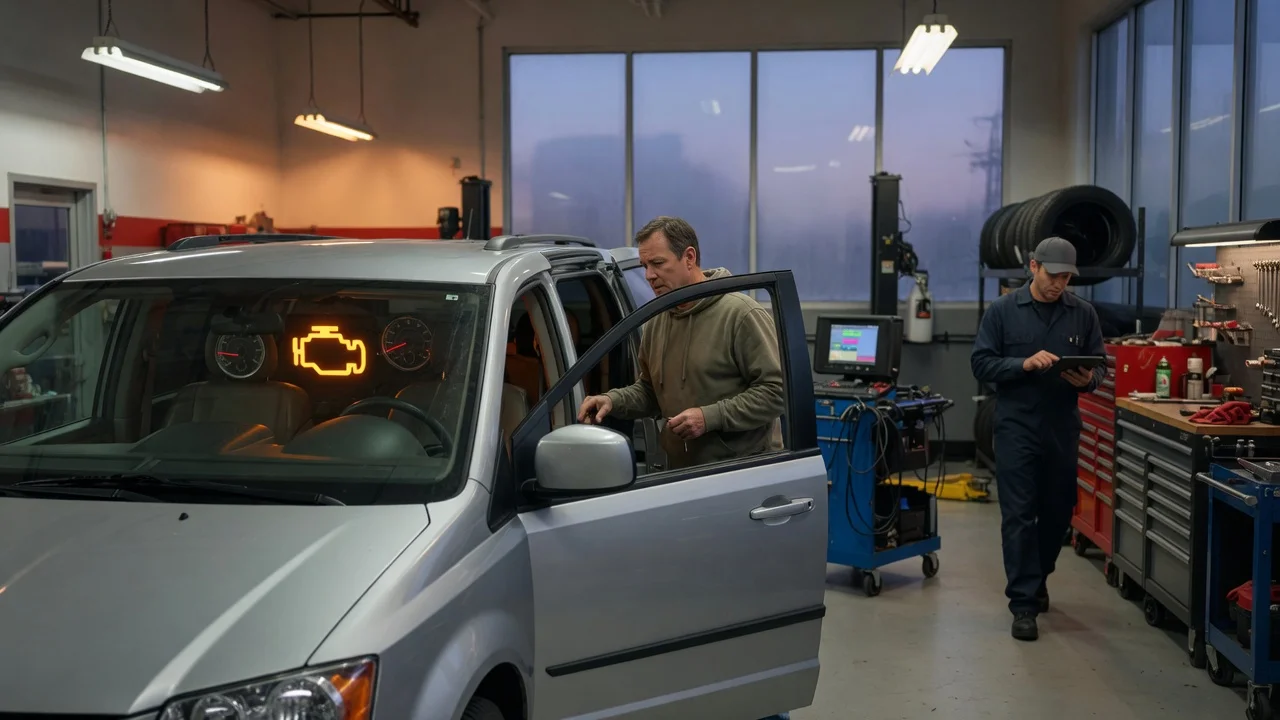
What the light means
A check engine light on a Chrysler Pacifica is the malfunction indicator lamp. It turns on when the powertrain control module detects a fault that can affect emissions or engine management. On Pacifica Hybrid plug-in models, related hybrid controllers can also set faults that illuminate the same lamp or appear with it. The light reports a stored or pending diagnostic trouble code. It is not an oil-change reminder; Chrysler uses separate messages for scheduled service.
Two vehicles have used the Pacifica name, and the underlying hardware is not the same. The 2004–2008 Pacifica is a crossover. The 2017-and-later Pacifica is a minivan, sold with a 3.6-liter Pentastar V6 and, in many markets, as a plug-in hybrid. Sensors, evaporative-emissions hardware, and hybrid-specific modules differ by model year, powertrain, trim, and market. Treat any cause list as a starting point for that vehicle, not a substitute for a code readout on that VIN.
Steady light versus flashing light
How the lamp behaves changes the urgency. A steady light usually means the computer has logged an emissions-related fault and the van may still be drivable, though it can fail an inspection and the underlying problem can worsen. A flashing light typically means an active engine misfire severe enough to overheat the catalytic converter. Reduce engine load and stop as soon as it is safe. Continuing to drive with a flashing lamp risks converter damage and a much larger repair.
Steady light: diagnose soon; avoid long trips and heavy load until codes are read. Flashing light: misfire risk to the catalyst; stop when safe and arrange professional diagnosis. Light plus overheating, oil-pressure warning, strong fuel smell, or sudden loss of power: stop use and have the vehicle inspected before driving farther. Pacifica Hybrid with the lamp plus charging, battery, or propulsion warnings: treat as a hybrid-system issue as well as an engine issue; generic OBD-II readers often miss those modules.
Plausible causes and what to check
A trouble code is evidence to investigate a circuit or monitor, not proof that a named part has failed. Upstream problems (exhaust leaks, misfires, vacuum leaks, a contaminated sensor) can set oxygen-sensor or catalyst codes. Confirm the system involved with freeze-frame data and related tests before replacing parts.
These checks apply to the emissions and engine-management systems that commonly turn on the lamp on Pacifica gasoline and hybrid models. They do not rank failure rates by year, and they are not a complete list of every code the PCM can store.
Fuel cap: inspect for a loose, cracked, or missing cap and a damaged filler-neck seal. A poor seal fails the evaporative-emissions (EVAP) leak test. After the cap is seated, the lamp may stay on for several complete drive cycles while the monitor runs again. EVAP leak or purge fault: fuel odor at the tank, hissing after shutdown, or a pump that clicks off early during refueling points to hoses, the purge valve, the leak-detection pump, or the charcoal canister. An EVAP code means a leak test failed; it does not by itself identify which component leaked. Misfire: rough idle, stumble, shaking, or a flashing lamp points to spark plugs, ignition coils, fuel delivery, or an intake vacuum leak. On 3.6-liter Pentastar engines, cylinder-specific coil and plug faults are a frequent path, and cylinder deactivation (MDS) on equipped gasoline years can complicate misfire diagnosis. Stop driving if the lamp flashes. Oxygen sensors and catalyst: poor fuel economy, a sulfur smell, or an inspection failure can involve upstream or downstream oxygen sensors or catalytic-converter efficiency. An exhaust leak ahead of a sensor can mimic a failed sensor or converter. Coolant temperature: a gauge that is slow to reach normal temperature, a weak heater, or a related temperature warning can involve the thermostat or the coolant-temperature sensor. Many Chrysler powertrains store a thermostat-rationality fault when the engine is slow to warm; verify with live temperature data rather than replacing parts on the code name alone. Air metering and vacuum: unstable idle or hesitation can involve the manifold absolute pressure sensor, a dirty throttle body, or disconnected vacuum lines, especially after recent service. Recent work: a connector left unplugged, a sensor unseated, or an EVAP line left off after fuel-system or intake service will set the lamp even when no part has failed. Pacifica Hybrid only: reduced electric range, charging that will not start, or extra hybrid-system messages with the check engine light can involve the gasoline engine, the hybrid battery, the charger, or power electronics. Those faults often require a scan tool that can read Chrysler hybrid modules, not only generic powertrain codes.
What to do next
Start with what you can observe, then move to a code readout. Do not clear codes before they are recorded; erasing them also erases freeze-frame data that shows the conditions when the fault set.
Write down whether the lamp is steady or flashing and copy any other cluster messages (temperature, oil pressure, battery, hybrid, or propulsion). Check that the fuel cap is present, the seal is intact, and the cap clicks down fully. Note drivability: misfire, stall, overheating, loss of power, or fuel smell. Those findings change whether the van should be driven to a shop. Have an OBD-II scanner read stored and pending codes and freeze-frame data. On a Hybrid, ask for hybrid-module codes as well as generic powertrain codes. Use each code as a test plan for that monitor or circuit. Confirm with live data, smoke or leak tests for EVAP, and ignition or fuel tests for misfire before replacing a part. After a confirmed repair, complete the drive cycle the monitor requires. The lamp may not turn off the moment the part is replaced.
When to stop and get professional diagnosis
Stop driving if the lamp flashes, if the engine overheats, if oil pressure is low, if there is a strong fuel smell, or if power drops suddenly. Pacifica Hybrid models with simultaneous hybrid or charging warnings should be diagnosed with factory-level scan data; a parts-cannon replacement of an oxygen sensor or a gas cap will not address a hybrid-module fault. Official torque values, fluid specifications, technical service bulletins, and recall applicability are VIN- and model-year-specific and are not listed here. Those details belong in the manufacturer service information for the exact powertrain.