Choosing Transmission Cooler Lines for a Ford F-150
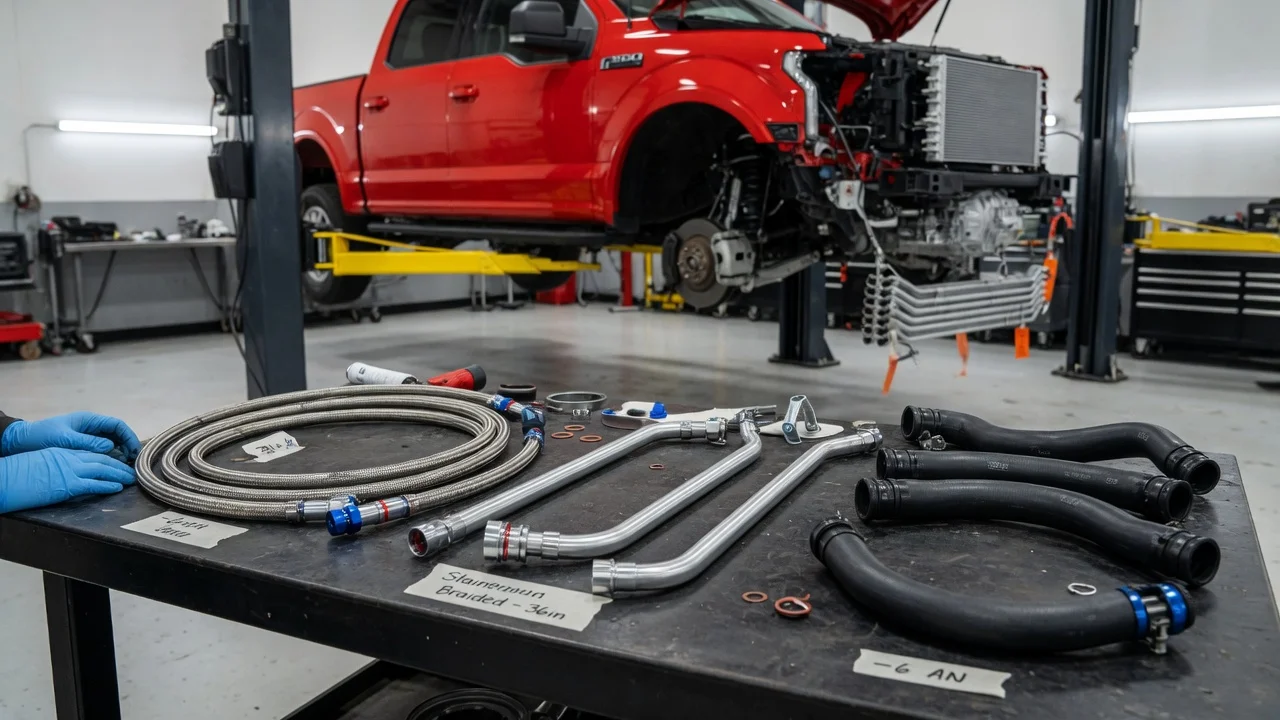
A leaking or damaged transmission cooler line on a Ford F-150 can drain fluid quickly, and the wrong replacement can create a second leak. This guide explains how to match replacement lines to your truck, how OE-style assemblies differ from aftermarket and universal repair parts, and what the job involves beyond the part. It assumes you have confirmed, or will confirm, that the line itself is leaking rather than a nearby fitting, cooler or seal.
Define the job the product must do
Start with the reason you are shopping. Common triggers are a weeping crimp where rubber hose meets steel tube, rust-through on steel sections in road-salt regions, cracked rubber, or a line bent by debris or off-road use. Fluid near the lines does not prove a line has failed. Transmission fluid can run along a tube from a cooler, a radiator fitting, the pan gasket or a case connection, then drip from a lower point. Clean the area, run the truck, and trace the wetness to its highest point before buying anything.
Next, consider how the truck is used. A truck that tows near its rating, plows or hauls daily pushes more heat through the fluid than a commuter. That makes it more important to keep the factory routing, including any auxiliary cooler. Also weigh your practical constraints: budget, whether you will do the work in a driveway or at a shop, how corroded the frame and fittings are, and how soon you need the truck back.
If fluid has been lost, you may notice changes in shift behavior such as slipping, delayed engagement or harsh shifts, or a transmission temperature warning. These symptoms and any stored diagnostic codes mean the transmission needs attention. They do not identify the line as the cause. Driving with low fluid risks internal damage, so check the level using the procedure for your transmission before driving further.
Check compatibility
Identify the transmission type first. Across its generations, the F-150 has used several automatics: the four-speed 4R70W and 4R75 family in older trucks, then the six-speed 6R80 and the ten-speed 10R80 in later trucks. The changeover between them depends on model year and engine, and hybrid PowerBoost trucks use a hybrid version of the ten-speed. Confirm your unit from the transmission code on the certification label or a dealer VIN lookup rather than guessing from the model year.
Fitment goes beyond the transmission. Engine, cab and bed configuration, wheelbase, two- or four-wheel drive, the factory tow package and the radiator design can all change line length, bends and routing. Lines may be sold as separate supply and return pieces or as a matched assembly. Compare the end fittings closely. Many Ford lines use quick-connect fittings at the radiator or transmission that need the correct retaining clip and sometimes a release tool, while other connections are threaded. If the part number on the old line is legible, record it and match it against interchange listings for your VIN.
The lines do not change the fluid specification, but replacing them loses fluid, and you must top up with the type your transmission requires. Older four-speeds generally use Mercon V, the 6R80 uses Mercon LV, and the 10R80 uses Mercon ULV. Confirm the requirement in the owner's manual or service information, and do not mix fluid types.
Features that affect the choice
There are three broad categories. An OE assembly follows the factory routing, usually arrives with the correct fittings and shaping, and costs the most. An aftermarket direct-fit line is cheaper, but quality varies. Compare the bends against your original, inspect crimp quality in photos, and check whether clips, O-rings and mounting brackets are included. A universal repair kit or hose section splices out a damaged portion. It is inexpensive, but it adds joints that can leak. A worm clamp over a cut steel tube with no bead is a common point where hoses slip or seep under pressure and heat.
Materials matter more than appearance. Coated or stainless steel tubing resists corrosion better than bare steel, which helps in salt-belt states. Any rubber section should be rated for transmission oil and its operating temperature. A listing that names a transmission oil cooler hose standard such as SAE J1532 tells you more than a braided outer cover. Labels such as heavy duty, OEM quality or lifetime say little on their own unless backed by a stated rating, a material description or written warranty terms.
Useful evidence includes a part number or interchange that matches your truck, clear photos of both ends of each line, a list of included hardware, and a return policy that covers parts that do not fit. Seller fitment checkers are a starting point. Measuring and comparing against the line you remove is more reliable.
Limitations and ownership costs
Plan for more than the part price. The lines run along the frame and near hot or moving components. Access may require removing a skid plate or splash shield, and corroded fittings can seize or break during removal. Budget for replacement clips and O-rings, the correct fluid in enough quantity, a line wrench or quick-connect release tool, and a drain pan. Later F-150 transmissions often lack a conventional under-hood dipstick and use a level check at a specified fluid temperature, so an incorrect check can leave the unit overfilled or underfilled. If you are not equipped to follow that procedure, shop labor may be the better value.
New lines cannot fix a leaking auxiliary cooler, an internal radiator cooler failure that mixes coolant and fluid, a case or pan seal leak, or internal transmission problems. If the fluid is dark, smells burnt or contains debris, or if the truck was driven while low, inspect the transmission further and ask whether the cooler circuit should be flushed. Repair options range from replacing one damaged line, to replacing both lines as a set, to addressing the cooler or transmission when the diagnosis points there.
After installation, reinstall every isolator and bracket so the lines cannot rub against the frame or vibrate loose. Check for seepage and verify the fluid level after the first few drives. Look at the lines at each oil change, rinse road salt from the underside in winter, and log the work in the truck's service history so the next owner or technician knows which parts are new.
Build a practical shortlist
Before comparing listings, write down your transmission code, engine, drivetrain, cab and bed configuration, tow package status and the old line's part number if readable. Then decide whether you need a full assembly, a single supply or return line, or a short repair section. That decision alone usually narrows the field to a handful of candidates.
Compare each candidate on the same points. Does the fitment cover your exact configuration, not just the model year? Do the end fittings match yours, and are clips and seals included? Is the tubing material and hose rating stated? Does the shape match the original routing and brackets? What fluid will you need, how much, and which tools? Finally, what return and warranty terms apply in writing? A part that answers every question clearly is a safer choice than a cheaper one with vague details.
If two options pass the checklist, weigh price against corrosion resistance and how long you plan to keep the truck. If none of them clearly match your fitment, or a fault code or shift problem remains after the leak is fixed, have a transmission shop confirm the diagnosis before buying more parts.