Choosing Tie Rod Ends for a Jeep Wrangler JK
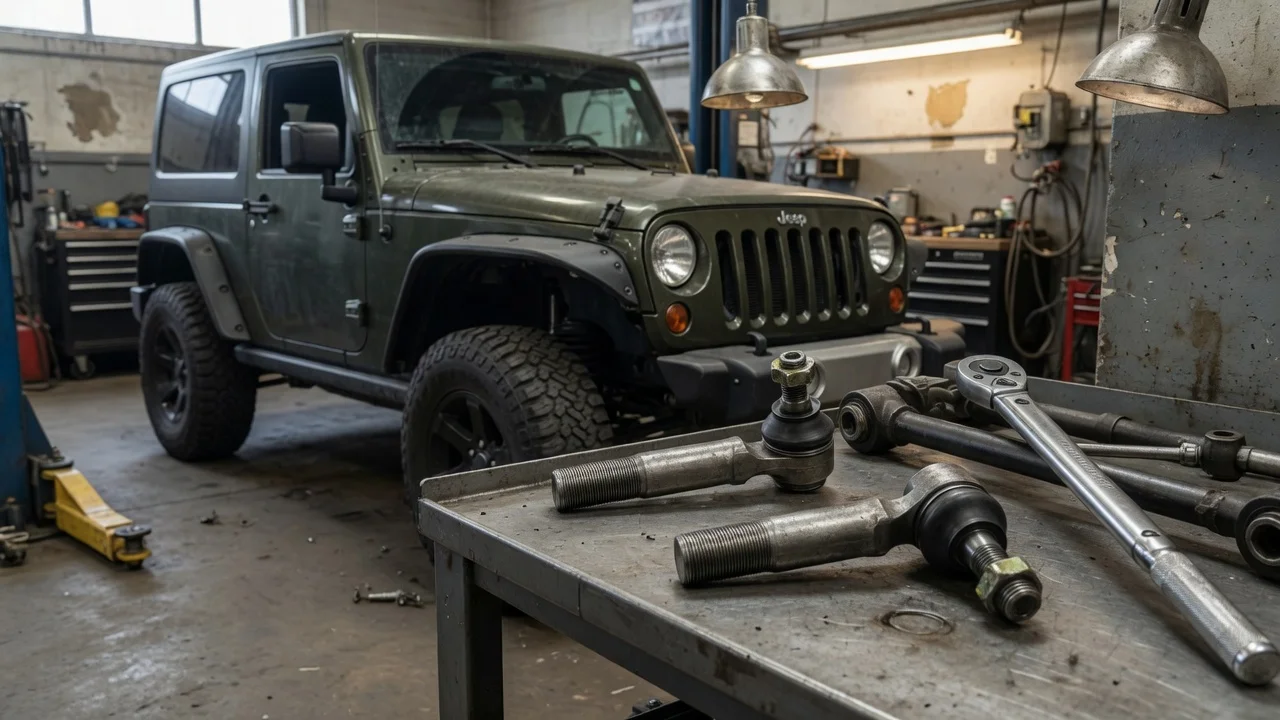
What tie rod ends do on a Jeep Wrangler JK
Tie rod ends are the ball-joint style pivots that connect the steering linkage to the steering knuckles. On a Jeep Wrangler JK, the tie rod assembly spans the front of the vehicle and helps transfer steering input from the steering box to the wheels. The outer tie rod ends thread onto the tie rod and fasten to the steering knuckles, while the assembly also affects toe adjustment and overall steering response.
In daily use, these joints move through steering and suspension travel while carrying lateral loads. Because the Wrangler is a solid-axle vehicle, steering components such as the tie rod and drag link sit in a relatively exposed position. That exposure, combined with off-road use, lifted suspensions, oversize tires, and rough roads, can increase wear compared with many passenger vehicles.
Signs that a tie rod end may need attention
Worn tie rod ends commonly produce loose or imprecise steering. Drivers may notice a dead spot at center, wandering, a shimmy that appears at certain speeds, or clunking from the front end over bumps. Uneven tire wear, particularly feathering on the front tires, can also point to a steering linkage problem.
The most reliable check is to lift the front wheel safely, grasp the tire at the three o'clock and nine o'clock positions, and rock it. Movement in that plane when the wheel bearing is known to be tight can indicate linkage wear, including a bad tie rod end. A dry or split boot is also worth attention because contamination can accelerate internal joint wear.
Model-year and configuration considerations
The JK generation covers the 2007 through 2018 Wrangler and Wrangler Unlimited. Within that generation, steering linkage dimensions can differ according to model year, market, and whether the vehicle has a factory or aftermarket lift. A component listed for a JK is not automatically correct for every JK, so the specific year and axle configuration should be confirmed before purchase.
Physical fit is not the only compatibility issue. Changes in ride height or steering geometry can affect how the tie rod ends operate even when the threaded connection matches. On a lifted vehicle, the operating angles of the steering joints change, and some owners replace the complete linkage with heavy-duty components designed for those angles. A stock replacement that fits the taper may still be the wrong choice if the surrounding linkage has been modified.
Choosing between replacement and upgraded linkage
For a Wrangler that stays close to stock and is driven mainly on paved roads, a good-quality replacement tie rod end matched to the existing linkage is usually the straightforward option. The priority should be a clean taper fit, a serviceable boot, and threads that match the tie rod or adjuster sleeve.
Owners running larger tires, a lift, or frequent off-road use often look beyond individual tie rod ends. In those conditions, complete upgraded tie rods and matching ends may provide larger-diameter tubing, heavier joints, or improved geometry correction. The trade-off is that an upgraded assembly may change steering feel or require additional alignment and clearance checks.
What to verify before buying
Because listings can be broad, confirm the thread size and hand, the taper diameter, and the overall length against the existing part rather than relying only on a generic Jeep JK description. Note whether the tie rod end is for the driver side or passenger side when the linkage uses different ends, and check whether the vehicle has any aftermarket steering components.
A replacement tie rod end should be treated as part of a steering-system repair, not an isolated part swap. After installation, a proper front-end alignment is necessary because the tie rod controls toe. Driving a Wrangler with incorrect toe can cause rapid tire wear and unpredictable handling even when all the joints are new.
A part that physically threads on is not automatically compatible with the rest of the steering geometry. Confirm the vehicle configuration and inspect the complete linkage before choosing a tie rod end.