Choosing Intercooler Hoses: Fitment, Materials and Real Ownership Costs
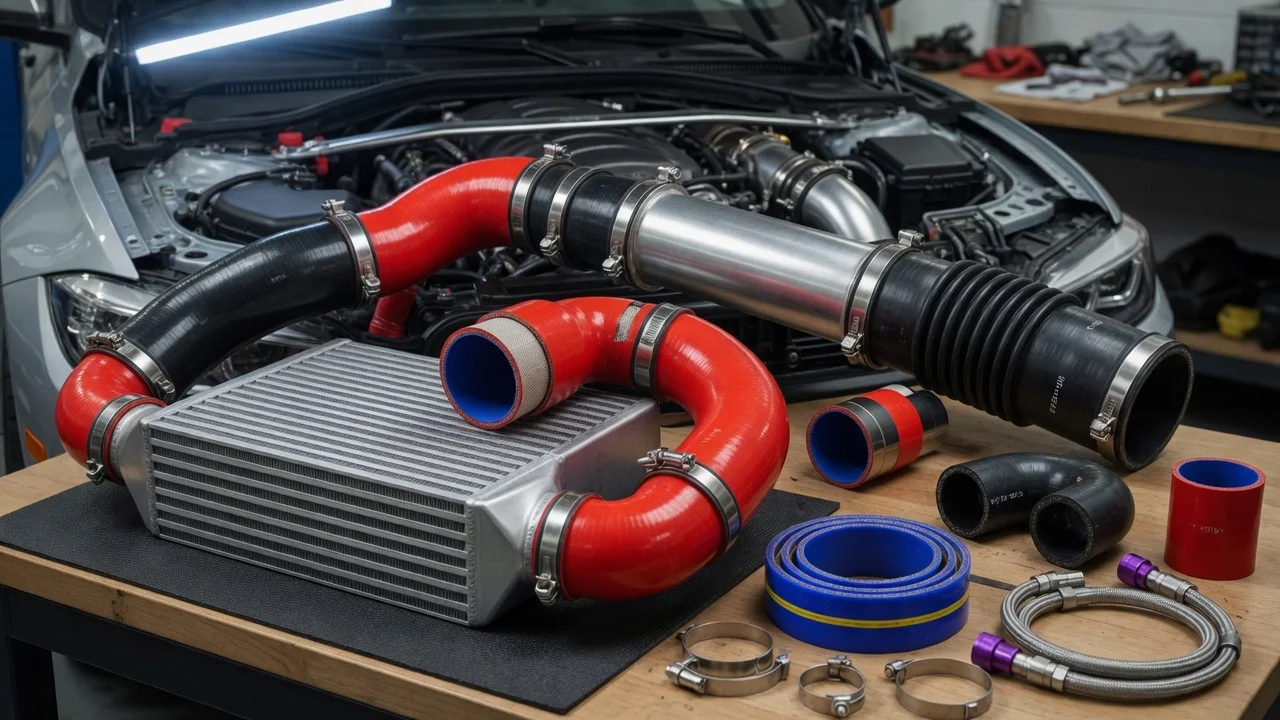
An intercooler hose or pipe carries pressurized intake air between the turbocharger, the intercooler and the throttle body. A poor choice shows up as lost boost, new noises or a hose that blows off under load. This guide helps owners pick a replacement for their own vehicle by confirming the actual problem, matching the part to the model year and engine variant, weighing materials and clamps, and understanding what a new hose can and cannot fix.
Define the job the product must do
Start by separating what you have noticed from what you have confirmed. A symptom report, such as hissing under acceleration, sluggish response, a whistle that rises with boost or oily residue on the outside of a hose, suggests a charge-air leak but does not prove which part failed. A verified failure is something you can see or measure: a split or ballooned hose, a cracked plastic pipe section, a coupler that has slipped off its bead, or a leak located with a smoke or pressure test of the intake system. Write down the symptom conditions, for example whether the problem appears only at full throttle, on the highway, when cold or after recent work, and note any stored diagnostic codes such as an underboost fault. These details narrow the search, but a sticking wastegate, a faulty sensor or a leaking intercooler core can produce similar complaints, so buy the hose only after the leak is traced to it.
Next, define how the vehicle is used. A daily driver on factory boost needs a part that restores original performance and lasts, while a tuned engine running more boost or a diesel used for towing places higher pressure and heat demands on every joint. Check the service history: whether the hose has been replaced before, with what type of part, and whether previous failures repeated in the same spot. Finally, set practical limits. Decide whether you need a single section or the complete set, how much you want to spend, and whether access requires removing a bumper cover, undertray or other components that affect whether you do the job yourself.
Check compatibility
Factory-fit intercooler hoses are rarely interchangeable across a model line. The same nameplate can use different charge-air routing depending on engine configuration, including gasoline or diesel, displacement, single or twin turbochargers and output level, and routing can change within a model year or at a mid-cycle update. Identify the correct part by VIN, engine code and the number molded or printed on the old hose, or by the manufacturer parts catalog, rather than by model name alone. Confirm whether a listing covers the hot side, from the turbocharger to the intercooler, or the cold side, from the intercooler to the throttle body, because the two are not interchangeable and may face different temperatures.
Then compare the physical interfaces. Measure or confirm the inner diameter at each end, overall length and the angle of every bend. Look at how each end attaches: some pipes have a raised bead that the hose and clamp sit behind, while many modern systems use quick-connect fittings with O-rings and retaining clips. Check for sensor bosses for boost pressure or intake temperature sensors, and for nipples serving crankcase ventilation or a bypass valve. A hose that matches in diameter but lacks a port or uses a different fitting will not install correctly. Universal straight or elbow couplers can join pipe sections, but only when the diameters match and each end can be clamped securely behind a bead.
Features that affect the choice
Material is the main trade-off. Original equipment intercooler hoses are often molded rubber, sometimes combined with rigid plastic sections and integrated fittings, while many aftermarket options are multi-ply reinforced silicone. Silicone tolerates heat well and resists age cracking, but standard silicone is less resistant to oil than some rubber compounds. Because crankcase ventilation can leave oil mist in the charge-air system, look for an oil-resistant inner liner, often fluorosilicone, or stay with an OE-type compound if your hoses show oil contamination. Ply count and fabric reinforcement help a hose resist swelling under boost, but stated pressure and temperature ratings are more useful than labels such as performance, racing or heavy-duty.
Clamping matters as much as the hose. Worm-drive clamps are common, but T-bolt or constant-tension clamps hold more evenly on boosted joints and are less likely to cut into silicone. Some kits replace molded hoses with aluminum hard pipes and short couplers; these can reduce flexing sections, but they often take more fitting work and may relocate or omit sensor ports, resonators or vent connections, so check what the kit retains and whether it affects emissions-related components. Treat an exact part number match, published dimensions, material specification, ratings and a clear return policy as useful evidence. Claims of added horsepower deserve skepticism: a new hose restores boost lost to a leak but does not add power to an intact system.
Limitations and ownership costs
Installation affects how long any hose lasts. Pipe ends should be clean and free of oil, the hose must seat fully past each bead, and clamps should be tightened to the manufacturer specifications rather than as tight as possible. Avoid lubricants on boosted joints unless the service procedure calls for them, since they can let a hose creep off under pressure. Budget for consumables: clamps, O-rings and retaining clips on quick-connect fittings are frequently specified as single-use. Labor can exceed the part price when access requires removing the front bumper cover or splash shields, so factor shop time into the comparison if you are not doing the work yourself. Recheck clamps after a few heat cycles.
Know what the part cannot do. Replacing intercooler hoses will not fix a leaking intercooler core, worn turbocharger seals, a faulty wastegate or actuator, or a failing boost sensor. Heavy oil inside the hoses calls for diagnosis of the source rather than repeated hose replacement. If a new hose blows off or swells again quickly, investigate clamp type, bead condition and possible overboost before buying another. After the repair, clear stored codes and confirm the result under the same conditions that originally triggered the symptom, then include the charge-air hoses in routine inspection for swelling, cracking, chafing and oil saturation.
Build a practical shortlist
Before comparing products, confirm the checklist for your vehicle. The leak should be located and verified, not assumed from symptoms alone. Record the VIN, model year, engine code and original part number. Specify the exact section needed, hot side or cold side, and whether adjoining hoses show similar wear. Match inner diameters, length, bend angles, end fittings and any sensor or vent ports. Choose a material suited to your boost level and oil exposure. Confirm whether clamps, O-rings and clips are included or must be bought separately, and read the warranty and return terms before ordering.
Narrow the field to two or three candidates, typically an original manufacturer part, an OE-equivalent replacement and a reinforced silicone option, and compare them on the checklist rather than on price or appearance alone. Original parts are often the simpler choice for complex molded hoses with integrated sensor bosses and quick-connect fittings, while silicone may suit simple sections or modified engines when the dimensions and liner are correct. Whichever intercooler hose you choose, the deciding evidence is a confirmed fit for your engine variant and a successful test drive under the original symptom conditions.